

Portugal Permanent Residence: The Complete 2026 Guide to Long-Term Stability

Securing portugal permanent residence in 2026 is now a more strategic move than pursuing immediate citizenship. While many residents prioritize a passport, the May 2026 nationality law changes have extended the naturalization timeline to ten years for most non-EU nationals. You’ve likely spent the last five years building a life here, yet the transition from the former SEF to AIMA has left many feeling uncertain about their administrative status. It’s natural to feel anxious about document rejection or appointment backlogs after investing so much time into your integration.
This guide provides the professional clarity you need to master the transition from temporary residency to permanent status. You’ll learn exactly how to navigate the current AIMA landscape, from meeting the A2 language proficiency requirement to organizing the specific procedural file needed for a successful appointment. We’ll break down the legal benefits of permanent status and provide a clear roadmap to ensure your right to stay in the country remains indefinite and secure. By understanding the distinction between permanent residency and the new citizenship timelines, you can make an informed decision for your family’s future.
Key Takeaways
- Understand the mandatory requirements for portugal permanent residence, including the five-year legal residency period and the A2 level Portuguese language proficiency.
- Evaluate why permanent residency is the most efficient pathway for stability in 2026, avoiding the extended ten-year naturalization timeline for non-EU nationals.
- Learn how to navigate the AIMA appointment system by preparing a comprehensive documentation file six months in advance to prevent administrative delays.
- Master the financial subsistence requirements and understand how to demonstrate stable income for yourself and your dependents under current regulations.
- Gain clarity on the long-term benefits of Article 80 status, including simplified renewal cycles and streamlined family reunification rights.
Understanding Portugal Permanent Residence in 2026
The acquisition of portugal permanent residence represents a significant administrative milestone for foreign nationals who’ve established their center of vital interests within the country. Governed by Article 80 of the Foreigners’ Act, this status transitions residents from the restrictive nature of temporary permits, such as D-series or Golden Visas, to a more stable, indefinite legal standing. As the landscape of Immigration to Portugal continues to evolve, understanding the nuances of this transition is essential for ensuring your long-term security.
In 2026, this shift is particularly critical due to the recent extension of the citizenship timeline to ten years for most non-EU nationals. Permanent residency now serves as the primary mechanism for securing rights to work, study, and facilitate family reunification without the constant pressure of permit expiration. This pivot allows residents to bypass the lengthy processing delays currently associated with nationality applications while enjoying nearly identical socio-economic benefits.
To better understand the differences between these pathways and what you stand to gain, watch this helpful comparison:
Legal Framework: Article 80 of the Foreigners’ Act
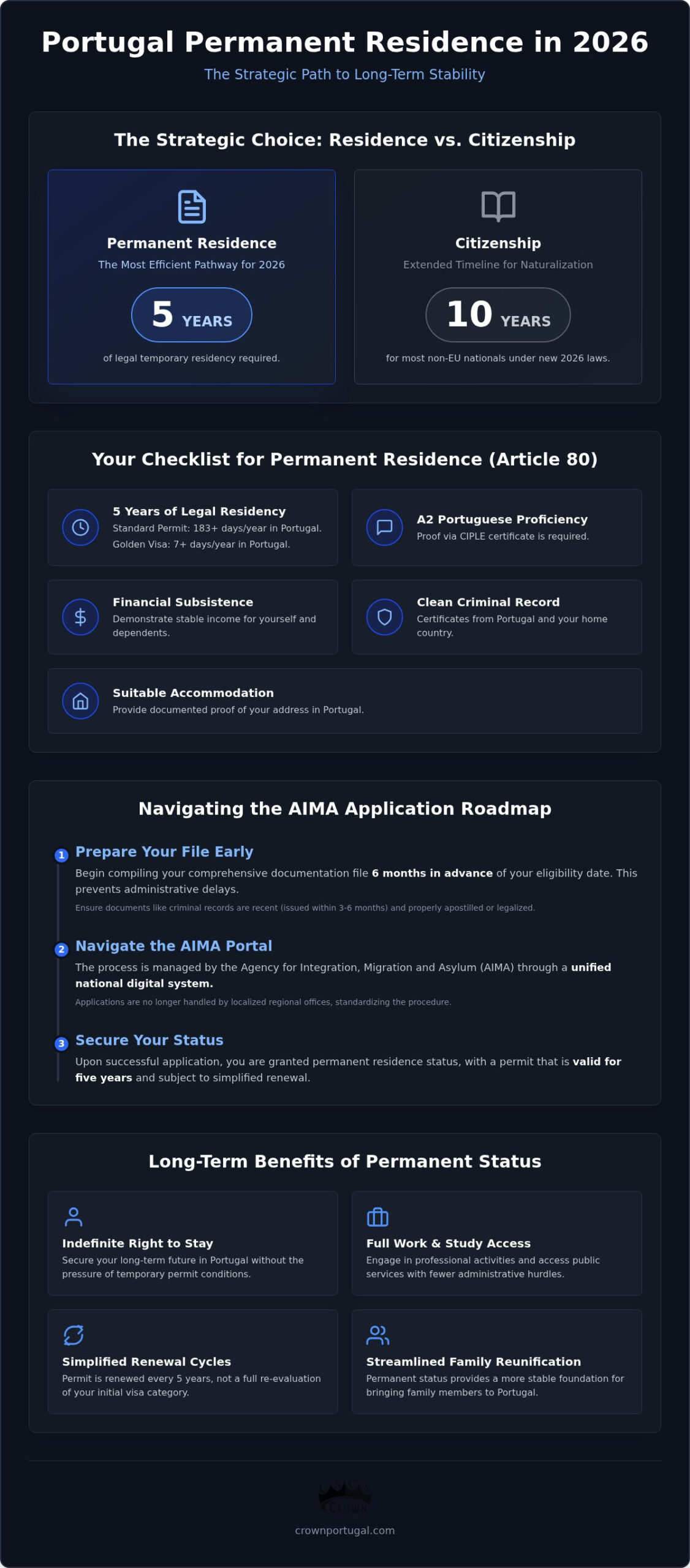
Article 80 serves as the definitive legal basis for granting permanent status to those who’ve maintained legal temporary residency for at least five years. Unlike temporary permits that require frequent justification of activity, a permanent permit grants holders the right to engage in professional activities and access public services with fewer administrative hurdles. The permit remains valid for five years and is subject to a straightforward renewal cycle rather than a full re-evaluation of the applicant’s initial visa category.
The Role of AIMA in the 2026 Residency Landscape
The administrative transition from the former SEF to the Agency for Integration, Migration and Asylum (AIMA) has redefined how permanent permits are processed. Applicants must now navigate a digital-first portal that emphasizes “national territory” filing, meaning your application is managed within a unified national system rather than through localized regional offices. This shift aims to standardize processing times for portugal permanent residence, though it requires meticulous document preparation to avoid the backlogs currently affecting the 2026 landscape. For the most recent administrative updates and procedural guides, you can visit the Crown Portugal YouTube channel.
Eligibility and Mandatory Requirements for 2026 Applicants
Securing portugal permanent residence in 2026 involves more than just a calendar count. The foundational “5-Year Rule” requires you to have maintained legal residency for five consecutive years. For standard permit holders, this means spending at least 183 days per year in the country. However, Golden Visa holders benefit from a reduced requirement of just seven days per year. These residency standards align with the broader EU Migration and Asylum Policy, which ensures that long-term residents demonstrate a genuine link to their host nation before granting indefinite status.
Beyond time spent in the country, you must provide proof of suitable accommodation and a clean criminal record. AIMA requires certificates from both the Portuguese authorities and your home country (or any country where you’ve resided for more than one year). These documents must be recent, typically issued within the last three to six months, and properly apostilled or legalized to be accepted during your appointment.
The A2 Portuguese Language Requirement (CIPLE)
One of the most frequent points of confusion for applicants is the language proficiency mandate. To qualify for permanent status, you must demonstrate a basic command of the Portuguese language at the A2 proficiency level. This is usually achieved by passing the CIPLE (Certificado Inicial de Português Língua Estrangeira) exam. Alternatively, you can complete a recognized “Português Língua de Acolhimento” (PLA) course through a certified educational institution. Exemptions exist for those who’ve attended school in a Portuguese-speaking country, individuals over 60 with learning difficulties, or children under the age of ten, provided specific medical or educational evidence is presented.
Subsistence and Fiscal Compliance (NIF/NISS)
Financial stability is a non-negotiable pillar of the application. You must demonstrate that you possess sufficient resources to support yourself and your dependents without relying on the social assistance system. For 2026, the minimum income threshold is tied to the national minimum wage of €920 per month. Applicants must show 100% of this amount for the main applicant, 50% for a spouse, and 30% for each dependent child. Your NIF (Tax Identification Number) and NISS (Social Security Number) records are essential here. They provide a transparent history of your fiscal residency and contributions. If you’re currently transitioning from a Portugal D7 Visa Passive Income, your established history of passive returns will be the primary evidence for this requirement. Ensuring your fiscal file is immaculate before your AIMA appointment is the best way to secure your long-term stability in Portugal.
Portugal Permanent Residence vs. Citizenship: The Strategic Choice
Choosing between portugal permanent residence and nationality involves a careful analysis of your long-term mobility goals and the current administrative climate. While many residents view citizenship as the ultimate objective, the May 2026 nationality law changes have shifted the landscape significantly. For most non-EU nationals, the residency requirement for naturalization has extended to ten years, whereas eligibility for permanent status remains fixed at the five-year mark. This creates a strategic window where securing a permanent permit serves as a vital security layer while you wait for the multi-year citizenship processing queue to clear.
When you submit your Official Portugal Permanent Residence Application, you’re locking in a status that doesn’t expire based on investment or employment changes. Unlike temporary permits, which require you to justify your continued presence under specific visa categories, a permanent permit grants you the indefinite right to live, work, and study. It functions as a robust “safety net,” ensuring your legal standing remains intact even if administrative backlogs delay your passport application for several years.
Why Permanent Residence is the ‘Safe Move’ in 2026
The primary advantage of PR in the 2026 landscape is the speed of implementation. AIMA’s current processing times for Article 80 applications are considerably shorter than the national archives’ backlog for citizenship. Relying solely on temporary permit renewals while waiting for a passport carries the risk of permit expiry during periods of administrative transition. For those currently on an investment track, our Portugal Golden Visa Investment Guide details how to maintain your temporary status while preparing for this transition. Securing your PR first guarantees you won’t be subject to the rising fees or changing requirements of temporary visa categories.
Comparing Stay Requirements and Maintenance
You must consider how your global mobility needs align with the maintenance rules of each status. Portugal permanent residence requires you to avoid long-term absences to keep the permit valid; generally, you shouldn’t be away for more than 24 consecutive months or 30 total months over a three-year period. In contrast, citizenship removes all stay requirements permanently, granting you a Portuguese passport and full voting rights. If your lifestyle requires complete freedom to live outside the EU for years at a time, citizenship remains the goal. However, for those making Portugal their primary home, the PR card, renewable every five years, provides nearly identical domestic rights with a much faster approval timeline.
The Step-by-Step Application Process for Permanent Permits
Successful acquisition of portugal permanent residence requires a methodical approach that begins at least six months before your current temporary permit expires. This preparation phase is essential for gathering time-sensitive documents, such as fresh criminal record certificates from your home country, which often require apostilles and official translations. The administrative shift to AIMA means the scheduling portal operates on a nationalized queue system; you’ll need to monitor the digital platform closely for appointment releases to ensure you don’t face a gap in your legal status.
The interview at the AIMA office is a formal verification of your integration and fiscal compliance. An administrative officer will cross-reference your physical documents with the data already held by the Tax Authority (AT) and Social Security. You’ll be expected to provide biometric data again, including fingerprints and a digital signature. Accuracy during this stage is paramount. Even minor discrepancies in your registered address history can trigger additional inquiries that delay your card’s issuance by several months.
The Document Checklist for 2026
Maintaining an organized file is the most effective way to avoid the rejection pitfalls common in high-volume administrative offices. Your 2026 application file must include:
- A valid temporary residence permit and a passport with at least six months of remaining validity.
- Proof of subsistence, typically demonstrated through your most recent IRS tax return and the last three months of Portuguese bank statements.
- Updated criminal record certificates from Portugal and any country where you’ve resided for more than one year since your initial move.
- Evidence of a registered residential address, such as a rental contract or property deed, accompanied by a recent utility bill.
Fees and Administrative Costs
AIMA updated its fee schedule on March 1, 2026, to reflect the increased operational costs of the new unified system. The standard fee for the grant of a permanent residence permit is currently €351.10. You’ll receive a digital receipt upon payment, which serves as temporary proof of your pending status until your physical card arrives via registered mail. If you’re starting this journey from a work-based track, our Portugal D1 Visa Step-by-Step Guide provides the foundational context for your eventual transition to permanent status. To ensure your file meets every legal standard before your appointment, you may want to consider professional administrative logistics support to review your documentation for potential errors.
Maintaining Your Status and Expert Assistance
Securing portugal permanent residence is a definitive step toward long-term stability, but maintaining that status requires ongoing administrative diligence. While the right to reside is indefinite, the physical residence card must be renewed every five years to update biometric data and verify continued legal compliance. This renewal cycle is significantly less demanding than the initial application process, yet it remains a critical touchpoint with AIMA to ensure your records are current.
One of the primary advantages of this status is the simplified path to family reunification. Permanent residents can facilitate the legal entry and residency of spouses, children, and dependent parents through Article 98 of the Foreigners’ Act. This process ensures your family unit remains secure within the national territory under the same indefinite protections you enjoy as a primary holder. It eliminates the need for dependents to navigate separate, complex visa tracks.
Common pitfalls often arise from fiscal non-compliance or exceeding absence limits. You must ensure your tax residency remains transparent and that your NIF records accurately reflect your residential situation. Failure to maintain these records can complicate future card renewals or even lead to the revocation of your status during a routine administrative audit. Keeping your fiscal file immaculate is just as important as the physical permit itself.
Stay Requirements and Absence Rules
The maintenance of your permanent status depends on your physical presence in Portugal. Generally, your permit may be cancelled if you’re absent for more than 24 consecutive months or a total of 30 non-consecutive months within any three-year period. These rules are designed to ensure that permanent residents maintain a genuine, active connection to the country. Exceptions exist for those who can prove their absence was due to professional, educational, or humanitarian reasons, such as being stationed abroad by a Portuguese employer.
The maximum period of consecutive absence allowed for a permanent resident without risking permit revocation is 24 months. If you anticipate a longer absence, you must present certified documentation to AIMA to justify your time away and protect your legal standing.
How Crown Portugal Facilitates Your Permanent Move
Navigating the shift from a temporary visa to portugal permanent residence involves complex administrative logistics that leave little room for error. Our team provides expert document auditing to identify potential discrepancies before they reach an AIMA officer’s desk. We focus on ensuring your fiscal history, language certification, and criminal records are perfectly aligned with 2026 regulatory standards. This methodical approach minimizes the risk of document rejection after years of living in the country.
Beyond documentation, we offer comprehensive support in appointment facilitation and logistical coordination. Whether you’re transitioning from a Golden Visa or a D-series permit, having a disciplined professional guide ensures your pathway is mapped out clearly. For those still in the early stages of their residency journey, our guide on Choosing a Portugal Investment Residency Consultant offers strategic advice on selecting the right partner for your long-term goals. We act as your steady, knowledgeable intermediary in all bureaucratic processes to ensure a smooth transition to indefinite stay.
Securing Your Indefinite Future in Portugal
Transitioning to portugal permanent residence in 2026 is a disciplined choice that prioritizes immediate stability over the extended ten-year citizenship timeline for non-EU nationals. You’ve established your life here; now is the time to solidify that foundation by mastering the Article 80 requirements. Success depends on your ability to present an immaculate fiscal file and a certified command of the language at the A2 level. By opting for permanent status, you bypass the administrative backlogs of the nationality track while securing the right to live, work, and reunite your family indefinitely.
Navigating the complex AIMA landscape requires more than just patience; it demands professional precision. Crown Portugal was founded in 2018 to provide this exact level of administrative expertise. We specialize in the logistics of the SEF-to-AIMA transition, offering comprehensive fiscal and relocation support to ensure your application is processed without delay. Secure your future in Portugal with Crown Portugal’s expert residency consultancy.
Your journey toward long-term stability is a significant milestone, and with the right preparation, your indefinite stay is well within reach.
Frequently Asked Questions
How long does it take to get permanent residence in Portugal?
You can apply for permanent residence after five years of legal temporary residency in Portugal. Once you meet this five-year milestone; the administrative processing by AIMA for Article 80 applications typically takes several months. This timeline depends on current appointment availability and the speed of document verification cycles. It’s essential to begin gathering your file six months before your current permit expires to ensure a seamless transition without gaps in your legal status.
Do I need to speak Portuguese to get permanent residence?
Yes; applicants for portugal permanent residence must demonstrate a basic command of the language at the A2 proficiency level. This requirement is generally satisfied by presenting a CIPLE certificate from a recognized testing center or by completing a certified “Português Língua de Acolhimento” (PLA) course. Exemptions apply to children under ten; individuals over 60 with specific health conditions; or those from Portuguese-speaking countries who’ve completed formal education there.
Can I work in other EU countries with a Portuguese permanent residence permit?
A Portuguese permanent residence permit grants you the right to live and work indefinitely within Portugal; but it doesn’t provide automatic work authorization in other EU member states. While you can travel within the Schengen Area for up to 90 days in any 180-day period; taking up employment elsewhere usually requires a local work permit or an EU Long-Term Residence permit. Each country maintains its own specific labor market regulations for non-EU nationals.
What is the difference between permanent residence and citizenship in Portugal?
Permanent residency allows you to stay indefinitely with a card renewed every five years; whereas citizenship grants a Portuguese passport and full voting rights. Under the May 2026 law changes; the naturalization timeline has extended to ten years for most non-EU nationals; making portugal permanent residence the faster route to security after five years. Citizenship removes all stay requirements permanently; while PR holders must adhere to specific maximum absence limits to maintain their legal status.
How much income do I need to show for Portugal permanent residence?
Applicants must demonstrate stable financial resources equivalent to the 2026 national minimum wage of €920 per month for the primary applicant. If you’re including family members; you must show an additional 50% for a spouse and 30% for each dependent child. These funds can be proven through Portuguese bank statements; employment contracts; or evidence of passive income. This ensures you possess sufficient subsistence without relying on the national social assistance system.
What happens if my permanent residence application is rejected?
If AIMA rejects your application; you’ll receive a formal notification detailing the specific grounds for refusal; such as insufficient financial proof or an incomplete criminal record. You generally have a window to respond through a “prior hearing” to contest the findings or provide missing evidence. If the rejection is finalized; you may need to reapply after correcting the errors or seek administrative review to challenge the decision based on established legal grounds.
Can I include my family in my permanent residence application?
You can include family members in your transition to permanent status through the family reunification process under Article 98. This allows spouses; minor children; and dependent parents to secure residency based on your permanent permit. Each family member must provide their own set of documents; including criminal records and proof of relationship; to ensure the entire household achieves long-term stability under a unified legal framework without navigating separate; complex visa tracks.
How many days do I need to stay in Portugal to keep my permanent residence?
To maintain your permanent status; you shouldn’t be absent from Portugal for more than 24 consecutive months or a total of 30 non-consecutive months within a three-year period. Exceeding these limits can lead to the revocation of your permit unless you can justify the absence for professional; educational; or humanitarian reasons. It’s critical to document any extended time abroad with certified evidence to protect your residency during future card renewal cycles at AIMA.