

Living in Portugal as an Expat: The Definitive 2026 Guide to Relocation

Successful relocation to the Atlantic coast in 2026 is no longer just about finding the right climate; it’s about mastering a complex framework of administrative and fiscal compliance. You’ve likely heard that living in Portugal as an expat offers an exceptional quality of life, yet the reality often involves navigating a labyrinth of residency permits and evolving tax regulations. It’s natural to feel overwhelmed by the prospect of choosing between a D7 passive income visa or the updated Digital Nomad D8 category while worrying about potential non-compliance with local authorities.
This definitive guide provides the clarity you need to move forward with absolute confidence. We’ve mapped out the essential administrative, financial, and lifestyle frameworks required to secure your status under the latest 2026 guidelines. You’ll find a methodical breakdown of the residency roadmap, including NIF and NISS registration, detailed fiscal obligations, and the specific documentation needed to bridge the gap between your current location and your new home in Portugal. Our goal is to ensure every procedural detail is accounted for, allowing you to focus on your transition while we provide the professional expertise necessary to navigate the bureaucratic landscape.
Key Takeaways
- Understand the essential balance between Portugal’s high quality of life and the procedural rigor required for successful administrative compliance in 2026.
- Identify the most appropriate residency pathway for your specific circumstances, focusing on the distinct requirements of the D7 passive income and D8 digital nomad visas.
- Establish a clear hierarchy for your administrative setup, prioritizing the acquisition of a NIF and NISS to facilitate banking and professional activity.
- Navigate the complexities of the 2026 tax framework and the dual healthcare system to ensure long-term stability while living in Portugal as an expat.
- Recognize the critical role of professional document review in mitigating the risk of application rejection and streamlining the transition to your new environment.
The Reality of Living in Portugal as an Expat in 2026
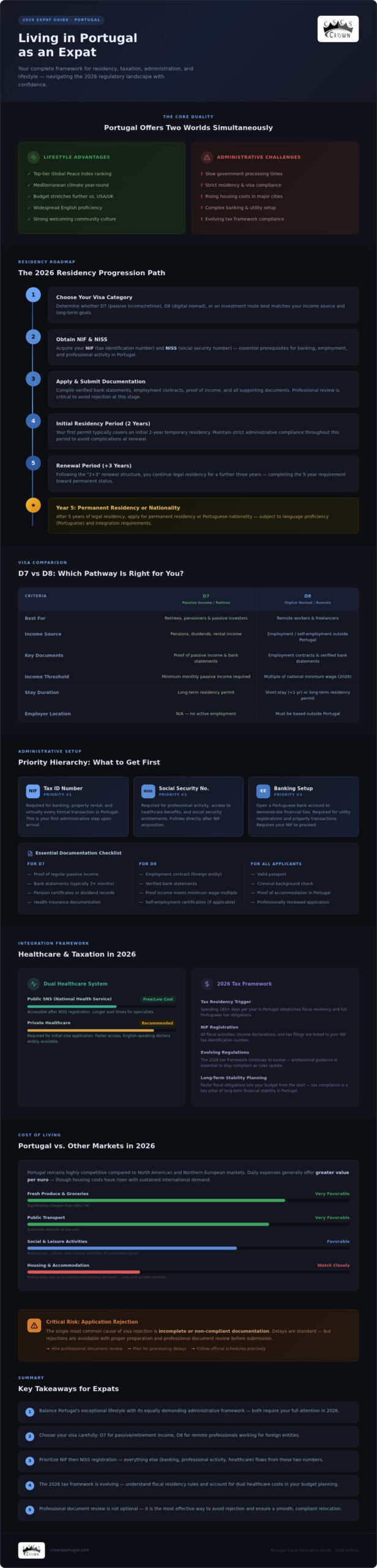
Moving to the Atlantic coast represents a strategic decision to prioritize personal well-being and security. By 2026, the country has solidified its reputation as a premier destination, yet the experience of living in Portugal as an expat is defined by a distinct duality. You’ll find a world where unparalleled lifestyle advantages coexist with a meticulous administrative framework that requires precise attention to detail. It’s a balance between the ease of the afternoon sun and the rigor of the morning’s bureaucratic appointments. Success in this environment depends on your ability to reconcile the relaxed social atmosphere with the precise requirements of official residency.
Cost of living trends for 2026 indicate that Portugal remains a highly competitive option compared to North American and Northern European markets. While global economic shifts have influenced local prices, daily expenses and essential services generally offer greater value here. You’ll find that your budget often stretches further than in the United States or the United Kingdom, particularly regarding fresh produce, public transport, and social leisure. However, it’s essential to account for rising housing costs, which have adjusted to meet the sustained demand from international residents. Planning for these fiscal realities is a core component of a successful relocation strategy that ensures long-term financial stability.
Core Advantages of the Portuguese Lifestyle
Security is a fundamental pillar of the Portuguese experience. The country consistently ranks within the top tiers of the Global Peace Index, providing a stable and predictable environment for families and retirees. This safety, combined with a Mediterranean climate that impacts every facet of daily routines, facilitates a lifestyle centered on outdoor activity and community engagement. You’ll find that the sense of community is strong, with local residents often welcoming those who make an effort to integrate. English proficiency is also widespread in professional and commercial sectors, which helps reduce the friction of initial relocation efforts for those still learning the language.
Navigating Local Challenges and Bureaucracy
The relaxed pace of daily life rarely translates to official government timelines. In 2026, administrative processing for residency and tax matters remains a structured and sometimes slow process that demands strict adherence to official schedules. You must manage expectations regarding the response times of public authorities; delays are a standard part of the procedural landscape. Professional guidance is critical for managing complex residency renewals and ensuring all documents meet the latest standards. Adapting to local banking requirements and utility registrations involves a learning curve where patience and precise documentation are your most valuable assets. These administrative hurdles are manageable, but they require a methodical approach to avoid unnecessary setbacks.
Strategic Residency Pathways: D7, D8, and Investment Options
Selecting a suitable residency category is the foundational step for anyone considering living in Portugal as an expat. The 2026 framework distinguishes between temporary stay permits, which are ideal for short-term projects, and residency permits that lead to permanent status. This progression usually follows a "2+3" year renewal structure. After five years of legal residency, you’ll become eligible to apply for permanent residency or Portuguese nationality, provided you meet the language and integration requirements. It’s a structured path that rewards administrative consistency and long-term planning.
The D8 Digital Nomad Visa for Remote Professionals
Remote professionals must provide comprehensive evidence of their employment or self-employment status with entities located outside of Portuguese territory. The Digital Nomad Visa Portugal Requirements: The Complete 2026 D8 Guide details the specific income thresholds, which are currently pegged to a multiple of the national minimum wage. Applicants must choose between a short-stay visa for stays under one year or a residency permit for long-term relocation. Precise contract documentation and verified bank statements are mandatory to satisfy the authorities during the initial application phase.
The D7 Visa for Passive Income and Retirees
The D7 visa is the primary route for passive income earners seeking residency in the country. Qualifying income sources include state or private pensions, transferable rental income from real estate, and dividends from corporate holdings. You must demonstrate that these funds are stable and meet the minimum financial thresholds for the primary applicant and any accompanying dependents. For a detailed breakdown of these requirements, consult our Portugal D7 Visa Passive Income: The Definitive 2026 Residency Guide. This pathway remains a favorite for retirees due to its clear financial criteria and straightforward renewal process.
Golden Visa and Entrepreneurial Pathways
For those seeking flexibility without a strict physical stay requirement, the D9 Golden Visa remains a viable option through specific investment funds or cultural contributions. If you intend to be more active in the local economy, the D2 Entrepreneur Visa supports those starting a local business or branch. Innovative technology professionals may instead opt for the Startup Visa, which requires endorsement from a certified incubator. Navigating these categories requires a disciplined professional approach; you might consider an expert document review to ensure your application aligns with the latest 2026 standards and avoids common rejection pitfalls.
Essential Administrative Setup: NIF, NISS, and Banking
Establishing a robust administrative foundation is a prerequisite for anyone living in Portugal as an expat. The procedural hierarchy begins with the acquisition of a tax identification number, followed by the opening of a national bank account and registration with social security. These steps are not merely formal requirements; they’re the functional keys that unlock your ability to engage with the local economy, secure housing, and access public services. A methodical approach to this setup ensures that your transition remains compliant with current 2026 regulations while minimizing the risk of bureaucratic delays.
Fiscal representation is a critical component for non-resident applicants, particularly those from outside the European Union. A fiscal representative acts as a professional intermediary between you and the Portuguese Tax and Customs Authority, ensuring that all official correspondence is received and addressed promptly. Once your tax status is established, opening a national bank account becomes the next priority. To facilitate this process, you should prepare a comprehensive document dossier. Most financial institutions require the following items for account activation:
- A valid international passport or government-issued ID;
- Your Portuguese tax identification number (NIF);
- Proof of address, which can often be a utility bill from your current country of residence;
- Evidence of professional status, such as a work contract, pension statement, or payslips.
Securing Your NIF (Tax Identification Number)
The NIF is the most fundamental document in the Portuguese administrative system. It’s required for everything from signing a long-term rental agreement to setting up a basic internet contract or purchasing a vehicle. You don’t need to wait until you arrive in the country to start this process. By utilizing a NIF Registration Service Portugal: Remote Tax Numbers, you can obtain your identification number before relocation. This proactive step allows you to handle essential logistics, such as transferring funds for a security deposit, well in advance of your flight.
Registration for Social Security (NISS)
While the NIF handles your fiscal identity, the NISS (Número de Identificação de Segurança Social) manages your professional and social contributions. This number is mandatory for anyone planning on living in Portugal as an expat while engaged in professional activity, whether as a remote worker under a D8 visa or a local employee. The application process for self-employed individuals requires specific documentation regarding their business activity. Once issued, your NISS is also the primary link to the national healthcare system (SNS), allowing you to register at a local health center and receive a user number for public medical services.
Integrating into Portuguese Society: Healthcare and Taxation
Successful integration for anyone living in Portugal as an expat necessitates a clear understanding of the country’s social infrastructure. This stage of relocation moves beyond initial registration and focuses on the long-term management of your health and fiscal status. Portuguese society operates on a dual-system model where public services provide a foundational safety net, often supplemented by private provisions to ensure efficiency and specialized care.
Accessing Healthcare as an Expat
The SNS is the national health service accessible to residents. Registration occurs at your local health center (Centro de Saúde), where you’ll be assigned a family doctor based on your place of residency. While the public system is robust and covers most medical necessities, many international residents opt for private health insurance to secure faster access to specialists and elective procedures. Proof of health insurance is often a mandatory requirement during the initial visa application stage to ensure you don’t place an immediate burden on public resources. Private plans are widely available and vary in coverage; many expats choose premiums that include dental care and international coverage for travel.
Fiscal Responsibilities and Taxation
Your fiscal obligations are determined by your residency status. You’re generally considered a tax resident if you spend more than 183 days in the country during a calendar year or maintain a permanent residence that suggests an intention to stay. This status triggers a requirement for annual personal income tax (IRS) reporting on your global income. The 2026 tax framework requires precise reporting of foreign earnings, rental income, and dividends to remain compliant with local regulations. You must file your annual tax return between April and June of the following year. This process requires a thorough review of all deductible expenses to optimize your fiscal position while ensuring full legal adherence.
Maintaining accurate records and meeting filing deadlines is essential for long-term residency compliance. Failure to adhere to these timelines can result in significant penalties and may complicate future residency renewals. For those seeking to ensure their financial transition is handled with professional precision, you can consult with our residency experts to review your specific fiscal obligations and documentation.
Relocation Strategy: Why Professional Assistance is Critical
The administrative complexity of relocating to a new country often creates significant anxiety for international applicants. Engaging professional assistance transforms this process from an overwhelming series of tasks into a managed, predictable journey. While the lifestyle benefits of living in Portugal as an expat are clear, the procedural requirements are uncompromising. A single missing document or an incorrectly formatted bank statement can result in months of delays or an outright application rejection. Expert consultancy serves as a critical buffer, ensuring that every submission aligns with current 2026 standards and legal expectations.
Professional support extends beyond mere document preparation; it provides a comprehensive framework for success. This includes meticulous review of financial evidence, verification of criminal record certificates, and the precise organization of residency files. By leveraging specialized knowledge, you can navigate the nuances of the Portuguese administrative landscape with the assurance that your case is being handled by experienced consultants who understand the specific preferences of local authorities. This methodical arrangement suggests a process-oriented mindset where every detail is accounted for and nothing is left to chance.
Consultancy Services for Residency and Investment
The foundation of a successful move lies in the accuracy of the initial file. Our Portugal D7 Visa Assistance: Professional Consultancy provides a structured approach to document review and application preparation. This service includes the scheduling of essential immigration appointments and professional representation before official bodies. Having an intermediary who speaks the local language and understands the internal logic of the residency process is invaluable for maintaining compliance. This professional oversight significantly reduces the risk of pitfalls associated with the D7, D8, and investment-based pathways.
Post-Arrival Resettlement and Compliance
The relocation process doesn’t conclude upon your arrival at the airport. Initial entry is merely the beginning of a five-year path toward permanent residency or citizenship. Post-arrival support is essential for handling local logistics, such as home address registration (atestado de residência) and the finalization of your residency card. Professional guidance ensures that you remain compliant with annual reporting requirements and renewal timelines during your first few years. This steady, knowledgeable partnership helps to lower your anxiety regarding complicated administrative tasks by presenting them as a series of manageable steps.
Managing these ongoing obligations is vital for long-term stability. To stay informed about the latest regulatory changes and procedural updates, you should subscribe to Crown Portugal on YouTube for daily updates. This resource provides ongoing value as you transition from a new arrival to a settled resident. Expert knowledge in accommodation and logistical support allows you to focus on integration while we manage the administrative details that define the success of living in Portugal as an expat.
Securing Your Future in Portugal
Transitioning to life in the Atlantic region requires more than just a desire for a new environment; it demands a disciplined approach to administrative and fiscal compliance. You’ve seen that the path to living in Portugal as an expat is paved with specific requirements, from securing your NIF and NISS to selecting the appropriate residency category like the D7, D8, or Golden Visa. Mastering these frameworks ensures that your relocation is built on a foundation of legal stability and professional security. Every procedural detail you address now prevents complications during your future residency renewals and your eventual path toward permanent status.
Founded in 2018, Crown Portugal provides specialized expertise in D7, D8, and Golden Visas, offering complete relocation and administrative support to streamline your move. We act as a steady bridge between your goals and the complexities of Portuguese bureaucracy. To ensure your documentation meets every 2026 standard and to avoid common application pitfalls, book a professional consultation with Crown Portugal today. Your successful relocation is within reach when you have a knowledgeable partner to guide every step of the procedural journey.
Frequently Asked Questions
Is living in Portugal as an expat expensive in 2026?
Portugal remains more affordable than most of North America and Northern Europe in 2026. While housing costs in major metropolitan areas have risen, daily expenses such as groceries, public transit, and local dining remain competitive. Living in Portugal as an expat generally allows for a high quality of life on a moderate budget. It’s vital to account for global inflation and local market adjustments when planning your long-term financial strategy for relocation.
Can I live in Portugal without speaking Portuguese?
You can navigate daily life without fluent Portuguese, particularly in commercial centers and professional sectors where English is widely spoken. However, official administrative settings and government interactions often require Portuguese or a professional translator. Learning basic phrases is highly recommended for deeper social integration. For residency renewals and eventual citizenship applications after five years, demonstrating a basic level of language proficiency (A2 level) is a mandatory legal requirement.
How long does it take to get a residency permit in Portugal?
The timeline for obtaining a residency permit varies based on the visa category and the current volume of applications at the immigration authorities. Generally, the process involves a two-step approach: an initial visa from your home consulate followed by an appointment in Portugal. You should plan for a total duration of four to eight months from the start of your application to receiving your physical residency card. These timelines depend heavily on procedural backlogs.
What is the minimum income required for the D7 visa in 2026?
The minimum passive income required for the D7 visa is tied to the national minimum wage, which is adjusted annually. In 2026, the primary applicant must demonstrate a stable monthly income that meets or exceeds this threshold. Additional amounts are required for a spouse (50%) and each dependent child (30%). These funds must be verifiable through bank statements or pension letters to satisfy the strict administrative review process during your application.
Is healthcare in Portugal free for expats?
Healthcare is not entirely free, but it’s highly subsidized for legal residents. Once you have a residency permit and a NISS number, you can access the public SNS (Serviço Nacional de Saúde) by paying small co-payments for appointments and prescriptions. Many expats supplement this with private health insurance to avoid waiting lists for specialized care. Note that private insurance is typically a mandatory requirement during the initial visa application phase for all applicants.
Can I work remotely in Portugal with a D8 visa?
Yes, the D8 Digital Nomad Visa is specifically designed for professionals who work remotely for employers or clients located outside of Portuguese territory. To qualify, you must provide a valid employment contract or service agreement and meet the specific 2026 income thresholds. This visa allows you to live in Portugal as an expat while maintaining your international professional ties. You must also fulfill the physical stay requirements for long-term residency compliance.
Do I need a lawyer to move to Portugal?
While a lawyer isn’t legally required for a standard residency application, professional consultancy is highly recommended to navigate the complex bureaucratic landscape. The administrative process involves precise document formatting and strict adherence to official timelines. Professional support helps prevent common pitfalls, such as document rejection or missed deadlines, which can jeopardize your relocation. Consultants act as a bridge between you and the authorities, ensuring all legal and fiscal requirements are handled with absolute competence.
How do I get a NIF in Portugal as a foreigner?
Foreigners can obtain a NIF (Número de Identificação Fiscal) by applying through the tax office (Finanças) or using a fiscal representative. If you’re outside the country, you can secure your number remotely through a professional service. This identification is essential for all financial transactions, including signing a rental lease, opening a bank account, or setting up utility contracts. It’s the first priority in your administrative setup before you begin the relocation process.