

Portugal D8 Visa Processing Time 2026: A Complete Timeline Guide

What if the most critical factor in your relocation isn’t your income, but the specific month you choose to submit your paperwork? In 2026, understanding the Portugal D8 visa processing time requires more than just reading a consulate website; it demands a strategic view of the entire administrative cycle. You’ve likely heard that establishing your life in Portugal is a simple matter of remote work proof, yet the reality involves a multi-stage marathon through both international consulates and the Agency for Integration, Migration and Asylum (AIMA).
It’s natural to feel overwhelmed by conflicting reports of three-month approvals versus nine-month backlogs. This guide provides the clarity you need by breaking down the 2026 Digital Nomad Visa timeline into manageable stages, from your initial NIF registration to the final residence permit issuance. We’ll examine consulate variations, the impact of recent legislative changes on citizenship eligibility, and the exact steps required to ensure your application is decision-ready from the moment it reaches an official’s desk.
Key Takeaways
- Understand the four distinct stages of the D8 application process, from initial document preparation to the final residency card issuance by AIMA.
- Learn why the total Portugal D8 visa processing time varies between 2 and 9 months based on consulate jurisdiction and current administrative backlogs.
- Identify the critical fiscal requirements, including NIF registration and bank account opening, that should be completed remotely to eliminate unnecessary delays.
- Discover strategic methods to ensure your application is “decision-ready,” significantly reducing the risk of administrative rejection or requests for additional evidence.
- Master the 2026 timeline for residency conversion to better manage your transition from an entry visa to a long-term residence permit.
Defining the Portugal D8 Visa Processing Stages in 2026
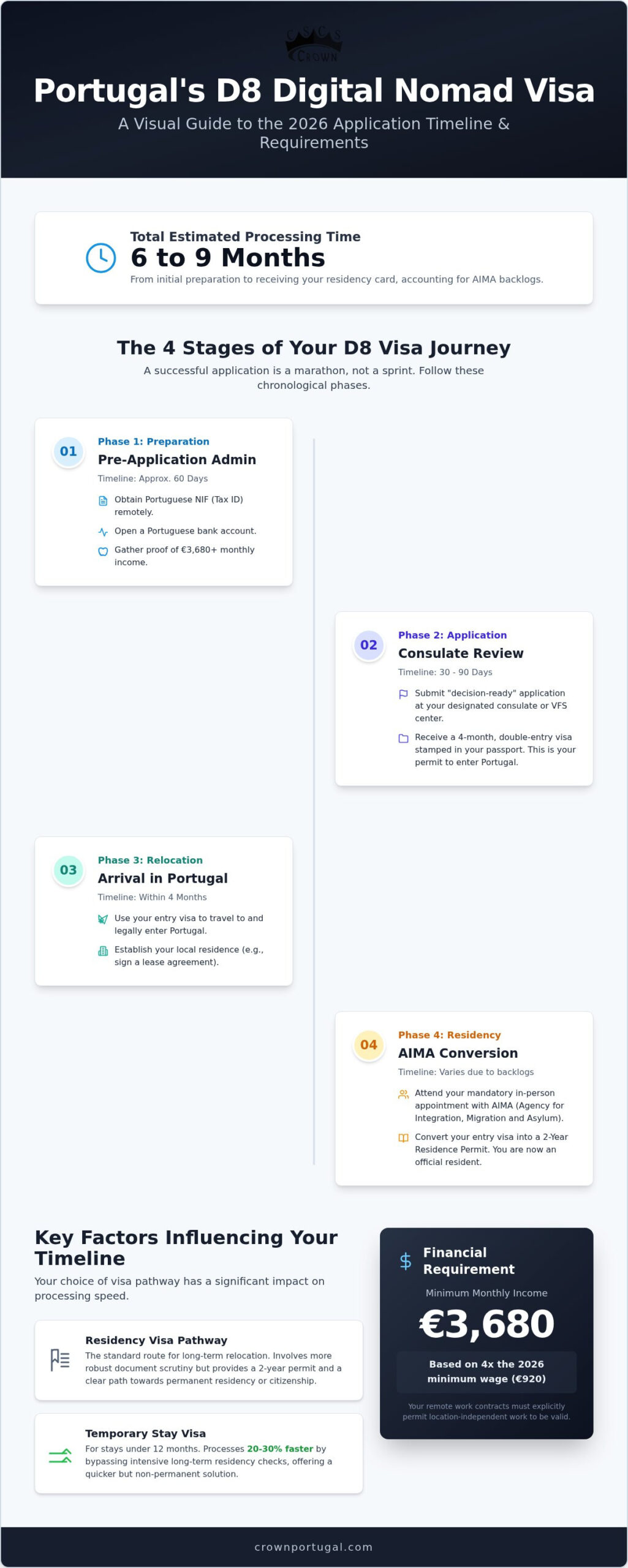
The Portugal D8 visa processing time is frequently misunderstood as a single waiting period. In reality, it constitutes a cumulative timeline spanning four distinct administrative phases: strategic preparation, consulate review, initial entry, and residency conversion. For applicants in 2026, the speed of this progression depends almost entirely on achieving “decision-ready” status before the first appointment. An application is considered decision-ready when every fiscal requirement and supporting document is verified and formatted according to current AIMA standards, leaving no room for requests for additional information.
The total duration from your first document collection to receiving a physical residency card typically ranges from six to nine months. This timeline accounts for the significant backlogs currently managed by the Agency for Integration, Migration and Asylum (AIMA). To navigate this administrative marathon successfully, you must view the process as a series of chronological hurdles rather than a singular event. Delays at the start of the cycle, particularly during the fiscal setup, often compound into much longer wait times during the final residency stages in Portugal.
The Pre-Application Administrative Phase
Many applicants fail to account for the preliminary 60-day window required for fiscal setup. Securing a Portuguese Tax Identification Number (NIF) and opening a local bank account are non-negotiable prerequisites that should be completed well before filing your visa application. Fiscal representation is essential here; it allows these tasks to be completed remotely, preventing the 4-8 week delay that occurs when individuals attempt to manage these requirements without local assistance.
During this phase, you must consolidate documentation proving a minimum monthly income of €3,680. This figure is calculated as four times the 2026 Portuguese minimum wage of €920. Preparation involves more than just gathering bank statements. You need to ensure your remote work contracts specifically include clauses that permit location-independent work, as vague employment terms are a common cause for consulate rejection. Completing these steps early ensures that the official Portugal D8 visa processing time starts with a high probability of immediate approval.
Temporary Stay vs. Residency Pathway Timelines
The choice between a Temporary Stay visa and a Residency visa significantly impacts your relocation schedule. Temporary Stay visas, designed for stays under 12 months, generally process 20-30% faster because they bypass the intensive long-term residency scrutiny. These permits align with the broader Schengen Area visa policy, providing flexibility for those who do not yet wish to commit to a permanent move.
Conversely, the Residency pathway requires a more robust document trail. While the initial consulate stage may take 30 to 90 days for both types, the Residency pathway involves a second, more complex stage once you arrive in Portugal. This second phase converts your entry visa into a two-year residence permit. Because this stage requires an appointment with AIMA, the total time to receive your card is longer, but it provides the legal stability necessary for those who eventually intend to apply for permanent residency or citizenship after the ten-year eligibility period.
The Two-Phase Timeline: From Consulate Submission to Residency Permit
Navigating the transition from an applicant to a resident involves a structured two-phase journey. It’s a common misconception that the process ends once the visa is stamped in your passport. In 2026, the total Portugal D8 visa processing time is split between the initial entry visa granted in your home country and the residency permit issued within Portugal. The first document you receive is a double-entry visa valid for four months. This window is designed to allow you to enter the country, establish your local residence, and attend your mandatory registration appointment.
The 2026 administrative landscape has shifted toward a more digital-first approach, yet the physical requirements remain stringent. Understanding that your initial visa is merely a “bridge” to residency is vital for planning your relocation logistics, especially regarding housing contracts and school enrollments. This two-part structure ensures that the Portuguese government can verify your intentions both abroad and upon arrival.
Phase 1: Consulate and VFS Global Review
Phase 1 begins at a Portuguese consulate or through their administrative partner, VFS Global. In 2026, the standard window for a decision at this stage remains between 60 and 90 days. VFS Global serves as the primary gatekeeper, ensuring your file is complete before it reaches a consular officer. If your documentation is insufficient, you’ll receive a Request for Additional Information (RFI). This administrative pause is the most frequent cause of delays, as it effectively stops the processing clock until the new documents are submitted and verified. Common triggers for RFIs include unclear proof of income or health insurance policies that don’t explicitly meet the €30,000 minimum coverage requirement.
Phase 2: AIMA Appointment and Card Issuance
The second phase occurs entirely within Portugal and focuses on converting your four-month entry visa into a two-year residence permit. Under the 2026 administrative framework, AIMA has integrated a digital portal to streamline scheduling, yet the backlog remains a factor. Once you attend your biometric appointment, the processing of the physical card takes an additional 60 to 90 days. During this interval, your stamped passport and the receipt from your AIMA appointment serve as legal proof of your right to remain in the country.
To ensure your file moves through these stages without friction, engaging with expert relocation support can help you avoid the common errors that trigger lengthy reviews. This phase concludes when your residency card is delivered to your registered Portuguese address, officially completing your relocation timeline and providing you with full access to the rights afforded to residents.
Variables Affecting Your D8 Application Speed
The Portugal D8 visa processing time is not a static figure. It fluctuates based on the specific variables of your application, ranging from where you file to the complexity of your income sources. While the standard consulate window for a decision is 30 to 90 days, your geographic location is often the most significant predictor of speed. High-volume hubs like San Francisco, London, or São Paulo frequently experience appointment backlogs that do not exist in smaller jurisdictions.
Timing your submission is equally critical. The Portuguese administrative system experiences predictable seasonal slowdowns, particularly during the August summer holidays and the end-of-year festive period. During these windows, staffing levels at both consulates and AIMA offices are reduced, which can extend the review process by several weeks. Planning your filing for the spring or autumn months is a strategic way to avoid these systemic bottlenecks.
Geographic Consulate Bottlenecks
Consulates in the United States, the United Kingdom, and Brazil currently handle the highest volume of Digital Nomad applications globally. This sustained demand creates a bottleneck at the appointment scheduling stage, which occurs before the official review clock even begins. Jurisdiction rules are strictly enforced; you must apply at the consulate serving your legal place of residence. You cannot engage in “consulate shopping” by seeking out an office in another country simply because they report faster turnaround times. However, if you hold legal residency in a country with lower demand, filing from that location can often shave four to six weeks off the initial phase. Remote workers based in the US can find a detailed breakdown of country-specific requirements, including FBI background check timelines and apostille procedures, in our comprehensive guide to the Portugal D8 visa for US citizens.
Document Accuracy and the RFI Delay
A single administrative oversight, such as a missing Hague Apostille on a criminal record check, can instantly add a month to your timeline. When a consulate issues a Request for Additional Information (RFI), your file is moved out of the active review queue. In the Portuguese administrative register, precision is paramount. All non-Portuguese documents must have certified translations and appropriate legalizations to be accepted. We recommend “over-documenting” your financial stability by providing six to twelve months of bank statements instead of the minimum three. This proactive approach reduces the likelihood of follow-up questions that pause the processing clock.
Your professional profile also dictates the level of scrutiny your file receives. Remote employees with a single, clear contract and a steady salary of at least €3,680 typically move through the system faster than freelancers with multiple international clients and fluctuating invoices. If you’re including family members through a D6 family reunification filing, it’s vital to coordinate these applications. While adding a spouse increases the income requirement by 50% and each child by 30%, filing as a single unit ensures your relocation schedule remains synchronized and avoids the stress of staggered approvals.
Strategic Steps to Minimize Delays in Your Digital Nomad Application
Minimizing the Portugal D8 visa processing time requires a proactive approach that addresses administrative requirements before they become bottlenecks. The most effective strategy is to eliminate “dead time” by completing fiscal and contractual audits during the preparation phase. A primary cause of rejection or delay is a remote work contract that lacks explicit “location-independent” or “remote-work-friendly” clauses. Consular officers must see that your employment remains valid while you reside in Portugal. If your contract is vague, request a formal addendum from your employer to prevent a Request for Additional Information (RFI) that could stall your application for weeks.
Securing your NIF (Personal Tax Number) and opening a Portuguese bank account remotely can save between four and six weeks of processing time. Attempting to manage these tasks after arrival often leads to a cascade of delays, as these documents are essential for your initial consulate submission. Additionally, your proof of accommodation must align with strict consulate standards. This typically requires a long-term lease agreement or a property deed. Short-term bookings or informal letters of invitation are frequently flagged, leading to immediate setbacks in your relocation schedule.
The “Decision-Ready” Submission Framework
Organizing your application file according to the meticulous VFS hierarchy is a simple yet powerful way to accelerate the review process. An application that is easy to navigate is processed more efficiently. Your file should include a clear personal statement or cover letter that explains your remote work setup and your motivation for moving to Portugal. When submitting financial evidence, don’t simply provide a stack of bank statements. Explicitly highlight the recurring income entries that meet the €3,680 monthly threshold. This clarity prevents the reviewer from having to hunt for data, reducing the risk of administrative errors.
Managing Post-Arrival Logistics Proactively
Once you arrive in Portugal, the clock for your residency card issuance begins. You should register your home address (Atestado de Residência) at the local Junta de Freguesia within the first week of arrival. Simultaneously, securing your Social Security Number (NISS) demonstrates your intent to integrate into the Portuguese system. These steps aren’t just formalities; they are the foundation of your AIMA appointment. Completing these registrations early ensures that your file is fully updated when you attend your residency interview, which can significantly speed up the final issuance of your physical card.
To ensure your documentation meets every regulatory requirement for 2026, you can book a professional document review to confirm your application is “First-Time Approval” ready.
Professional Facilitation: How Crown Portugal Accelerates Your Relocation
Crown Portugal acts as a specialized intermediary in the relocation sector, bridging the gap between global digital nomads and the specific demands of the Portuguese administration. By providing end-to-end support for the Portugal D8 visa processing time, we ensure that every administrative milestone is met with precision. This is particularly vital in 2026, where the integration of new digital portals at AIMA has created a learning curve for unassisted applicants. Our role is to eliminate the “dead time” that occurs when files are left idle due to minor errors or missing certifications.
The Value of Expert Administrative Oversight
Professional document review is the foundation of a successful application. We meticulously audit every piece of evidence, from the Hague Apostille on criminal records to the specific wording of remote work contracts. This oversight significantly reduces the risk of common consulate rejections. For freelancers or applicants with multiple income streams, we provide personalized guidance to structure financial proof in a way that aligns with the €3,680 monthly requirement. Our expertise in NIF and Social Security (NISS) acquisition allows these critical steps to be handled correctly from the outset. This prevents the 4-8 week delays often caused by improper fiscal representation or incorrect document formatting. We maintain constant communication with consulate partners to stay informed of the latest shifts in AIMA portal behaviors and review standards.
Comprehensive Relocation and Resettlement
A successful move involves more than just a visa stamp. Crown Portugal provides logistical support that begins the moment you land. Our services include airport pick up in Portugal and dedicated assistance in securing compliant accommodation that meets the residency requirements. Once you’re on the ground, we facilitate the registration of your local address at the Junta de Freguesia. This step is a prerequisite for your final residency appointment and is often a source of confusion for new arrivals. By managing these resettlement tasks proactively, we ensure your transition is stable and your legal status remains secure while awaiting your physical residency card. You can focus on your professional commitments while we manage the bureaucratic intricacies.
Simplify your Portuguese residency journey with Crown Portugal
Achieving a Seamless Transition to Portuguese Residency
Navigating the Portugal D8 visa processing time in 2026 requires a disciplined approach to both the initial consulate filing and the subsequent residency conversion. By prioritizing fiscal readiness, such as securing your NIF and Portuguese bank account well in advance, you eliminate the primary causes of administrative delay. Success is found in the details of your remote work contract and the precision of your document hierarchy.
Since 2018, Crown Portugal has provided expert immigration consultancy to help remote workers master these procedural requirements. Our comprehensive NIF and NISS registration services, combined with meticulous administrative support, ensure your application is decision-ready upon submission. We act as your knowledgeable partner throughout the entire relocation cycle, from initial review to local resettlement.
Consult with a Crown Portugal expert to secure your D8 Visa
Your transition to a new professional life in Portugal is achievable when backed by competent guidance and thorough preparation.
Frequently Asked Questions
What is the average Portugal D8 visa processing time in 2026?
The total Portugal D8 visa processing time typically ranges from six to nine months in 2026. This duration accounts for the initial 30 to 90 days required for consulate review and the subsequent residency conversion through AIMA. You should also factor in a 60-day preliminary window for fiscal preparation, including NIF acquisition and bank account setup, before your official submission.
Can I speed up my Digital Nomad Visa application?
You can accelerate your application by ensuring your file is decision-ready before your first appointment. Securing your NIF and Portuguese bank account remotely through fiscal representation eliminates common delays. Professional document reviews also prevent administrative pauses caused by Requests for Additional Information (RFIs); these requests often add four to six weeks to the standard review cycle.
Does the D8 visa processing time include the NIF and bank account setup?
The official Portugal D8 visa processing time quoted by consulates does not include the preliminary stages of NIF registration and bank account opening. These essential fiscal steps usually require 30 to 60 days to complete properly. You must have these documents finalized and verified before you can successfully book or attend your mandatory visa interview at a consulate.
How long is the wait for an AIMA appointment after arriving in Portugal?
Wait times for AIMA appointments currently range between 60 and 90 days after your arrival in Portugal. Due to administrative backlogs in 2026, the interval between your biometric interview and receiving your physical residency card may take an additional three months. Your four-month entry visa serves as your legal bridge while you await the final issuance of your permit.
Will my family’s D8 application take longer than mine?
Family applications generally process within the same timeframe as the main applicant when submitted as a single unit. While adding a spouse increases the income requirement by 50% and each child by 30%, it does not inherently slow the review. Staggered filings, where family members apply later, will result in different approval dates and can complicate your collective relocation schedule.
What happens if my D8 visa application is delayed past my planned move date?
If your visa is delayed, it’s critical to wait for official approval before traveling to Portugal to begin your residency. You cannot legally convert a tourist entry into a D8 residency permit from within the country; the initial visa must be issued by the consulate in your home jurisdiction. Entering on a Schengen waiver while pending can lead to significant administrative complications.
Is the processing time different for the Temporary Stay vs. Residency D8?
There is a noticeable difference in the Portugal D8 visa processing time for these two pathways. The Temporary Stay visa often processes 20% to 30% faster because it bypasses the intensive long-term residency scrutiny required for the two-year permit. However, the Temporary Stay version does not lead to permanent residency or the ten-year citizenship eligibility path available to residency applicants.
How much time should I allow for document apostilles and translations?
You should allow at least four to six weeks for document apostilles and certified translations before your consulate appointment. Government agencies in your home country often experience their own backlogs for legalizing criminal record checks and birth certificates. All documents must be current and usually issued within the last six months to be accepted by the Portuguese administrative register.