

Portugal Visa for US Citizens: 2026 Residency Guide

In 2023, U.S. citizens became the top nationality among new Golden Visa investors, signaling a historic shift in transatlantic relocation trends. You’ve likely felt the same draw toward Portugal’s stability, yet the administrative reality of the 90-day Schengen rule and the NIF registration process can create significant anxiety. It’s common to fear that a minor document error might result in a visa rejection after months of planning. This guide serves as a professional roadmap to secure a Portugal visa for US citizens, providing the clarity needed to navigate complex bureaucratic requirements.
We’ll break down the specific differences between the D7, D8, and Golden Visa pathways. You’ll also find a comprehensive checklist for your pre-departure fiscal obligations and a step by step timeline to manage your transition with absolute confidence. This systematic approach ensures that every procedural detail is addressed before you arrive at your VFS Global appointment.
Key Takeaways
- Distinguish between the D7, D8, and Golden Visa pathways to determine which residency route aligns with your specific income or investment goals.
- Recognize the necessity of the NIF (Tax Identification Number) as the foundational requirement for opening a bank account and initiating your residency process.
- Gain a clear understanding of the administrative steps required to obtain a Portugal visa for US citizens, including the transition from VFS Global to AIMA.
- Learn how to prepare a “perfect folder” with proper apostilles and translations to prevent common application rejections.
- Understand the strategic advantage of professional fiscal representation and document review in navigating Portugal’s evolving immigration landscape.
Navigating the 90-Day Rule and Long-Term Residency in Portugal
US citizens often arrive in Portugal under the impression that their passport allows for indefinite stays, provided they leave briefly every few months. This is a fundamental misunderstanding of the Schengen Area 90-day rule. While Americans enjoy visa-free entry for tourism or business for up to 90 days within any 180-day period, this status does not grant residency rights. Transitioning to a life in Portugal requires a formal Portugal visa for US citizens, a process that must begin at a Portuguese consulate within the United States.
Attempting to “extend” a tourist stay once you’re on the ground is generally impossible for those seeking residency. The Portuguese legal framework requires applicants to apply for a Long-Stay (National) visa from their home country or country of legal residence. Because the administrative process involves gathering FBI background checks, securing fiscal representation, and coordinating with VFS Global, we recommend starting your preparations 4 to 6 months before your target departure date. This timeline accounts for current administrative backlogs and the meticulous document collection required for a successful application.
Short-Stay vs. Long-Stay: What US Citizens Need to Know
Short-stay entries are strictly for non-remunerated activities. If your intent is to work, retire, or live permanently, a National Visa is mandatory. These visas, such as the D7 or D8, are processed through the Portuguese consulate network in the U.S., often utilizing VFS Global as an intermediary. The application fee for a National D Visa is €110 per applicant. This initial step is the only legal pathway to secure the right to apply for a residence permit once you arrive in the country. You cannot simply switch from a tourist waiver to a residency status without this prerequisite document.
The Residency Permit: Beyond the Initial Visa
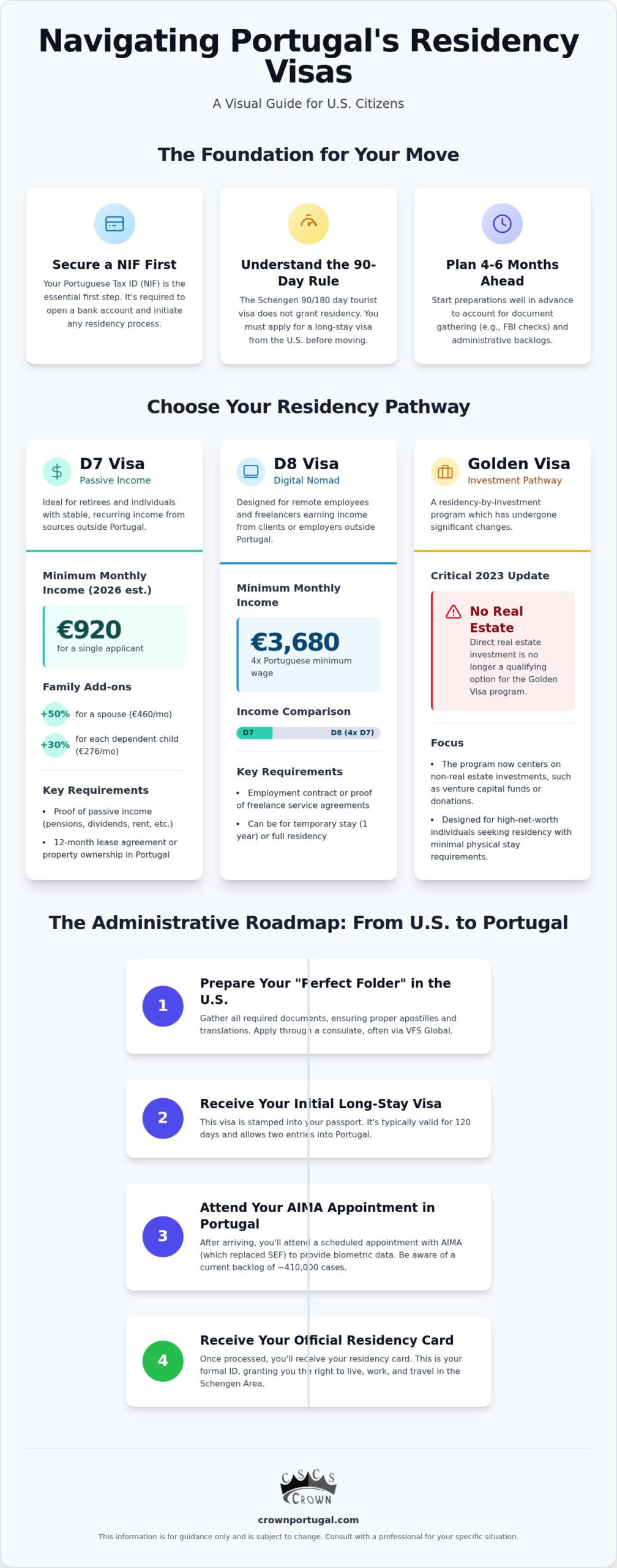
It’s vital to understand that the visa stamped in your passport is merely a temporary entry permit, typically valid for 120 days. It allows you two entries into Portugal for the specific purpose of attending an appointment with AIMA (Agency for Integration, Migration and Asylum). AIMA is the administrative body that replaced the former SEF and currently manages a backlog of approximately 410,000 immigration cases. During your scheduled appointment, officials collect biometric data to issue your actual residency card. This card serves as your formal identification, granting you the right to reside, access public services, and travel throughout the Schengen zone as a legal resident.
The Three Main Residency Pathways for Americans: D7, D8, and Golden Visa
Selecting the appropriate Portugal visa for US citizens requires a clear understanding of your financial profile and long-term residency goals. The Portuguese government has established distinct administrative tracks to accommodate retirees, remote professionals, and investors. Each pathway carries its own set of fiscal prerequisites and documentary burdens that must be addressed during the initial application phase at a Portuguese consulate in the United States.
The D7 Passive Income Visa Requirements
The D7 visa is the traditional route for retirees and individuals who possess stable, recurring passive income. For 2026, the minimum monthly income requirement for a single applicant is €920, which amounts to €11,040 per year. If you’re applying with a spouse, this requirement increases by 50% (€460 per month), and by 30% (€276 per month) for each dependent child. Acceptable income sources include Social Security benefits, pension distributions, dividends, and verifiable real estate rental income. A critical component of this application is the provision of a 12-month lease agreement or proof of property ownership in Portugal, which serves as your official residential address.
The D8 Digital Nomad Visa for Remote Workers
The Portugal Digital Nomad Visa, or D8, is specifically designed for remote employees and freelancers whose income originates outside of Portugal. The financial threshold for the D8 is significantly higher than the D7, requiring the main applicant to demonstrate a monthly income of at least €3,680. This figure is calculated as four times the Portuguese minimum wage. Applicants must choose between a temporary stay visa, valid for up to one year, or a residency visa, which initiates the multi-year residency permit process. You’ll need to provide an employment contract or freelance service agreements to validate your professional status.
The 2026 Golden Visa: Investment Without Real Estate
The Golden Visa (D9) underwent significant structural changes in late 2023, effectively removing direct real estate investment as a qualifying option. Current regulations focus on capital transfers, requiring a minimum investment of €500,000 into qualifying Portuguese venture capital or private equity funds. Another option involves a €250,000 donation to approved national heritage or arts projects. This pathway is particularly attractive for those who don’t plan to relocate immediately, as it only requires a physical presence of seven days per year. For entrepreneurs, the D2 visa remains a specialized path for launching small businesses or startups within the country. If you’re struggling to determine which category fits your situation, reviewing the specific criteria for the Portugal Digital Nomad D-8 Visa or the D7 can provide necessary administrative clarity.
The Fiscal Foundation: NIF, NISS, and Banking Prerequisites
Establishing a fiscal identity is the non-negotiable first step in your relocation journey. While many applicants focus on the visa application form, the Portuguese administrative system requires a foundational layer of local registration before a file can be considered complete. A Portugal visa for US citizens effectively requires you to exist within the Portuguese tax and banking systems before you even set foot in the country. This fiscal footprint is what allows you to sign a lease, set up utilities, and demonstrate the financial self-sufficiency required by AIMA.
Beyond the tax number, those planning to work as freelancers or employees must also secure a Social Security Number (NISS). This identification is critical for legal employment and ensures your contributions to the Portuguese social security system are correctly attributed. Integrating these fiscal elements early in your timeline prevents the common bottleneck where a visa appointment is secured, but the supporting financial documents are not yet localized.
How to Get a NIF in Portugal Remotely
The NIF (Número de Identificação Fiscal) is your gateway to every legal transaction in Portugal. For non-EU residents, including Americans, the law requires the appointment of a fiscal representative who acts as a bridge between you and the Portuguese Tax Authority (Finanças). This representative must be a Portuguese resident or a professional entity. To initiate NIF Registration (Personal Tax Number), you’ll need to provide a high-quality scan of your US passport and a recent proof of address from the United States, such as a utility bill or bank statement. Securing this number remotely allows you to move forward with lease agreements and bank account openings while you’re still stateside.
Setting Up Your Portuguese Bank Account
A local bank account is essential because Portuguese consulates typically require “proof of funds” to be held in a Portuguese financial institution. While you can technically apply with US bank statements, having a local account significantly strengthens your application by showing a commitment to the local economy. Most major Portuguese banks allow for remote account opening through professional intermediaries, though some may require an in-person visit once you arrive to finalize biometrics. For D7 and D8 applicants, it’s standard practice to deposit a minimum of 12 months’ worth of the required income into this account to demonstrate immediate fiscal stability. This proactive step serves as a clear signal to immigration officers that you have the liquidity to support yourself without relying on Portuguese public funds.
The Administrative Roadmap: From VFS Global to Your Residency Permit
Once your fiscal foundation is secure, the administrative focus shifts to the physical submission of your file. Obtaining a Portugal visa for US citizens is a process of meticulous document compilation. Even a minor clerical error can lead to a rejection at the service counter. This stage requires a chronological approach to document gathering, starting with federal level clearances in the United States and ending with the final biometrics interview in Portugal. Every document serves as a specific proof of your eligibility and intent to reside.
The Pre-Departure Phase in the United States
The preparation of your “Perfect Folder” begins with the FBI Identity History Summary. This document must be apostilled by the U.S. Department of State, a process that often takes several weeks. Simultaneously, any state issued documents, like marriage or birth certificates, require apostilles from the respective Secretary of State. All English language documents must be accompanied by certified translations into Portuguese. VFS Global acts as the intermediary for the Portuguese government, with centers in Washington D.C., New York, San Francisco, and other major hubs. You’ll pay a National D Visa fee of €110 and a VFS service fee of approximately €40 during your appointment. Missing a single apostille can result in a total application restart, so organization is paramount.
Post-Arrival Steps in Portugal
Entering Portugal on your 120-day residency visa initiates the local administrative phase. Most visas issued in 2026 include a pre-scheduled appointment link or QR code for AIMA. At this biometrics appointment, you’ll present the same folder of documents submitted in the U.S., along with updated Portuguese bank statements. The residence permit application fee is €99.80, with an additional €85.80 for the card issuance. After your appointment, you must visit your local Junta de Freguesia to obtain an Atestado de Residência to officially register your address. This step is vital for tax residency and local health service access. To avoid common administrative pitfalls, we recommend utilizing our Portugal Passive Income D-7 visa or D-8 consultancy services for an expert document audit before your VFS appointment.
Streamlining Your Move: The Value of Professional Residency Consultancy
Transitioning from the United States to Portugal involves more than just filling out forms; it’s a complex administrative project that requires a high degree of organizational precision. The process of obtaining a Portugal visa for US citizens is often fraught with bureaucratic trial and error, where a single missing apostille can halt your entire relocation. Crown Portugal operates as a steady partner, mapping out every pathway to ensure your transition is managed with professional authority. By acting as an active intermediary, we handle the exhaustive details of procedural requirements, allowing you to focus on the practicalities of your new life, while CiDATax SRL can provide the specialized tax and regulatory support needed for those with ongoing business interests in the EU and the United States.
Why Professional Guidance Matters for US Applicants
The primary advantage of professional consultancy lies in the avoidance of common pitfalls that lead to application rejections. Our expert document review service occurs well before your VFS Global appointment, ensuring your “Perfect Folder” is compliant with the latest Ministry of Foreign Affairs standards. We specialize in managing the fiscal foundation remotely, facilitating NIF Registration (Personal Tax Number) and bank account openings without the need for you to travel to Portugal prematurely. This approach provides a sense of security and stability, particularly as the government works through a backlog of approximately 410,000 immigration cases. You don’t have to navigate these complexities alone; we provide access to a network of trusted local partners who understand the intricacies of the 2026 regulatory landscape.
Comprehensive Relocation and Resettlement Services
Our commitment to your relocation extends beyond the initial visa approval. We recognize that true residency involves successful integration into the local community and compliance with ongoing administrative duties. Crown Portugal provides holistic support that covers every facet of your move. We facilitate your arrival with Airport Pick Up in Portugal and help you secure Accommodation in Portugal to meet your residency requirements. Our team also manages the acquisition of your Social Security Number (NISS) and provides guidance on local tax compliance.
We offer customized strategies for various profiles, ensuring that whether you’re an entrepreneur on the Immigrant entrepreneurs D-2 VISA track or a remote worker using the Portugal Digital Nomad D-8 Visa, your specific administrative needs are met. This methodical arrangement ensures that nothing is left to chance during your transition. If you’re seeking a disciplined professional to navigate these regulations, Contact Crown Portugal for a tailored residency consultation to begin your journey with confidence.
Secure Your Future in Portugal with Professional Guidance
Navigating the transition to Portugal requires a methodical approach to both fiscal and administrative requirements. By understanding the specific income thresholds for the D7 and D8 pathways and securing your NIF before departure, you establish the necessary foundation for a successful application. The complexity of the Portugal visa for US citizens demands a disciplined adherence to document apostilles and a clear understanding of the AIMA timeline. Success lies in the meticulous organization of your “Perfect Folder” and the proactive management of your local registrations.
Crown Portugal provides the expert oversight required to manage this transition without the risk of procedural errors. We offer comprehensive support for D7, D8, and Golden Visa applications, alongside specialized relocation services designed specifically for US citizens. Our team manages NIF registration and fiscal representation to ensure every detail of your administrative roadmap is accounted for, from initial document review to your final residency interview. Book Your Professional Residency Consultation with Crown Portugal to begin your relocation journey today. Your transition to a new life in Portugal is achievable when backed by professional competence and local expertise.
Frequently Asked Questions
Can I apply for a Portugal visa while already in Portugal as a tourist?
US citizens cannot apply for a long-stay residency visa while physically present in Portugal as a tourist. The legal framework requires that you initiate the application for a Portugal visa for US citizens at the Portuguese consulate or VFS Global center in your country of legal residence. You must remain outside Portugal while the Ministry of Foreign Affairs processes your file and grants the initial 120-day entry visa.
What is the minimum income required for a US citizen to get a D7 visa in 2026?
For 2026, the minimum monthly passive income for a single D7 applicant is €920. This total increases by €460 per month for a spouse or partner and €276 per month for each dependent child. These figures are strictly tied to the Portuguese minimum wage. You must demonstrate that this income is stable and originates from passive sources like pensions, dividends, or rental properties.
Do I need to speak Portuguese to qualify for a residency visa?
There is no Portuguese language requirement to qualify for an initial residency visa like the D7 or D8. You can secure your residency permit and live in Portugal indefinitely without speaking the language. However, if you intend to apply for permanent residency or Portuguese citizenship after five years, you must demonstrate a basic A2 level of proficiency through a certified examination.
How long does the visa application process take for US citizens?
The total timeline for US citizens generally ranges from four to six months. This includes the time needed to gather apostilled FBI reports, secure a NIF, and attend a VFS Global appointment. Once you arrive in Portugal, you must wait for your AIMA appointment to receive your residency card. The government is currently addressing a backlog of approximately 410,000 immigration cases, which can influence local wait times.
Can I bring my family members on my residency visa application?
You can include family members in your relocation through the family reunification process. Spouses, dependent children, and sometimes dependent parents are eligible to join the main applicant. While each family member requires their own set of documents and increased financial proof, the process allows your household to move together. This ensures a stable transition for the entire family unit under a single residency structure. If your move involves legal assets or family matters in other regions, you might also need to explore family law with the Israel Cross Border Law Firm to manage your international legal profile.
What is the difference between the Digital Nomad Visa and the D7 Visa?
The primary difference lies in the source and amount of required income. The D8 Digital Nomad Visa is designed for active remote workers and requires a monthly income of at least €3,680. In contrast, the D7 Visa is for those with passive income, such as Social Security or rental earnings, with a much lower threshold of €920 per month. Both pathways lead to residency but cater to different professional profiles.
Is the Golden Visa still a viable option for US investors in 2026?
The Golden Visa remains a viable pathway for US investors in 2026, though direct real estate investment is no longer permitted. Qualifying options include a €500,000 investment in Portuguese venture capital or private equity funds. Alternatively, a €250,000 donation to national heritage or arts projects is eligible. This remains the top choice for those seeking a Portugal visa for US citizens without a full-time physical relocation requirement.
What documents need to be apostilled for a Portuguese visa?
You must obtain apostilles for all federal and state-issued documents to ensure their legal validity in Portugal. This specifically includes your FBI Identity History Summary and any vital records such as birth or marriage certificates. Federal documents require an apostille from the U.S. Department of State, while state documents are handled by the Secretary of State in the state where the document was issued.