

The Comprehensive Portugal Visa Document Checklist: 2026 Residency Guide

Could a single missing stamp be the only factor standing between you and your residency in Portugal? Many applicants discover too late that the difference between an approval and a rejection lies in the meticulous preparation of a Portugal visa document checklist. It’s common to feel overwhelmed by the conflicting instructions found on official portals, especially when you’re trying to secure a NIF remotely or decipher complex apostille requirements from abroad. You deserve a process that’s defined by professional certainty rather than administrative guesswork.
This guide provides a definitive framework designed to ensure your application is entirely audit-ready for 2026. By following this structured approach, you’ll master the specific mandates for the D7, D8, and Golden Visas while gaining clarity on essential legalization and translation protocols. We’ll walk through every requirement, from fiscal representation to accommodation proof, providing the expert oversight needed to prevent avoidable delays. This methodical approach transforms a complex bureaucratic landscape into a clear, manageable path toward your residency goals.
Key Takeaways
- Distinguish between short-stay and residency visas to ensure your file complies with the 2026 AIMA regulatory standards.
- Utilize a professional Portugal visa document checklist to verify that your passport and application forms meet exact validity and formatting requirements.
- Tailor your documentation to your specific pathway, whether you’re meeting D8 remote work thresholds or D7 passive income mandates.
- Master the technical legalization process, including apostilles and certified translations, to ensure your international documents have full legal standing in Portugal.
- Implement a final consistency check across all twenty-plus documents to eliminate discrepancies in names or addresses that frequently lead to rejections.
Understanding the Portugal Visa Document Landscape in 2026
The administrative framework for moving to Portugal has evolved significantly following the transition from SEF to AIMA. For anyone planning a move in 2026, understanding the current Portugal visa document checklist is no longer just a recommendation; it’s a structural necessity. A residency visa, officially known as a National Visa, differs fundamentally from a Schengen short-stay visa. While the latter allows for 90 days of travel within a 180-day period, a National Visa grants you the legal right to establish a home, work, or retire in the country.
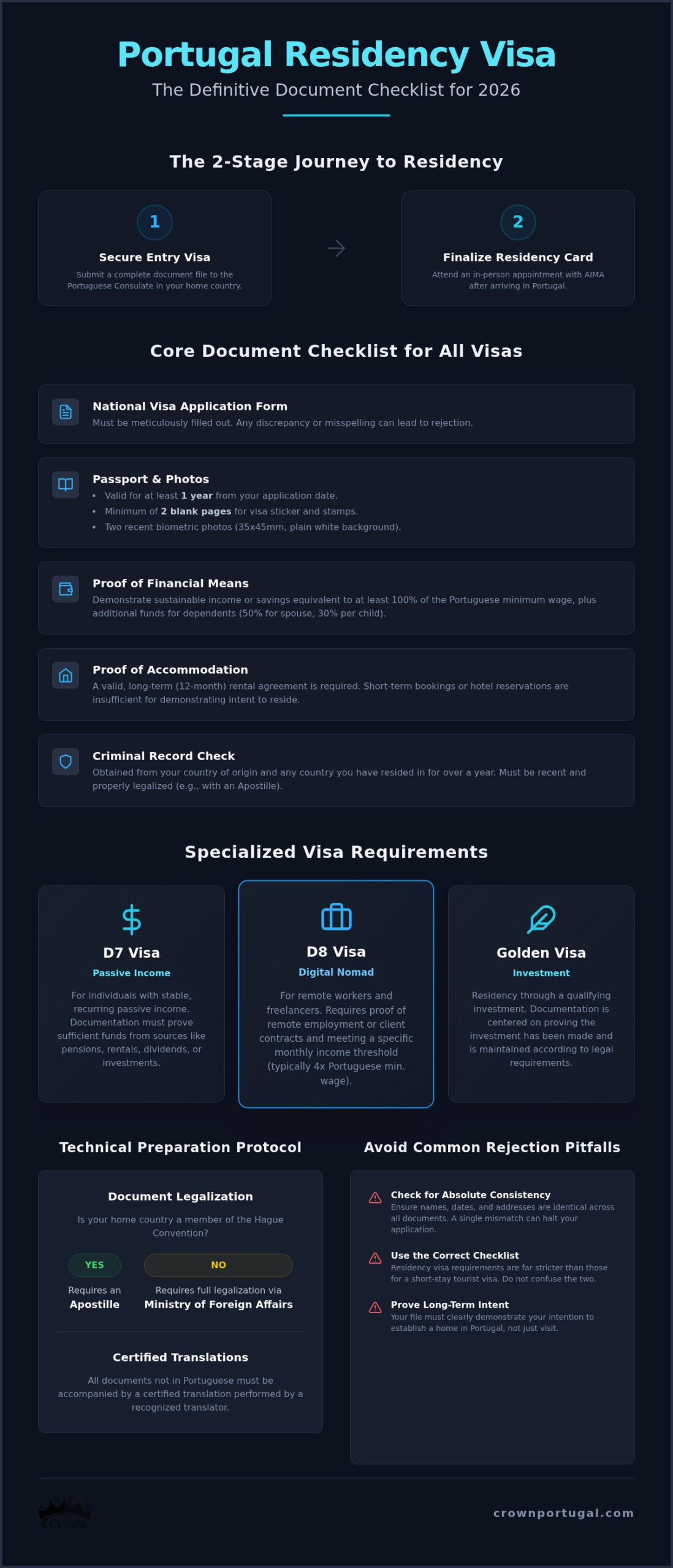
Success in this process relies on the "Consultant’s Rule," which views residency as a two-stage journey. First, you must secure an entry visa through the Portuguese consulate in your home country. Second, you must attend an in-person appointment with AIMA once you arrive in Portugal to finalize your residency card. Your documentation must be prepared to satisfy both entities, accounting for variations based on whether your home country is a member of the Hague Convention. If it is, your documents require an apostille; if not, a more complex legalization process through the Ministry of Foreign Affairs is mandatory.

The Distinction Between Short-Stay and Long-Stay Requirements
Applicants often make the mistake of using a tourist visa checklist for residency applications. This is insufficient because a National Visa requires proof of long-term "intent of stay." While a tourist visa focus is on your return flight, a residency application demands evidence of your future in Portugal. This includes a four-month entry visa validity period, which acts as a bridge while you wait for your permanent residency appointment. You’ll need to provide comprehensive proof of accommodation and financial means that go far beyond what is required for a simple vacation.
Why Precision Matters: The Cost of Administrative Errors
Even a minor discrepancy in your paperwork can cause a cascade of delays. Incomplete files directly increase the Portugal D8 visa processing time, often pushing your start date back by months. Beyond the lost time, there’s a tangible financial burden. Re-applying means paying new consular fees, obtaining fresh criminal record checks, and potentially losing deposits on Portuguese rentals. Administrative compliance is the cornerstone of a successful move. By adhering to a rigorous Portugal visa document checklist, you ensure your file is audit-ready and protected against the most common reasons for rejection.
The Core Document Checklist for All Portuguese Residency Visas
Every residency application begins with a foundation of universal requirements. Regardless of whether you’re pursuing a D7 or a D8, a standardized Portugal visa document checklist ensures your file meets the baseline expectations of the Portuguese Consulate. Accuracy is paramount here. Even a slight misspelling on the National Visa Application Form or a discrepancy between your passport and your application can trigger an immediate rejection. You’ll need to provide an original passport that remains valid for at least one year. A common error is assuming that the standard six-month validity is sufficient, but residency visas require a longer window to accommodate the processing time and the initial four-month entry period.
Identity and Travel Documentation Standards
Passport standards go beyond simple validity. Your document must contain at least two blank pages for the visa sticker and stamps. Photocopies must be high-quality and include every page, even the blank ones, to demonstrate your full travel history. Biometric photos must meet the strict 35x45mm standard with a plain white background. Disclosing your previous stays in the Schengen area is mandatory. Omissions here are often viewed as a lack of transparency, which can negatively impact the officer’s assessment of your "intent of stay."
Financial Means and Accommodation Proof
Proving subsistence in 2026 requires more than a snapshot of a bank balance. Consular officers look for income sustainability. You must demonstrate that you earn or possess at least 100% of the Portuguese minimum wage, with additional percentages for dependents. Bank statements should be stamped by the issuing institution or digitally verified. Securing your NIF registration is the essential first step that enables you to open a bank account and sign a valid lease. Your accommodation proof must be stable; a short-term Airbnb booking is rarely accepted. Instead, focus on a one-year rental contract registered with the Portuguese Tax Authority or a deed of ownership.

Finally, your file must include a federal-level criminal record certificate, such as an FBI report for US citizens. These documents usually have a strict 90-day validity window from the date of issuance. For health coverage, while standard Schengen travel insurance is the technical minimum, obtaining a plan specifically designed for residency is highly recommended. These policies ensure you’re covered for the entire duration of your initial entry visa until you can register with the national health system. Following a meticulous Portugal visa document checklist prevents these technical details from becoming roadblocks in your relocation journey.
Specialized Requirements: D8, D7, and Golden Visa Variations
While the core identity documents remain constant, the specialized portion of your Portugal visa document checklist is where the most critical nuances reside. This section defines your legal basis for residency. A failure to provide the exact evidence required for your specific visa category often results in immediate administrative refusal. Whether you’re a remote professional, a retiree, or an investor, your file must demonstrate a precise alignment with current 2026 legislative standards. Each residency path demands a unique set of proofs that verify your financial independence and legal standing.
Remote Work Evidence for the D8 Digital Nomad Visa
The D8 visa requires rigorous proof of income that exceeds four times the current Portuguese minimum wage. You must provide a tax residency certificate from your home country to prove your fiscal status elsewhere. Documentation varies depending on your professional structure. Subordinate workers need a formal employment contract, while freelancers must provide service agreements or written proposals. For a detailed breakdown of these specifics, refer to the Digital Nomad Visa Portugal requirements. Your bank statements must clearly show the recurring nature of these funds over the last three months.
Passive Income and Retirement Proof for the D7 Visa
Unlike the D8, the D7 visa focuses exclusively on passive income. The Portuguese consulate requires definitive proof that these funds are generated without active labor. For retirees, this involves official pension statements. For others, it may include dividend certificates or rental income proven through registered lease agreements. When deciding between these paths, reviewing the Portugal D8 visa vs D7 differences is essential to ensure your documentation matches your actual financial reality. Consular officers look for the "passive" nature of the income, so ensure every source is backed by legal contracts.
Golden Visa Investment and Compliance Paperwork
The Golden Visa checklist shifts focus from recurring income to capital deployment. You’ll need investment fund subscription certificates that comply with the latest 2026 regulations. A mandatory declaration from a Portuguese financial institution is required to confirm the successful transfer of funds. Additionally, you must provide clean tax record declarations from the Portuguese Tax Authority (AT) to prove you have no outstanding debts within the country. Maintaining a precise Portugal visa document checklist for investment purposes is vital for long-term compliance and successful residency renewals. This methodical approach ensures that your investment remains a secure vehicle for your relocation. For investors who appreciate the value of high-end architecture and are looking for premium residential standards, you can explore Custom Home Building to see how bespoke design-build firms deliver luxury properties.
Technical Preparation: Legalization, Translations, and Fiscal Setup
Once you’ve gathered the necessary paperwork, the next phase of your Portugal visa document checklist involves technical validation. A document issued in your home country isn’t legally recognized in Portugal until it undergoes a formal legalization process. This step is often the most time-consuming part of the preparation, yet it’s frequently overlooked by applicants who assume that original certificates are sufficient. Without proper authentication and translation, even the most accurate application will be dismissed by consular officers or AIMA officials.
The Legalization Process: Apostilles and Authentications
For citizens of countries within the Hague Convention, legalization is achieved through an Apostille. This is a specialized stamp issued by your government that verifies the authenticity of public documents, such as birth certificates and federal criminal records. If your country isn’t a signatory, you must follow a multi-step authentication path involving your local Ministry of Foreign Affairs and the Portuguese Consulate. You must ensure these legalizations are recent. A criminal record certificate, for instance, generally loses its validity for visa purposes after 90 days. Using an outdated legalization is a common technical error that results in immediate file rejection.
Translations represent another critical technical hurdle. While some consulates may review documents in English, Portuguese is the only official language for administrative procedures within Portugal. You shouldn’t rely on unofficial translations. Most documents require a certified translation performed by a recognized professional and subsequently verified by a notary or the Portuguese consulate. This ensures that the legal terminology used in your contracts and certificates aligns perfectly with Portuguese administrative standards.
Fiscal Registration and the NIF Number
The Numero de Identificação Fiscal (NIF) is the absolute prerequisite for any residency application. It’s the "key" that unlocks every other requirement on your Portugal visa document checklist, from signing a lease to opening a local bank account. Non-EU applicants must appoint a fiscal representative to obtain this number. You can simplify this requirement by using a professional registration service to secure your NIF remotely before you begin the visa process. This allows you to establish your fiscal presence in Portugal while still in your home country.
With your NIF in hand, you can proceed to open a Portuguese bank account. Most banks require proof of your NIF, a valid passport, and evidence of your profession or income. This account is vital for demonstrating your "proof of subsistence" through internal transfers, which carries more weight with AIMA than foreign bank statements alone. To ensure your technical file is complete and compliant, consider partnering with Crown Portugal for a comprehensive document review before your submission.
Finalizing Your Application: Avoiding Common Rejection Pitfalls
Assembling your file is the most labor-intensive part of the residency process, but the final review determines your success. According to Crown Portugal data from 2024 and 2025, most rejections stem from technical discrepancies rather than a lack of eligibility. Even with a comprehensive Portugal visa document checklist, the "Consistency Check" is where many applicants fail. Consular officers cross-reference every name, date, and address across 20 or more documents. If your middle name appears on your passport but is omitted from your rental contract or NIF registration, it creates an administrative mismatch that can lead to a request for additional evidence or an outright denial.
For those pursuing the Portugal D8 visa for US citizens, the FBI background check requires specific attention. Unlike state-level documents, the FBI report must receive a federal apostille from the U.S. Department of State. Timing is critical here; the lead time for federal apostilles often exceeds the 90-day validity window of the criminal record itself. You must coordinate the issuance and legalization dates with professional precision to ensure the document remains valid on the day of your consular interview.
The Consultant’s Eye: Beyond the Basic List
Consular officers often look for subjective indicators of "intent of stay" that aren’t always explicitly detailed in a basic Portugal visa document checklist. A well-crafted Cover Letter, or Statement of Purpose, serves as the narrative for your move. It should clearly explain your professional background, your choice of Portugal, and your plan for integration. Additionally, you should review your bank statements for "red flag" transactions. Large, unexplained deposits without a documented source can raise questions about the legitimacy of your funds. Providing a clear trail for your capital demonstrates the transparency that Portuguese authorities expect.
How Crown Portugal Streamlines the Documentation Process
Crown Portugal acts as a steadfast partner, transforming a chaotic stack of papers into an "Audit-Ready" submission file. We provide an exhaustive review of every translation and apostille to ensure they comply with current 2026 standards. Our methodical approach covers the following essential services:
- Line-by-line consistency audits of all identity and financial documents.
- Direct facilitation of NIF and NISS registration to establish your fiscal foundation.
- Assistance with local accommodation registration to meet strict residency proof standards.
- Expert guidance on presenting your folder during the consular interview to project professional competence.
Securing Your Future in Portugal with Administrative Precision
Achieving residency in 2026 requires more than just gathering paperwork; it demands a process-oriented mindset where every detail is accounted for. By following a structured Portugal visa document checklist, you ensure that your file meets the rigorous standards of both the consulate and AIMA. Successful applications are built on the foundation of early NIF registration and meticulous document legalization. These steps, combined with a final consistency audit, eliminate the technical errors that lead to avoidable rejections.
Crown Portugal brings over five years of specialized experience to your relocation journey. Our team provides comprehensive NIF and NISS registration services alongside expert document review to ensure your file is audit-ready. We offer national coverage for all residency categories, including the D7, D8, and Golden Visas. Download our Expert-Vetted Residency Checklist or Book a Consultation today to begin your move with absolute confidence. Portugal is ready to welcome you.
Frequently Asked Questions
Do I need to translate my documents into Portuguese?
Yes, you must translate all official documents into Portuguese if they’re issued in another language. While some consulates occasionally review English documents during the initial interview, the final residency file processed in Portugal requires certified translations. These translations must be performed by a recognized professional and often require notarization or consular authentication to be legally valid. Using uncertified translations is a common cause for administrative delays and file rejections.
How long is a criminal record check valid for a Portugal visa?
A criminal record certificate is generally valid for 90 days from the date of issuance. This strict window applies to both the original document and its corresponding apostille or legalization. You must coordinate your application timeline carefully to ensure the certificate remains valid when you submit your file. If the 90-day period expires before your consular appointment, you’ll need to obtain a fresh report and have it legalized again.
Can I apply for a Portugal residency visa without a NIF?
No, you cannot successfully apply for a residency visa without first obtaining a Numero de Identificação Fiscal (NIF). This tax identification number is the essential foundation for your entire Portugal visa document checklist. It allows you to open a local bank account, sign a rental agreement, and register with the tax authorities. Most applicants secure their NIF remotely through a fiscal representative before starting the formal visa application process.
What is an Apostille and do I really need one for every document?
An Apostille is a specialized certificate issued by your home government that authenticates public documents for use in Portugal. You don’t need one for every document; however, it’s mandatory for official records like criminal background checks, birth certificates, and marriage licenses. For countries not part of the Hague Convention, a more complex multi-step legalization through the Ministry of Foreign Affairs and the Portuguese Consulate is required to validate your paperwork.
Is a hotel reservation sufficient proof of accommodation for residency?
A standard hotel reservation is almost never sufficient proof of accommodation for a residency visa. Portuguese authorities require evidence of long-term housing, typically a rental contract registered with the tax authority for a minimum of 12 months. Alternatively, you can provide a property deed if you own a home or a Statement of Responsibility if a Portuguese resident is hosting you. Short-term bookings lack the stability required for approval.
What happens if one document is missing during my visa appointment?
Missing a single document can lead to an immediate rejection or a formal request for additional information. If the consular officer allows it, you might be given a short window, often 10 working days, to submit the missing paperwork. However, this isn’t guaranteed and frequently results in your application being moved to the back of the queue. Ensuring your Portugal visa document checklist is complete is the best way to avoid delays.
Does the Portugal visa document checklist change for US citizens?
The core requirements remain similar, but US citizens face specific procedural nuances regarding criminal records. You must provide a federal FBI background check rather than local or state-level reports. This FBI document requires a federal apostille from the U.S. Department of State in Washington, D.C., which has different processing times than state-level apostilles. US applicants also need to ensure their health insurance specifically covers repatriation and meets residency standards.
How much money needs to be in my Portuguese bank account for the D7 visa?
You should maintain at least the equivalent of 12 months of the Portuguese minimum wage for the primary applicant. If you’re applying with family, you must add 50% of that amount for a spouse and 30% for each dependent child. While showing these funds in a Portuguese bank account isn’t always a strict consular requirement for the initial entry visa, it’s highly recommended to demonstrate your financial commitment and ease the final residency appointment.