

Portugal Visa Processing: Legal Timelines & Duties

A duty to move a case forward is not, by itself, a fixed deadline for a final decision. The same provision further requires the Administration to promote the necessary steps for the case to proceed toward a decision. In Portugal visa processing, that distinction matters: a procedural duty and a legally set decision period are not interchangeable.
It is understandable to expect a clear timeline when an application is pending. The relevant question, however, is not only how long a decision takes, but also what the Administration must do to advance the case and how court opinions or decisions affect that duty. This article explains the difference between procedural progress and a deadline, and how severability may affect which provisions apply.
You will also learn how to consider these legal concepts without treating a court’s view in one dispute as an automatic outcome for every visa application. The discussion focuses on the relationship between the provision’s wording, the court’s reasoning, and the Administration’s next procedural steps, helping you understand what the duty requires and what it does not establish on its own.
Key Takeaways
- Understand why the duty to move a case forward requires procedural action but does not, by itself, promise a particular decision.
- Learn how to identify the authority responsible for handling the application at its current stage.
- Distinguish deadlines for procedural steps from the time required to reach a final decision.
- See why administrative inactivity must be assessed in its procedural context before drawing conclusions about its consequences.
- Explore how court opinions, decisions and severability can shape the duties that apply to a visa proceeding.
What does “promote the necessary steps” mean in this provision?
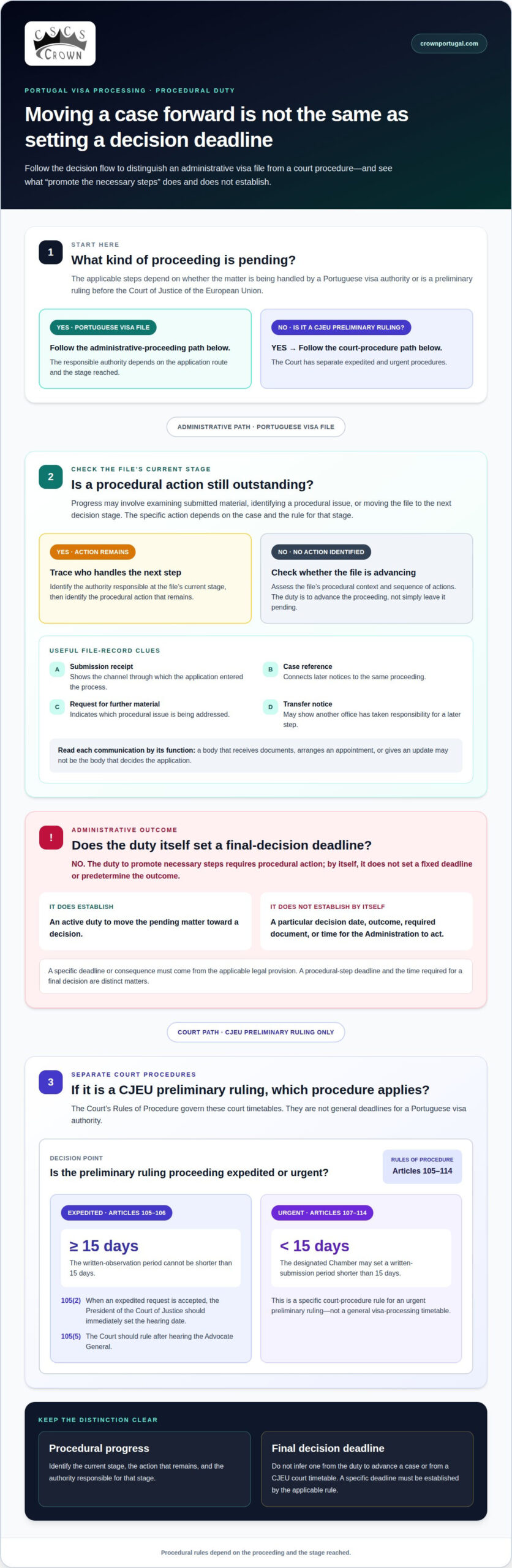
The phrase describes an active procedural duty: the Administration must take steps to move a pending matter toward a decision. It does not, by itself, set a fixed deadline or predetermine the outcome. In a visa file, progress could involve examining submitted material, identifying a procedural issue, or moving the file to the next decision stage. The specific action depends on the case and the rule governing that stage.
The wording should be read as a requirement to advance the proceeding, not simply leave it pending. For example, if an application requires a further procedural step, the relevant question is whether that step has been identified and addressed. The phrase alone does not establish which document is required, who must provide it, or how long the Administration has to act. Those details depend on the applicable procedure.
It is also important to distinguish administrative visa processing from proceedings at the Court of Justice of the European Union. The Court has separate procedures for preliminary rulings. Articles 105-106 of its Rules of Procedure govern the expedited procedure, while Articles 107-114 govern the urgent procedure. These are court procedures, not general deadlines for a Portuguese visa authority.
These court procedures show how “promoting” a matter can involve concrete procedural steps:
- Under Article 105(2), when an expedited preliminary ruling request is accepted, the President of the Court of Justice should immediately set the hearing date.
- Under Article 105(5), the Court should rule after hearing the Advocate General in an expedited case.
- In an urgent preliminary ruling procedure, the designated Chamber may set a written-submission period shorter than 15 days.
The differences matter. The expedited procedure’s written-observation period cannot be shorter than 15 days, while the urgent procedure permits a shorter period. These specific rules apply to proceedings before the Court of Justice; they do not establish that a visa application in Portugal must receive a decision within 15 days. A procedural step and a final decision deadline are distinct matters.
For a pending visa file, the practical focus is the sequence of actions: what stage the application has reached, what procedural action remains, and whether the matter is moving toward a decision. The phrase supports an expectation of procedural progress, but the applicable legal provision must establish any specific deadline or consequence. A court’s accelerated timetable cannot automatically be applied to an administrative visa proceeding.
Which administrative authority is responsible for moving the case toward a decision?
Responsibility rests with the competent administrative authority handling the proceeding, not with every public body connected to the applicant. In a Portugal visa matter, the application route and the stage reached identify the responsible authority. The wording “the Administration” refers to the public decision-making side of the proceeding. It does not, by itself, name one office for every visa category.
The distinction between an administrative authority and a supporting body matters. A body that receives documents, communicates an appointment, or provides a file update may not decide the application. The relevant question is which authority is responsible for the decision-making step. A transfer between offices can change who performs the next action, while the legal duty remains with the authority responsible for that stage.
For example, consider a file that has been received but has not reached substantive assessment. The office managing intake may record the submission and route it onward. If another authority handles the assessment or decision, the intake step alone does not establish that the first office controls the entire proceeding. The file’s procedural stage helps distinguish administrative handling from decision-making responsibility.
In practice, the authority can be traced through the file’s records and communications:
- The submission receipt identifies the channel through which the application entered the process.
- A case reference connects later notices to the same administrative proceeding.
- A request for further material indicates which procedural issue is being addressed.
- A transfer notice can show that another office has taken responsibility for a subsequent step.
These indicators help explain the file’s route, but read the name on a communication alongside its function. A sender may provide information without deciding the application. A notice requesting action may concern a specific stage, rather than the final outcome. This distinction is especially relevant when the applicant receives messages from more than one public office during processing.
The duty to advance a case should therefore be assessed against the role of the authority responsible at the relevant point. If an administrative step remains outstanding, identify which body is assigned to perform it and whether the file has moved to another stage. A court, including the Court of Justice of the European Union, has a different role from the administrative authority processing a visa file. Court procedures do not make the Court responsible for routine visa processing in Portugal.
For applicants, this distinction provides a practical framework for understanding procedural responsibility: follow the file reference, the function of each notice, and any recorded transfer. These details help separate administrative communication from the authority’s decision-making role, without assuming that every office involved controls the entire application.
What deadlines apply to the Administration’s procedural steps and final decision?
A deadline for a procedural step is not automatically a deadline for the final decision. For a Portugal visa file, identify the rule governing the application and the particular stage in question. A time limit for submitting documents, for example, applies to that submission step. Without a separate applicable rule, it does not establish when the authority must decide the application.
The timelines discussed here apply to Court of Justice proceedings, not to Portuguese visa applications generally. This distinction is essential. Court rules for preliminary rulings concern proceedings before the Court of Justice of the European Union. They are not a visa authority’s processing timetable simply because both processes involve administration or a pending matter.
For requests for preliminary rulings requiring particularly expeditious handling, paragraphs 30-36 of the Court of Justice Recommendations supplement its Rules of Procedure. In an expedited preliminary ruling procedure, the period for submitting written observations or statements of case cannot be shorter than 15 days. That minimum concerns written submissions in that court procedure. It does not set a 15-day deadline for the Administration to take a step or issue a visa decision.
When assessing a pending file, separate the relevant dates and actions rather than treating them as one countdown:
- The date an application or document was submitted records a filing event.
- A notice requesting material concerns the response step identified in that notice.
- A court deadline, such as the 15-day minimum for expedited written observations, applies to the court procedure stated in the rule.
- A final decision date requires a deadline that applies to the specific administrative proceeding.
For example, if a visa applicant receives a request for further information, the response period and the authority’s later decision are separate issues. The request may specify what the applicant must submit and by when. Assess the decision period under the rule governing that visa proceeding, not by inferring it from the submission period or a Court of Justice timetable.
This distinction also helps clarify delays. Missing a deadline for one procedural action may raise a different issue from a decision that remains pending. Ask which action has a stated time limit, who must perform it, and what event starts that period. A deadline cannot be calculated reliably without identifying these elements in the applicable rule or notice.
Accordingly, the court timelines above provide a precise comparison, not a universal visa-processing clock. For a Portuguese visa application, assess each procedural deadline separately from the time for a final decision. Do not transfer the Court of Justice’s 15-day submission minimum to an administrative visa file.
What happens if the Administration fails to promote the case toward a decision
If a Portuguese visa file stops progressing, first identify the action that remains outstanding. The provision describes a duty to advance the proceeding, but does not itself say that administrative silence equals approval. Nor does the wording alone establish that every delay invalidates the application. The consequences depend on the rule governing the proceeding and the stage where progress stopped.
Consider an application with a recorded submission but no later procedural activity. The timeline can help show when the file entered the process and what has happened since, but it does not explain why the next step has not occurred. The file could be awaiting review, a response, or action by an authority responsible for another stage. Distinguishing these situations is central to assessing inactivity.
A useful assessment separates the authority’s actions from steps assigned to the applicant. For example, a notice requesting a document identifies a task and its subject. If the response is submitted, the record can show that the applicant completed that step. The next question is whether the proceeding advanced afterward or another procedural issue remains. Consider any gap in activity alongside the file’s actual sequence.
For a clear record, organise the relevant events by date and function:
- The application receipt establishes the submission event and reference.
- A later notice identifies an administrative request or procedural action.
- The applicant’s response records whether that requested step was completed.
- Subsequent communications show whether the file moved to another stage.
This sequence helps distinguish an unexplained pause from a file awaiting a specified response. For instance, if a notice requests further material and no response appears, the file’s status differs from one where the requested material was submitted. If the response is recorded, its date and contents help establish what happened next. These facts inform the assessment; they do not independently decide whether the Administration breached its duty.
A court’s opinion or decision can matter when it interprets the provision or addresses its application to a dispute. Its relevance depends on the legal issue and the proceeding involved. The Court of Justice of the European Union’s preliminary-ruling procedures are distinct from routine administrative visa processing, so a ruling in that setting should not be treated as an automatic decision on an individual visa file.
Accordingly, a failure to advance a file raises a question about procedural compliance, not an automatic outcome. Identify the pending action, the responsible stage, and the record of communications before drawing conclusions. The next section considers how possible remedies relate to delay and the particular administrative proceeding.
What remedies are available for unreasonable delay in an administrative proceeding
The appropriate response to delay depends on the proceeding, the action still pending, and the legal route available. A Portuguese visa applicant should distinguish practical follow-up from a formal legal remedy. A request for a status update can clarify whether the file awaits assessment, an applicant’s response, or another administrative step. It does not itself establish that a legal deadline has been breached.
A useful first step is to create a clear chronology. Record the application submission, reference number, notices received, responses sent, and any later communication. For example, a timeline showing that a requested document was submitted can help distinguish an unanswered file from one awaiting action by the applicant. Keep copies of notices and proof of delivery together to create a coherent procedural history.
The next step can be a focused written enquiry to the authority handling the file. Include the application reference, state the date of the last recorded event, and ask which procedural stage remains pending. A precise enquiry is more useful than a general demand for approval. It seeks information about progress without assuming that silence means acceptance or that the decision must be favourable.
If the authority’s response does not resolve the delay, the matter may require assessment under the rules governing that specific proceeding. The relevant questions include whether a statutory decision period applies, what event starts it, whether it has expired, and whether any action remains outstanding from the applicant. These details affect whether a formal administrative or judicial route is available and what relief it could address.
Keep possible objectives distinct. An applicant may seek progress on a pending procedural step, a decision on the application, or review of an alleged failure to act. These outcomes are not interchangeable. A request to move a file forward does not itself determine eligibility, replace required evidence, or guarantee a residence permit. The legal basis and record shape the remedy sought.
- Preserve the application receipt, reference, notices, and submitted responses.
- Set out the timeline and identify the last completed procedural action.
- Ask the responsible authority for the current stage and outstanding action.
- Assess formal routes against the rule governing the application and the relief needed.
For example, a file with no recorded response to an evidence request calls for a different analysis from one where the response is documented. The chronology helps clarify that difference, while the applicable procedure determines the legal significance. Crown Portugal can help applicants understand visa-process requirements and organise the information relevant to their application. For support with your Portugal visa application, request immigration application assistance.
Crown Portugal
Crown Portugal helps applicants understand Portugal visa requirements and prepare their applications. If a file is delayed, clear application records and an understanding of its procedural stage can help clarify what remains to be addressed. Immigration consultancy can support the visa process, but it does not replace legal representation in court or determine the Administration’s decision.
Whether you’re considering the Portugal Digital Nomad D-8 Visa, Portugal Passive Income D-7 visa, or another immigration route, Crown Portugal can help you understand the application requirements relevant to your plans. This support is most useful when you need guidance with the visa process, rather than a guarantee of timing or approval.
Contact Crown Portugal to discuss support with your Portugal visa application.
Choose a clear next step for your Portugal plans
A pending visa matter is easier to assess when your next step reflects both the application and your wider plans in Portugal. Keep procedural questions separate from decisions about your immigration route. The provision further requires the Administration to take the necessary steps for the case to proceed toward a decision. How that duty applies depends on the proceeding and its circumstances.
Crown Portugal provides support for entrepreneurs applying for D-2 visas or setting up startups via Tech Visa programs. These offerings address different needs, so the relevant starting point is the purpose of your move and the administrative support you require.
If you’re ready to discuss your circumstances and possible next steps, contact Crown Portugal to discuss your case. A focused conversation can help you consider the appropriate direction for your Portugal plans. Move forward with a clearer understanding of the process and the decisions ahead.
Frequently Asked Questions
What legal provision says the Administration must promote steps for a case to proceed toward a decision?
The quoted wording alone doesn’t identify a numbered Portuguese visa provision. Its legal source must be established from the full text and context in which it appears, including the proceeding it governs. Don’t attribute it to Article 23a of the Statute of the Court of Justice of the European Union: that article concerns changes to the Court’s Rules of Procedure, not a general visa-processing duty in Portugal.
What steps must the Administration take to advance an administrative case?
The required steps depend on the file’s stage and its governing procedure. For example, progress might involve addressing an outstanding procedural issue or moving the file to the next stage. The quoted duty does not, by itself, set a universal checklist for every Portugal visa application. To understand what action is relevant, consider the procedural notice, the application record, and the rule applicable to that particular step.
Can a party request that the Administration move the case forward?
A party can send a focused written enquiry to the authority handling the file, identify the application reference, and ask about its procedural status. For example, the enquiry can ask whether a submitted response has been received or whether an action remains pending. Keep the enquiry factual and retain a copy. Sending it does not itself establish that a deadline has expired or require a particular decision.
How do courts interpret this duty to advance a case toward a decision?
Courts interpret a duty in the context of the provision and proceeding before them. The wording, procedural history, and action still pending can all matter to the legal issue under review. A ruling about a Court of Justice procedure should not automatically be applied to an individual Portugal visa application. Its relevance depends on whether the court addressed the same legal rule and comparable procedural circumstances.
Portugal Residency for Minor Children: A Family Guide – Crown Portugal at 10:50 am, November 19, 2026 -
[…] Portugal Visa Processing: Legal Timelines & Duties […]