

Portuguese citizenship application under the new rules

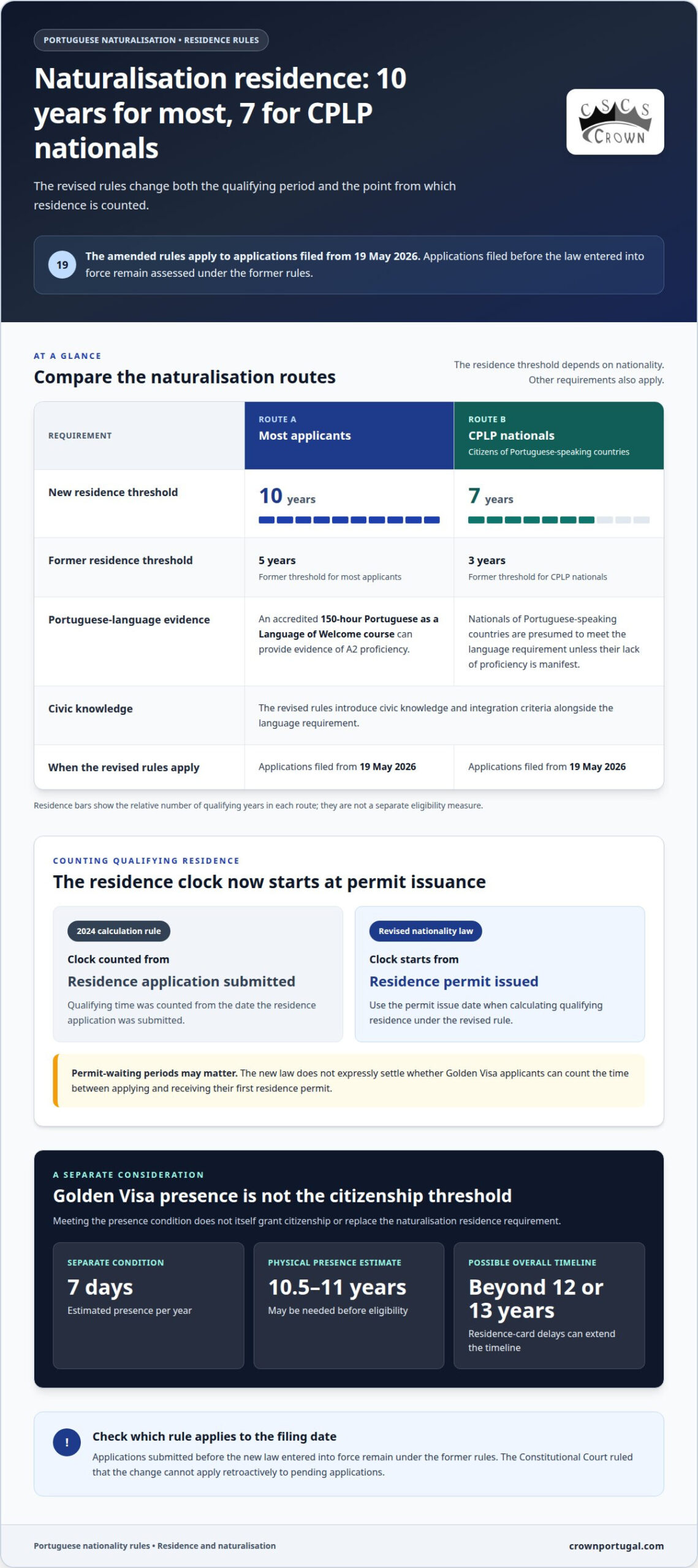
For most applicants seeking naturalisation, the Portuguese citizenship application under the new rules requires 10 years of residence. The amended law applies to applications filed from 19 May 2026, and the residence period is counted from the date the residence permit is issued. CPLP nationals have a separate 7-year residence requirement.
A longer residence period is only one part of the assessment. Applicants also need to understand the Portuguese language and civic knowledge requirements. Marriage or a legally recognised partnership with a Portuguese citizen follows a separate eligibility route.
This guide explains how the residence clock works, what language and civic evidence may be relevant, and how eligibility through marriage differs from naturalisation. It also outlines the filing and tracking stages, so you know what happens after submission and how to interpret progress updates.
Key Takeaways
- An accredited 150-hour Portuguese as a Language of Welcome course can serve as evidence of A2 Portuguese proficiency; the revised rules also introduce civic knowledge requirements.
- Marriage or a recognised partnership with a Portuguese citizen can provide a separate route, with eligibility generally requiring more than three years of marriage or partnership.
- Applicants in a qualifying relationship of five years or more generally do not need to meet the language-test or ties requirements.
- Application tracking includes an initial completeness check, estimated at 2-6 weeks, followed by official checks that may take 4-12 weeks depending on case complexity.
- Organising evidence for the applicable route and submitting a complete file helps you understand the stages your application will pass through.
Has the A2 Portuguese language requirement changed?
The revised nationality law retains a Portuguese-language knowledge requirement and adds civic knowledge and integration criteria. For naturalisation, the largest change is the residence threshold: most applicants now need 10 years, while CPLP nationals need 7 years.
Portuguese Language Knowledge
Portuguese-language knowledge means demonstrating sufficient ability in Portuguese for a nationality application. From 19 May 2026, applicants must prove this knowledge, and an accredited 150-hour Portuguese as a Language of Welcome course can provide evidence of A2 proficiency. Nationals of Portuguese-speaking countries are presumed to meet the language requirement unless their lack of proficiency is manifest, according to Imprensa Nacional-Casa da Moeda (INCM). This matters because language evidence remains distinct from the newer civic knowledge assessment.
Residence Periods by Nationality
For most naturalisation applicants, the new residence requirement is 10 years. CPLP nationals, meaning citizens of Portuguese-speaking countries, have a 7-year threshold under the revised rules. Residence requirements can differ depending on an applicant’s circumstances, so it is worth checking which route applies. The difference depends on nationality, so applicants should identify the route that applies before assessing their residence history.
The residence clock also has a new starting point. Under the new nationality law, it begins when the residence permit is issued. This differs from the 2024 calculation rule, which counted qualifying time from the date a residence application was submitted. For example, someone whose permit was issued after a pending application may need to calculate qualifying residence from the permit issue date under the revised rule.
Legal residence remains central to naturalisation. Portugal generally recognises residence based on permits, visas, or other legal immigration statuses provided for under its immigration law. Holding a visa alone does not determine which periods qualify. The key question is whether the period represents a recognised legal status under the applicable rules.
Transition Dates and EU Comparisons
Portugal’s Parliament approved the revised nationality law on 1 April 2026, and the President promulgated it on 3 May 2026. Organic Law No. 1/2026 was published on 18 May, and the amended rules apply to applications filed from 19 May 2026. Applications submitted before the new law entered into force should be assessed under the former five-year rule; the Constitutional Court ruled that the change cannot apply retroactively to pending applications.
How do Portugal’s citizenship requirements compare with those of other EU countries? EU nationality rules are set nationally, so residence and language conditions differ between countries. Portugal’s relevant comparison is its own route: 10 years for most naturalisation applicants, 7 years for CPLP nationals, plus language and civic knowledge requirements.
How long to live in Portugal for citizenship?
The revised rules extend the usual naturalisation residence threshold from five to 10 years, or seven years for CPLP nationals. Common refusal grounds include insufficient qualifying residence, missing evidence, or criminal and security exclusions; any challenge should address the refusal’s stated grounds and follow the route and deadline in the decision.
Changes to Residence Thresholds
The residence threshold is the period of qualifying legal residence required before naturalisation, and it determines when an application can be filed. Under the revised nationality law, most foreign nationals need 10 years, while CPLP nationals need seven years. The former thresholds were five years for most applicants and three years for CPLP nationals. The change can delay eligibility for residents who planned around the previous periods.
The calculation now starts on the date the residence permit is issued. Portugal’s 2024 rule counted qualifying time from the date a residence application was submitted, so the starting point has changed. The new law does not expressly settle whether Golden Visa applicants can count the period between applying and receiving their first residence permit. That gap may affect a person’s eligibility calculation.
Golden Visa holders have a separate residence-presence condition, estimated at seven days per year. Meeting that condition does not itself grant citizenship or replace the naturalisation residence threshold. Estimates indicate applicants may need 10.5-11 years of physical presence before eligibility, while residence-card delays can extend the overall timeline beyond 12 or 13 years.
Applicants Affected by the New Rules
The new periods apply to naturalisation applications filed from 19 May 2026. Applications filed before the law entered into force remain assessed under the former five-year rule, and the Constitutional Court ruled that the change cannot apply retroactively to pending applications. The filing date therefore matters alongside nationality and the date a residence permit was issued.
For people already living in Portugal, the longer threshold may shift the earliest filing date, particularly if their immigration history includes time awaiting a permit. Legal residence may be based on a residence permit, visa, or another status provided for under Portuguese immigration law. Distinguish qualifying years of legal residence from time spent physically in the country.
A refusal may result if the applicant has not completed the relevant residence period, cannot establish qualifying status, or does not meet criminal-background or security requirements. Under the revised rules, a criminal sentence of three years or more disqualifies a naturalisation applicant. Review the stated reason for refusal carefully: any appeal or review should address the disputed residence calculation, supporting records, or applicable exclusion. Follow the decision’s instructions for the available route and deadline. An appeal cannot replace a missing eligibility requirement.
Portuguese language and civic knowledge tests
Naturalisation applicants must prove Portuguese-language knowledge, and the revised law adds requirements for civic, cultural, and historical knowledge. These assessments are separate from the residence period and affect which evidence belongs in a nationality application.
Civic Knowledge Assessment
The civic knowledge assessment covers Portuguese history, democratic institutions, and civic rights and duties. The revised nationality law adds this integration-related knowledge alongside the language requirement. Keep the subjects distinct when preparing evidence: Portuguese proficiency demonstrates language ability, while the civic assessment concerns understanding Portugal’s public life and institutions.
The assessment format is not specified here, so do not assume it takes a particular written or oral form. The stated subject areas offer a practical framework for understanding civic knowledge. For example, democratic institutions and civic duties are distinct topics, even though both relate to participation in Portuguese society.
Language and Cultural Knowledge
Portuguese-language knowledge is evidence of sufficient proficiency for nationality purposes, while cultural knowledge forms part of the broader integration requirement. From 19 May 2026, applicants for Portuguese nationality must prove language knowledge. This matters to naturalisation applicants because meeting the residence threshold alone does not replace the separate language and civic criteria.
The CIPLE A2 exam is one way to demonstrate Portuguese proficiency. Its reported pass score is 55% or above, and it is typically held three times a year, in May, July, and November. Completing an accredited 150-hour Portuguese as a Language of Welcome course can also serve as evidence of A2 proficiency.
Nationals of Portuguese-speaking countries are presumed to meet the language requirement unless their lack of Portuguese proficiency is manifest, according to Imprensa Nacional-Casa da Moeda (INCM). This presumption concerns language; it does not establish that the applicant meets every other nationality criterion.
The new language, culture, and civic integration requirements generally apply to naturalisation based on legal residence and applications by grandchildren of Portuguese citizens. They generally do not apply to applications by children of Portuguese citizens or through marriage or a legally recognised de facto union. Exceptions to the civic, cultural, and historical tests also cover minors, older applicants, and children and grandchildren of Portuguese citizens.
For an applicant with a language certificate or course record, the relevant point is whether that evidence demonstrates the required proficiency. A CIPLE result and completion of an accredited course are identified forms of A2 evidence. They address language ability, not the separate civic topics of Portuguese history, democratic institutions, rights, and duties.
CPLP nationals benefit from the stated language presumption, but language and integration remain distinct. The applicant’s route determines which requirements apply, and the civil registry handles nationality applications. Match each piece of evidence to the requirement it demonstrates rather than treating one certificate as proof of every aspect of integration.
Citizenship through marriage or a recognised partnership
Marriage or a legally recognised partnership with a Portuguese citizen may provide a nationality route separate from naturalisation through residence. The relationship’s legal status and duration determine whether the relevant threshold is met.
From 19 May 2026, a person married to a Portuguese citizen for over three years may apply on that basis. A person in a recognised civil union with a Portuguese citizen may also apply after over three years. For a Portuguese de facto union, applicants need proof of three years of cohabitation.
These routes depend on the relationship, not on completing the standard 10-year naturalisation period. A couple married for four years, for example, exceeds the stated three-year marriage threshold. A couple in a de facto union must establish the required cohabitation period, rather than relying only on the length of their relationship.
Relationship duration can also affect language and ties requirements. Applicants who have been together for five years or more generally do not need to meet those requirements. The amended law’s language, culture, and civic integration requirements generally do not apply to applications through marriage or a legally recognised de facto union. The three-year eligibility threshold and the five-year exemption address different parts of the application.
For an application based on marriage, the relevant period is the duration of the marriage to the Portuguese citizen. For a civil union, the relationship must be legally recognised; for a de facto union, the stated evidence concerns three years of cohabitation. These are related but distinct tests. Identify the correct status to understand which threshold applies before assembling the nationality application.
Claims involving children or adoption raise issues distinct from the spouse or partner route. A child’s nationality claim is not measured by the applicant’s marriage or cohabitation period. Similarly, adoption does not establish the three-year relationship threshold described here. Keep these legal bases separate when assessing family circumstances and the appropriate nationality route.
Previous residence history may still matter to an applicant’s wider circumstances, but the marriage-based threshold is tied to the qualifying relationship. A spouse who has lived in Portugal for fewer than 10 years can still assess this separate route after the required marriage period. The route is based on marriage or recognised partnership with a Portuguese citizen, not simply residence in Portugal.
Where relationship status, legal recognition, or cohabitation records are complex, advice can help clarify which route and threshold apply. The distinction is straightforward: more than three years for marriage or a recognised partnership, proof of three years’ cohabitation for a de facto union, and generally five years together for the language-test and ties exemption.
Application filing and case tracking
A complete nationality file allows the registry to assess eligibility and begin its checks. For a Portuguese citizenship application under new rules, the filing date also determines which transition provisions apply.
Required Application Documents
Application documents establish identity, the nationality route, and the conditions supporting eligibility. Missing or unclear evidence can prevent the registry from treating a file as complete.
The documents required depend on the route. A naturalisation file should support identity, qualifying residence, language evidence, and applicable civic requirements. An application based on marriage needs evidence of the relationship and its duration. A de facto union requires proof of three years of cohabitation. Foreign criminal record certificates may also be relevant to background checks.
Organise records by what they establish: identity, route, residence history, or relationship status. Documents issued in other countries may need authentication, an apostille, or translation for use in Portugal. The file’s completeness matters because the 90-day decision target under the 2026 reform starts after confirmation that the application is complete.
Fees and Processing Times
Application costs and processing times relate to separate stages, from preparing supporting documents to registry review. Understanding these stages helps distinguish preparation from the official decision period.
These are document-related costs, not a single total for every application.
After submission, the initial completeness check is estimated at 2-6 weeks. Official checks may take 4-12 weeks, depending on complexity. Overall nationality processing is estimated at 2-3 years. The 2026 reform’s 90-day target for deciding a complete file starts after completeness is confirmed, so it differs from the wider processing estimate.
Keep the submission confirmation and any registry reference provided at filing. Use these details to identify the case when requesting a status update, and save subsequent requests and responses together. If the registry asks for additional records, this may affect when the file is considered complete and when the decision target begins.
For a Portuguese citizenship application under new rules, the submission date remains important when a file is pending. An application filed before 19 May 2026 falls under the transition rules, so keep proof of filing alongside the registry reference. These records help establish the date the application entered the process and provide a clear basis for tracking its status.
Crown Portugal: Portugal Nationality under new rules
Crown Portugal can help you understand how Portugal’s nationality rules relate to your residence pathway and application preparations. This is useful when you’re assessing whether your route, residence history, or supporting records align with the applicable requirements. For those planning a move to Portugal, its services include the Portugal Digital Nomad D-8 Visa, Portugal Golden Visa D-9, and Portugal Passive Income D-7 visa. NIF Registration can also support tax administration in Portugal.
Crown Portugal can help you understand the immigration steps connected to your plans, including how a residence route relates to longer-term nationality eligibility. The right starting point depends on your circumstances and intended pathway.
Contact Crown Portugal to discuss your plans for Portuguese nationality and the related immigration steps.
Build a clear plan for your next step
A Portuguese citizenship application under the new rules is easier to manage when your next decision reflects your route, records, and longer-term plans in Portugal. Consider how your residence pathway connects with your intended nationality route, and keep your supporting documents organised as your circumstances develop. A clear plan helps you approach each administrative stage with purpose.
Crown Portugal can help you understand the immigration steps related to your plans and how they fit into your broader goals. If you’re considering a move, arranging residence, or preparing for a future nationality application, guidance can help you focus on the relevant pathway and its requirements. Start with a conversation about your objectives and situation.
Contact Crown Portugal for guidance on your Portugal plans. With a considered approach and the right information, you can move forward with greater clarity and confidence.
Frequently Asked Questions
Can I keep my current citizenship?
Whether you can retain your current citizenship depends on the laws of that country as well as the rules governing Portuguese nationality. Before applying, find out whether your country permits dual nationality or requires notification or renunciation. The Portuguese application does not determine how another country treats your citizenship status. For example, a person with citizenship in two countries must consider the rules of both, not only Portugal’s.
Do I have to pass a test to become Portuguese?
Naturalisation generally requires proof of Portuguese-language knowledge and, under the revised rules, civic, cultural, and historical knowledge. A CIPLE A2 exam is one way to demonstrate language proficiency, while an accredited 150-hour Portuguese as a Language of Welcome course can also provide A2 evidence. Exceptions apply to some groups, including children of Portuguese citizens and applicants through marriage or a recognised de facto union.
Does the new law affect an application I have already filed?
An application filed before the amended law entered into force should be assessed under the previous rules. Portugal’s Constitutional Court ruled that the revised law cannot apply retroactively to pending citizenship applications. Keep the filing confirmation and registry reference with your records to help establish when the application was submitted. For this transition question, the filing date is central, not a later status update.
How many years of residence do I need to apply for naturalisation?
Under the revised rules, most naturalisation applicants need 10 years of residence, while CPLP nationals need seven years. The residence period starts from the date the residence permit is issued. This starting point matters if there was a gap between submitting a residence application and receiving the permit. Eligibility also depends on meeting the other requirements applicable to the applicant’s route.
I’m Brazilian. Does the new 7-year CPLP timeline apply to me?
Yes. Brazil is a Portuguese-speaking country, so Brazilian nationals fall within the CPLP group covered by the seven-year naturalisation residence threshold under the revised rules. The residence clock starts on the date the residence permit is issued. Nationals of Portuguese-speaking countries are presumed to meet the language requirement unless their lack of Portuguese proficiency is manifest, according to Imprensa Nacional-Casa da Moeda (INCM).
I’ve already been here for 5 years. Can I still apply under the old rules?
Having five years of residence alone does not preserve access to the previous threshold. The former rule applies to applications submitted before the amended law entered into force; applications filed from 19 May 2026 follow the new rules. If you have not submitted an application, assess your eligibility using the current threshold and the date your residence permit was issued, rather than residence duration alone.
What are Portugal’s latest citizenship law changes, and when do they take effect?
Portugal’s Parliament approved the revised Nationality Law on 1 April 2026, and the President promulgated it on 3 May 2026. Organic Law No. 1/2026 was published on 18 May 2026, and the amended rules apply to applications filed from 19 May 2026. Key changes include longer naturalisation residence periods and language, civic, cultural, and historical knowledge requirements for relevant routes.
Who qualifies for Portuguese citizenship under the new rules?
Eligibility depends on the legal route. Naturalisation applicants must meet the relevant residence period and other applicable requirements; marriage or a recognised partnership with a Portuguese citizen offers a separate route. Portuguese nationality may also be available through family descent, subject to the conditions for that route. For naturalisation, most applicants need 10 years of residence, while CPLP nationals need seven years under the revised rules.