

Portugal D7 Visa Passive Income: The Definitive 2026 Residency Guide

Relying on outdated residency advice is the fastest way to face a document rejection in the current administrative climate. As of 2026, the Portuguese minimum wage has risen to €920 per month, directly impacting the financial thresholds for every applicant. You likely understand that securing a future in Portugal offers unparalleled access to the Schengen Area, yet the transition from SEF to AIMA has left many feeling uncertain about their fiscal setup. It’s a common concern that a single missing document or an incorrectly structured bank deposit could derail your entire relocation timeline.

This guide provides the professional clarity you need to master the Portugal D7 visa passive income requirements with absolute precision. We will outline the exact documentation needed to satisfy AIMA’s heightened scrutiny and explain why the D7 remains distinct from the D8 Digital Nomad pathway. By following this methodical breakdown of the 2026 regulations, you’ll gain a clear understanding of the NIF acquisition process, Portuguese banking prerequisites, and the verified path toward permanent residency and eventual citizenship.
Takeaways
- Understand the core requirement of proving financial self-sufficiency through recurring funds without relying on the local Portuguese labor market.
- Master the 2026 financial thresholds, which require a minimum of €920 monthly for the primary applicant and specific additional amounts for dependents.
- Identify the critical fiscal steps needed to secure your Portugal D7 visa passive income, including obtaining a NIF and establishing a local banking presence.
- Follow a structured roadmap that transitions from the initial consulate interview in your home country to the final residency permit issued by AIMA.
- Gain clarity on the current five-year pathway toward Portuguese citizenship and the specific stay requirements necessary to maintain your legal status.
Understanding the Portugal D7 Visa for Passive Income Earners
The Portugal D7 visa is a specialized residency pathway designed for non-EU/EEA nationals who possess a stable, recurring income from sources outside of Portugal. Often called the Passive Income Visa, this permit allows individuals to establish legal residency without the requirement of seeking local employment. The core philosophy of this regulation ensures that residents support themselves through their existing wealth, contributing to the local economy through consumption and investment rather than competing in the domestic job market.

Applying for the Portugal D7 visa passive income route provides several long-term benefits, including visa-free travel within the Schengen Area and the right to family reunification. It also establishes a five-year timeline toward permanent residency or Portuguese citizenship. This visa is the primary choice for several specific profiles:
- Retirees: Individuals receiving state or private pensions.
- Investors: Those with income from real estate rentals or diversified financial portfolios.
- Intellectual Property Holders: Creators receiving recurring royalties or licensing fees.
The Legal Framework of the Passive Income Visa
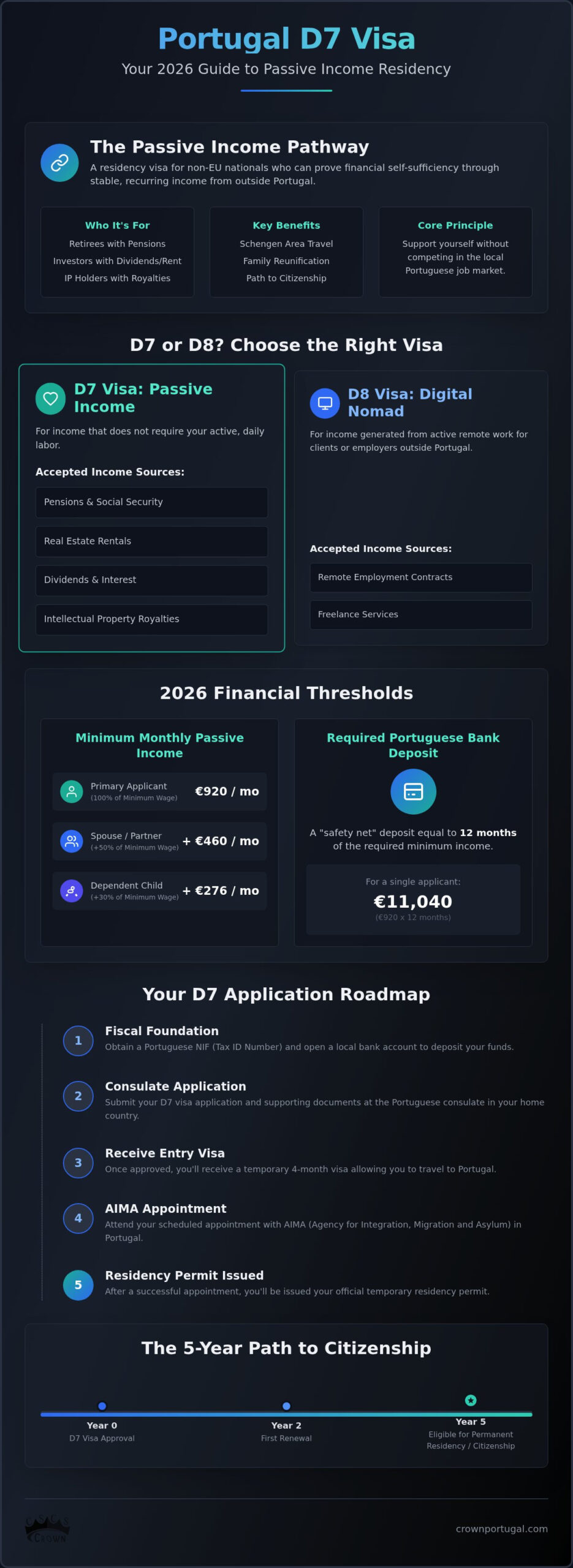
The D7 exists as a specific pillar within Portugal’s visa policies, aimed at attracting financially independent residents. By 2026, the administrative transition from the former SEF to AIMA (Agency for Integration, Migration and Asylum) has been fully implemented. This change requires applicants to navigate a more digitized but rigorous filing system. The procedure is structured as a two-step process. You must first obtain a temporary entry visa from the Portuguese consulate in your current country of residence. Once you arrive in Portugal, you attend a scheduled appointment with AIMA to exchange that visa for a formal residency permit.
D7 Visa vs. D8 Digital Nomad Visa: Clearing the Confusion
A common error in residency planning is the confusion between passive income and remote work. Portuguese authorities maintain a strict distinction between these two categories. Passive income, the requirement for the D7, includes funds like dividends or interest that don’t require daily active labor. If your income is generated through a remote employment contract or freelance services, you must apply for the D8 Digital Nomad Visa. Selecting the wrong category often results in document rejection and lost application fees. Deciding which residency path is yours? depends entirely on the nature of your income stream rather than the total amount of money you earn. For those whose residency is tied to local employment rather than passive funds, the Portugal D1 Visa step-by-step process offers a dedicated pathway through the IEFP and consular requirements.
Financial Requirements: Defining Eligible Passive Income in 2026
The 2026 administrative standards for the Portugal D7 visa passive income route are strictly tied to the national minimum wage. Currently, this figure stands at €920 per month. To secure approval, the primary applicant must demonstrate a recurring income equal to or greater than this amount. When bringing family members, the financial burden increases. You must account for an additional 50% (€460) for a spouse or partner and 30% (€276) for each dependent child. These figures represent the absolute minimum, and presenting income slightly above these thresholds often strengthens an application.

Beyond monthly income, authorities require proof of a "safety net" deposited in a Portuguese bank account. This typically equates to 12 months of the required minimum income. For a single applicant, this means having at least €11,040 readily available in a local account. This deposit serves as evidence of your commitment to the country and ensures you have immediate liquidity upon arrival. Consulting the official D7 visa information provided by the Ministry of Foreign Affairs confirms these baseline expectations for all non-EU applicants.
Recognized Sources of Passive Income
Stability is the defining factor for eligible income. Pensions and social security benefits remain the most straightforward sources to verify. For those planning ahead, understanding how your specific pension or Social Security statement aligns with these thresholds is essential — our detailed guide on Portugal residency for retirees covers exactly how these income sources are evaluated under the current €920 monthly requirement. For rental income, you must provide registered lease agreements and proof of property ownership. If you rely on dividends or interest, you’ll need to show a consistent history of payouts rather than a one-time lump sum. Royalties from intellectual property are also accepted, provided you can present a legally binding contract outlining the long-term payout structure and historical earnings data.
Structuring Your Passive Income Portfolio
Many applicants don’t realize they can aggregate multiple streams to reach the €920 threshold. A combination of a small pension, modest rental income, and stock dividends is perfectly acceptable if the audit trail is clear. You should provide three to six months of bank statements and the last two years of tax returns to prove the recurring nature of these funds. A well-crafted cover letter is essential here. It should explicitly break down each income source and explain how the total exceeds the 2026 requirements. This document acts as a roadmap for the consulate officer, reducing the risk of confusion or requests for additional evidence. If you’re unsure how to categorize your specific assets, our team can help you verify your fiscal setup before you submit your application.
The Essential Fiscal Foundation: NIF and Portuguese Banking
Securing a residency permit requires more than just proving wealth; it requires a local administrative identity. For those pursuing the Portugal D7 visa passive income route, the process begins long before the consulate interview. You must establish a fiscal foundation within Portugal to demonstrate that your funds are not only available but also accessible within the domestic economy. This groundwork ensures that the authorities view you as a serious applicant who has already begun the integration process.
The Número de Identificação Fiscal (NIF) serves as your primary tax identification number. It’s mandatory for every legal transaction in the country, from signing a residential lease to opening a bank account. When reviewing a comparison of Portuguese residency visas, it’s clear that the D7 is uniquely dependent on this early fiscal integration. Without a NIF, your application cannot proceed past the initial documentation phase. Investors who prefer an alternative route to EU residency through qualifying fund contributions should consult our Portugal Golden Visa investment guide to understand how the fund-based pathway compares under the 2026 regulatory framework.
Navigating NIF Registration
For applicants residing outside the EU or EEA, the law mandates the appointment of a Fiscal Representative. This representative acts as your official point of contact with the Portuguese tax authorities (Finanças) until you achieve legal residency status. Many applicants face delays because they attempt to navigate this without professional assistance, leading to document rejections. A professional consultancy ensures your NIF is registered correctly from the outset, aligning your tax profile with your residency objectives. Common pitfalls include using incorrect address formats or failing to update your status once you arrive in the country, both of which can cause administrative friction during your visa renewal.
Portuguese Banking for D7 Applicants
Once your NIF is issued, opening a Portuguese bank account is the next critical milestone. While some institutions allow for remote opening via power of attorney or digital platforms, the requirements remain stringent. You’ll need to provide certified proof of your current address, verified professional status, and a valid passport. This account acts as the primary vessel for your mandatory financial evidence. It’s not enough to show money in a foreign account; the consulate expects to see that you’ve transferred the required "safety net" to a local IBAN.

Consulate officers prioritize applications that show a full year of the required minimum income already settled in a Portuguese bank. For 2026, this equates to a minimum deposit of €11,040 for the main applicant. A fresh bank statement showing this balance, alongside your NIF certificate, forms the backbone of your financial proof. Choosing an institution experienced with international transfers is vital to ensure your recurring passive income streams arrive each month without unnecessary holds or fees.
The D7 Application Roadmap: From Consulate to Residency Permit
The journey to legal residency follows a strict four-phase roadmap. Each stage requires precise coordination between your home country’s consulate and the Portuguese authorities. Successfully securing the Portugal D7 visa passive income permit depends on your ability to present a flawless administrative file that leaves no room for interpretation. Mistakes at the initial stage often lead to months of delays once you arrive in Portugal.
Phase one involves the gathering and legalization of documents. Every foreign document must be apostilled and accompanied by a certified Portuguese translation. Phase two is the consulate interview in your country of residence, where an official reviews your financial stability and the recurring nature of your passive funds. Upon approval, you enter phase three: receiving a 120-day double-entry visa. This temporary permit allows you to travel to Portugal to attend your final appointment. Phase four concludes the process with the collection of biometric data at an AIMA office.
The Essential Document Checklist
A complete application file is the only way to avoid the bureaucratic delays that often plague the immigration system. You must provide a passport that remains valid for at least six months beyond your intended stay. Additionally, you need a clean criminal record certificate from your country of origin and any nation where you’ve resided for more than one year. These certificates must be recent, typically issued within the last 90 days.
Proof of accommodation is a non-negotiable requirement. You must present either a property deed or a registered rental contract with a minimum duration of 12 months. Finally, you must secure private health insurance that meets the minimum coverage standards for Portuguese residency. This policy must remain active until you’re able to register for the national health system (SNS) after receiving your residency card.
The AIMA Residency Appointment
In most cases, the entry visa issued by the consulate contains a pre-scheduled appointment date or a digital link to the AIMA booking system. This appointment is the final hurdle in your relocation. During the interview, an officer will verify the original versions of the documents you previously submitted to the consulate. They’ll also capture your biometric data, including fingerprints and a digital photograph.
Once your biometrics are processed and the file is approved, your residency card will be sent to your Portuguese address. This initial permit is generally valid for two years and can be renewed for subsequent three-year periods. Maintaining this status requires you to adhere to specific stay requirements, ensuring you remain a legal resident in the eyes of the law. To ensure your file is ready for this high-stakes review, you can request a document audit from our consultancy team.
Life After Approval: Tax Benefits and the Path to Citizenship
Receiving your physical residency card marks the transition from an applicant to a legal resident. This status comes with specific maintenance obligations that you must respect to ensure future renewals. To keep your permit valid, you must typically spend at least six consecutive months or eight non-consecutive months within Portuguese territory each year. Failing to meet these thresholds can jeopardize your standing with AIMA and reset your progress toward permanent status. You’ll also need to keep your address and fiscal information updated with the authorities to avoid administrative penalties.
The fiscal environment for those on the Portugal D7 visa passive income path has evolved significantly. Since the broad NHR tax regime was retired, new residents are generally subject to standard progressive income tax rates, which range from 13% to 48% in 2026. While the new IFICI (NHR 2.0) exists, it’s targeted toward specific high-value scientific and research roles and rarely applies to passive income earners. You should prioritize registering for a NISS (Social Security Number) alongside your residency to ensure full access to the SNS public health system and other state benefits.
Fiscal Integration and Tax Planning
Becoming a tax resident happens automatically once you exceed 183 days in the country within a single year. At this stage, your global income must be reported to the Portuguese tax authorities. It’s vital to consult with a cross-border tax specialist to leverage existing double taxation treaties between Portugal and your home country. This planning prevents you from paying tax twice on the same pension or dividend stream. Your NISS registration is a key part of this integration, as it links your fiscal identity to the broader social welfare and healthcare infrastructure, allowing you to contribute to and benefit from the local system.
The Path to Permanent Residency and Citizenship
One of the most significant administrative improvements in 2026 is the update to the Portuguese Nationality Law regarding the five-year residency requirement. In the past, the countdown toward citizenship only began once your first residency card was physically in hand. The current law now stipulates that the five-year period begins on the date you submitted your initial residency application. This change is crucial because it ensures that any processing delays at AIMA don’t unfairly extend your wait for a passport.
Achieving citizenship or permanent residency after five years requires you to pass the CIPLE A2 Portuguese language exam. This level demonstrates basic communicative competence and is a mandatory requirement for all applicants. A Portuguese passport provides the ultimate benefit of global mobility, granting you the right to live, work, and study anywhere within the European Union. By maintaining your Portugal D7 visa passive income status and respecting the stay requirements, you secure a predictable and stable pathway to becoming a European citizen.
Establishing Your Future in Portugal
Navigating the 2026 residency landscape requires a meticulous approach to financial documentation and administrative compliance. Success in securing the Portugal D7 visa passive income permit depends on meeting the €920 monthly threshold and establishing a robust fiscal foundation through a NIF and local bank account. The recent updates to the Nationality Law offer a distinct advantage, as the five-year path to citizenship now begins the moment you submit your initial application. This change provides a more predictable timeline for those seeking long-term stability within the European Union.
Since 2018, our team has provided specialized guidance to ensure every facet of the relocation process is handled with precision. We offer comprehensive support for NIF acquisition, bank account opening, and professional document reviews to minimize the risk of rejection. If you’re ready to begin your transition, secure your Portugal D7 visa with expert consultancy from Crown Portugal. Taking the first step today ensures that your residency objectives are met with administrative excellence and professional reassurance. We look forward to facilitating your smooth arrival in Portugal.
Frequently Asked Questions
Can I work in Portugal with a D7 visa if I find a job later?
Yes, you’re legally permitted to work in Portugal once your residency is granted. While the D7 is issued based on passive income, it grants the right to be employed by a local company or operate as a freelancer. You must still maintain your initial passive income sources to satisfy renewal requirements, as the visa’s legal basis remains your financial independence rather than your local salary or business earnings.
Does rental income from my home country count toward the passive income requirement?
Yes, rental income is a highly recognized source for the Portugal D7 visa passive income application. To qualify, you must provide a registered lease agreement and proof of property ownership. The income must be recurring and stable. Authorities expect to see these funds deposited into your bank account regularly, establishing a clear audit trail that proves your ongoing financial self-sufficiency throughout the duration of your residency.
How much money should I have in my Portuguese bank account for the D7 visa?
You should have a minimum of €11,040 for a single applicant, which represents 12 months of the 2026 Portuguese minimum wage. If you’re applying with a spouse, add €5,520, and for each dependent child, add €3,312. While these are the legal minimums, maintaining a higher balance provides administrative reassurance to consulate officers. This deposit serves as primary evidence that you have immediate liquidity upon arrival.
What is the minimum stay requirement for D7 visa holders in 2026?
Residents must spend at least six consecutive months or eight non-consecutive months in Portugal during each residency year. This requirement is essential for the renewal of your permit and for maintaining your legal path toward citizenship. If you fail to meet these thresholds without a justified professional or personal reason, AIMA may refuse your residency renewal or reset your five-year citizenship countdown, which began when you applied.
Can I include my spouse and children in my D7 visa application?
Yes, you can include immediate family members through the legal family reunification process. This includes your spouse or legal partner, dependent children, and dependent parents. Each family member increases your total passive income requirement by 50% for adults and 30% for children. You must provide legalized marriage and birth certificates to prove these relationships during the initial application or after you’ve secured your own permit.
Is a cover letter mandatory for the Portugal D7 visa application?
While not strictly mandated by law, a cover letter is a professional necessity for a successful application. It serves as your personal statement, explaining your motivations for moving and clearly breaking down your passive income sources. A well-structured letter helps the consulate officer navigate your financial documents and confirms your commitment to integrating into the Portuguese economy without relying on the local labor market for survival.
What happens if my D7 visa application is rejected?
If your application is rejected, the consulate provides a formal notification stating the specific grounds for refusal. Common reasons include insufficient proof of income or incorrect document legalization. You have the right to appeal the decision within a specified timeframe or submit a new application once the underlying issues are corrected. Professional document reviews before submission significantly reduce the risk of facing a rejection or administrative delay.
How long does the entire D7 visa process take from start to finish?
The total timeline typically ranges from four to six months from start to finish. The initial consulate phase usually takes 60 to 90 days for visa issuance. After arriving in Portugal, the wait for an AIMA appointment and the delivery of your residency card can add several more months due to administrative backlogs. Planning your relocation well in advance is vital to manage these procedural durations effectively.
Passive Income Visa Portugal Application: The Step-by-Step 2026 Roadmap – Crown Portugal at 9:32 am, August 20, 2026 -
[…] Portugal D7 Visa Passive Income: The Definitive 2026 Residency Guide […]
Portugal Residency for Retirees: Comprehensive 2026 Guide – Crown Portugal at 10:53 am, August 23, 2026 -
[…] Portugal D7 Visa Passive Income: The Definitive 2026 Residency Guide […]
Portugal D7 Visa Assistance: Professional Consultancy for 2026 Residency – Crown Portugal at 11:01 am, August 24, 2026 -
[…] Portugal Residency for Retirees: Comprehensive 2026 Guide – Crown Portugal on Portugal D7 Visa Passive Income: The Definitive 2026 Residency Guide […]
Living in Portugal as an Expat: The Definitive 2026 Guide to Relocation – Crown Portugal at 9:48 am, August 25, 2026 -
[…] Portugal D7 Visa Assistance: Professional Consultancy for 2026 Residency – Crown Portugal on Portugal D7 Visa Passive Income: The Definitive 2026 Residency Guide […]
Portugal Golden Visa Investment Guide: The Complete 2026 Roadmap – Crown Portugal at 10:46 am, August 26, 2026 -
[…] Living in Portugal as an Expat: The Definitive 2026 Guide to Relocation – Crown Portugal on Portugal D7 Visa Passive Income: The Definitive 2026 Residency Guide […]
Portugal Permanent Residence: The Complete 2026 Guide to Long-Term Stability – Crown Portugal at 10:50 am, August 30, 2026 -
[…] history of your fiscal residency and contributions. If you’re currently transitioning from a Portugal D7 Visa Passive Income, your established history of passive returns will be the primary evidence for this requirement. […]
Social Security Number Portugal Foreigners: The Complete 2026 NISS Guide – Crown Portugal at 10:56 am, September 4, 2026 -
[…] into the payroll system. However, for those under the Digital Nomad Visa Portugal or the Portugal D7 Visa, the responsibility often falls on the individual to ensure their NISS is active before their first […]
Portugal Immigration Consultancy Services: The 2026 Professional Guide – Crown Portugal at 10:08 am, September 11, 2026 -
[…] 2026 standards. Similarly, retirees or those with recurring earnings must carefully structure their Portugal D7 Visa submission. As of January 1, 2026, the minimum passive income requirement for a single applicant is […]
Portugal EU Long Term Residence Permit: The 2026 Strategic Guide – Crown Portugal at 10:51 am, September 14, 2026 -
[…] It’s the transition from holding a temporary title, such as the Digital Nomad D8 Visa or the Passive Income D7 Visa, to securing a stable, long-term foothold in the country. This milestone isn’t merely a […]
Moving to Portugal from the US: The Comprehensive 2026 Expat Guide – Crown Portugal at 5:04 am, September 16, 2026 -
[…] Portugal EU Long Term Residence Permit: The 2026 Strategic Guide – Crown Portugal on Portugal D7 Visa Passive Income: The Definitive 2026 Residency Guide […]
Portugal Visa Application Help: A Comprehensive 2026 Roadmap to Residency – Crown Portugal at 5:32 am, September 17, 2026 -
[…] interview. Detailed documentation of your global assets is essential to prevent delays. Our Portugal D7 Visa Passive Income Guide provides the necessary checklists for this […]
Lisbon Expat Apartments: 2026 Rental & Relocation Guide – Crown Portugal at 9:44 pm, September 19, 2026 -
[…] those pursuing the Portugal D7 visa passive income, this registered lease is the mandatory "Proof of Accommodation." AIMA (formerly SEF) […]
Portugal Residence Permit Types: A Comprehensive Guide – Crown Portugal at 10:45 am, September 20, 2026 -
[…] Lisbon Expat Apartments: 2026 Rental & Relocation Guide – Crown Portugal on Portugal D7 Visa Passive Income: The Definitive 2026 Residency Guide […]
Portugal Immigration Rules 2024: What Still Applies in 2026? – Crown Portugal at 4:58 am, October 4, 2026 -
[…] circumstances, while employment and study routes address different purposes and document sets. The Portugal D7 visa guide covers that pathway in more […]
D7 Visa Rental Income Proof Requirements in Portugal: 2026 Guide – Crown Portugal at 8:23 am, October 8, 2026 -
[…] Portugal Immigration Rules 2024: What Still Applies in 2026? – Crown Portugal on Portugal D7 Visa Passive Income: The Definitive 2026 Residency Guide […]