

Portugal Nationality Law Waiting Time Changes: What Applicants Should Know in 2026

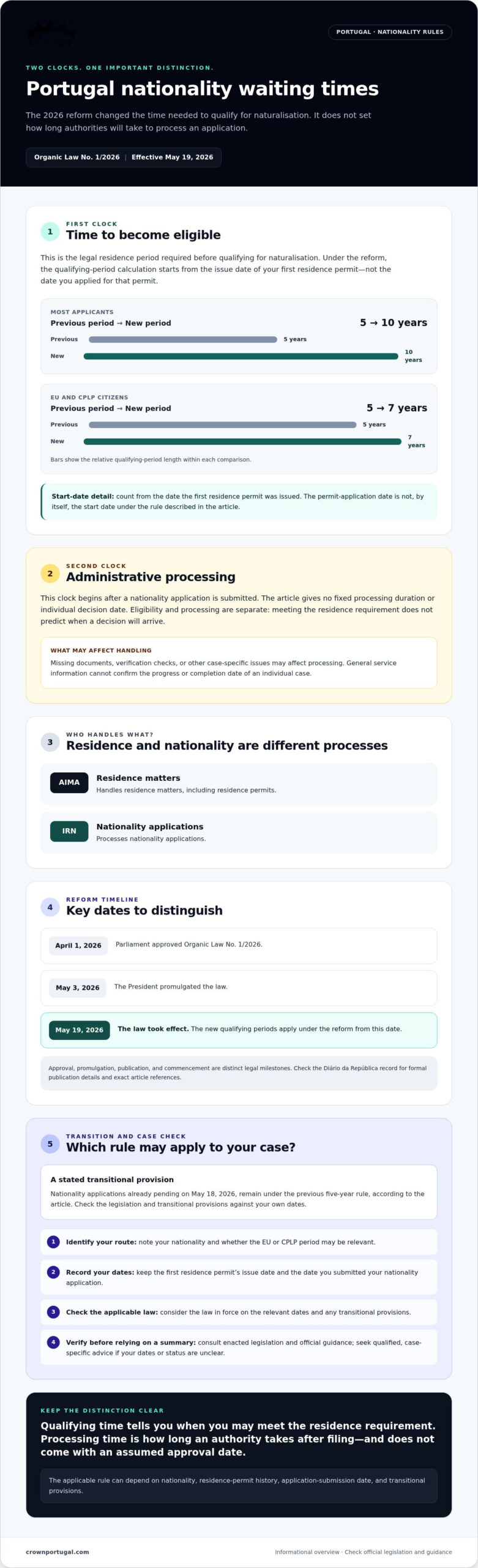
Have Portugal’s nationality waiting times changed, or are applicants seeing two different clocks? The Portugal nationality law waiting time changes took effect on May 19, 2026, under Lei Orgânica n.º 1/2026. For most applicants, the legal residence period for naturalisation increased from five to ten years. For EU and CPLP citizens, it increased to seven years.
Conflicting reports can be confusing because some describe the time needed to qualify, while others refer to delays after an application is filed. These are separate timelines. The rule that applies to you may depend on your nationality, residence-permit history, and whether you submitted a nationality application before the new law took effect.
This article explains how to distinguish eligibility time from administrative processing time, what changed, and which official dates and records to check. It also clarifies the roles of AIMA, which handles residence matters, and IRN, which processes nationality applications. Use these steps to assess your next move without assuming an approval date.
Key Takeaways
- The Portugal nationality law waiting time changes may affect eligibility differently from the time authorities take to process an application. Identify which timeline a reported delay refers to before applying it to your case.
- Check your nationality route and the law in force on the dates relevant to your application. Transitional rules may matter.
- Keep a record of key milestones, including when your residence permit was issued and when you submitted a nationality application.
- Verify rule changes against enacted legislation and official guidance. Seek qualified, case-specific advice if your dates or status make the applicable rule unclear.
- Assess your timeline without assuming an approval date. Eligibility requirements and administrative processing are separate factors.
Portugal nationality law waiting time changes: what does “waiting time” mean?
Reports about the Portugal nationality law waiting time changes can refer to two different clocks. The first measures how long a person must meet the legal residence requirement before qualifying for naturalisation. The second measures how long the authorities take to process an application after it has been submitted. Confusing the two can make an eligibility change sound like a prediction of when a decision will arrive.
Under the reform described in Lei Orgânica n.º 1/2026, which took effect on May 19, 2026, the residence qualifying period for naturalisation is generally counted from the date the first residence permit is issued, rather than the date the permit application was submitted. The law and its development are outlined in this overview of Portuguese nationality law. Check the applicable legislation and transitional provisions against your own dates.
For additional context on the reform, you can watch this overview:
Qualifying time is the time needed to become eligible; processing time is the time an authority takes to handle an application. A change to the first clock does not establish a decision date for the second. Even after someone qualifies and submits an application, the decision date depends on the administrative process and the individual case.
Does the residence qualifying period change when an application is filed?
That can depend on the rule in force and the applicant’s circumstances. Under the current rule described above, the issue date of the first residence permit matters to the qualifying-period calculation. The date someone applied for that permit is not, by itself, the start date. Keep records of permit issue dates and nationality-submission dates, then check which rules and transitional provisions apply. Don’t assume that filing pauses, resets, or preserves accrued time without confirming the legal text for your case.
What is an application-processing delay?
Processing means the administrative handling of a submitted nationality application. In Portugal, IRN processes nationality applications, while AIMA handles residence matters, including residence permits. Published service information may describe general procedures or reported timelines, but it cannot confirm the progress or completion date of an individual case. Missing documents, verification checks, or other case-specific issues may affect handling. For an update on your application, consult the relevant authority.
What changed in Portugal’s nationality rules, and when did each change take effect?
The Portugal nationality law waiting time changes are enacted provisions, not simply proposals or media announcements. The reform is Organic Law No. 1/2026, which took effect on May 19, 2026. Check the Diário da República record for its formal publication date and exact article references before relying on a summary. Parliament approved the law on April 1, 2026, and the President promulgated it on May 3, 2026. Those dates are distinct from publication and commencement.
Organic Law No. 1/2026 changed the naturalisation residence period and took effect on May 19, 2026. For most foreign nationals, the qualifying period increased from five to ten years. For EU citizens and nationals of Portuguese-speaking CPLP countries, it increased from five to seven years. The calculation now starts from the date the first residence permit is issued, rather than the date its application was submitted.
- Naturalisation eligibility: The longer qualifying periods apply under the new law from May 19, 2026. Nationality applications already pending on May 18, 2026, remain under the previous five-year rule, according to the stated transitional provision.
- New integration requirement: The law introduces a civic knowledge test covering Portuguese history, culture, and democratic principles. Check the consolidated law and official implementation guidance for the provisions and procedures relevant to your route.
- Sephardic ancestry route: The route is closed to new applicants under the reform. Check the law and applicable transitional provisions if an application is already in progress.
How to verify a reported nationality-law amendment
Start with the Diário da República, Portugal’s official legal publication. Open the law’s record, confirm its publication and commencement details, and read the relevant articles alongside the current consolidated nationality-law text. Check whether a provision is in force, has a later commencement date, or remains a proposal. Then compare it with guidance from the Ministry of Justice or the competent registry authority. News reports and professional commentary can help you spot an issue, but they do not replace the enacted text.
Which applicants may be affected by transitional provisions?
Transition rules may depend on the date an application was filed or whether a procedure was already pending. Apply the wording of the provision to the actual procedural status and keep proof of submission. Don’t assume that a pending residence-permit application receives the same treatment as a pending nationality application. If a calendar refers to a planned Law No. 62/2026 article, treat that entry as something to verify, not proof that the provision was enacted or changed nationality rules.
If your dates or application status are unclear, a case-specific review can help identify which provisions and records to check. Crown Portugal provides procedural consultancy on Portuguese nationality matters; the competent authorities make official decisions. Review nationality rules with Crown Portugal.
How do the nationality-law changes compare with previous waiting-time rules?
The Portugal nationality law waiting time changes affect the legal period needed to qualify, not just the time an authority takes to decide an application. The table separates the confirmed naturalisation-rule changes from administrative processing estimates. It summarises the reform in Organic Law No. 1/2026. Before applying the rules to an individual case, check the exact provisions and transitional wording in the Diário da República.
| Previous rule | Confirmed current rule | Effective date | Affected applicant group |
|---|---|---|---|
| Five years of legal residence for naturalisation. | Ten years of legal residence. | May 19, 2026 | Most foreign nationals applying for naturalisation, subject to transitional provisions. |
| Five years of legal residence for naturalisation. | Seven years of legal residence. | May 19, 2026 | Citizens of EU member states and countries where Portuguese is an official language (CPLP). |
| Under the 2024 amendment, residence time was calculated from the date the residence-permit application was submitted. | The calculation begins on the date the first residence permit is issued. | May 19, 2026 | Applicants whose qualifying residence period is assessed under the new rule. Verify transition details for your circumstances. |
| Pending nationality applications were assessed under the rules applicable to them before the reform. | Applications filed on or before May 18, 2026, remain under the previous five-year residence rule. | May 19, 2026 | Applicants with a nationality procedure pending when the new law took effect. |
These periods describe naturalisation rules, not every route to Portuguese nationality. A route based on family connection or another legal basis may have different conditions. Don’t use the table as a universal timeline, and don’t assume a pending residence-permit application receives the same treatment as a pending nationality application.
Which dates should applicants compare?
Gather the date the relevant rule took effect, the issue date of your first residence permit, any residence-permit application date, the date you submitted your nationality application, and your application’s current procedural status. A date matters only as the applicable law and its transitional provisions define it. Compare your records with those provisions before drawing a conclusion. A general example cannot resolve an individual case.
How can readers tell whether a timeline claim is reliable?
Start with enacted legislation and official guidance from the competent authority. For processing, a reported IRN estimate published on July 10, 2026, put standard naturalisation applications for non-EU nationals at approximately 12 to 18 months. Treat this as an administrative estimate, not a promise of completion. Before relying on it, check the original source, publication date, cases measured, and measurement method. A reliable claim identifies these details and cites the legal provision behind any eligibility change.
How to assess whether Portugal’s nationality waiting-time changes affect your case
The Portugal nationality law waiting time changes do not apply to every applicant in the same way. Start with your route and records, then check the rule and any transitional provision that applies to your dates. Use this checklist to organise your review:
- Identify your nationality route. Naturalisation, family-based routes, and other grounds may have different requirements. Don’t assume a rule for one route applies to another.
- Confirm your residence status. Note the type of residence permit you hold or held, its issue date, and any relevant renewals. If you’re unsure which permit applies, review official information about your status and the rules for that residence category.
- Record the key dates. Include the date your first residence permit was issued, the date you applied for it, the date you submitted your nationality application, and any receipt or reference number.
- Separate eligibility from application progress. Time spent meeting a residence requirement is not the same as the time an authority takes to process a completed nationality application. Check your filing confirmation and current status separately.
- Verify the rule in force. Check the enacted law and its transitional provisions, then compare them with current official guidance. If your case was pending when a change took effect, confirm how the provision defines a pending application.
Keep copies of official correspondence, application receipts, residence permits, and the documents you submitted. These records help establish what was filed and when. Share personal documents only through a secure, appropriate channel, and avoid posting identity or application details publicly.
What if the rules changed while your application was pending?
First identify whether your pending procedure is a nationality application or a residence-permit application. Then locate the transitional provision and check how it addresses your route and procedural status. Don’t infer that rules protecting one type of pending application also cover another. For a status update, use the official channel identified by the competent authority, such as the instructions on your receipt or its official website. If those instructions don’t resolve the issue, ask the authority or a qualified adviser for clarification.
Residence categories can affect which rules you need to check. Consult reliable information about the type of permit you hold before assessing your nationality timeline.
If the dates or transitional rules are unclear, a case-specific review can help identify what needs checking. Request a review of your nationality timeline. Consultancy can provide procedural guidance, but the competent authority makes the decision.
Verify your nationality timeline with reliable guidance
A clear timeline separates two questions: when you may meet the legal eligibility requirements, and how long the authorities may take to process a submitted application. The Portugal nationality law waiting time changes make it especially important to check which law applied on the relevant dates, including any transitional provisions. Neither an eligibility calculation nor a published processing estimate establishes when an individual decision will be issued.
Use a clear source order. First, read the enacted legislation in the Diário da República, including its commencement and transitional provisions. Next, consult current guidance from the competent Portuguese authority. If your route, dates, residence history, or application status still leave room for interpretation, consider qualified, case-specific advice. Note when you accessed each source, since legislation and guidance may be updated.
When may an individual review be useful?
A review may help if you’re unsure which nationality route applies, how a transitional provision relates to a pending procedure, or which residence and filing dates matter. It can also help you organise documents and identify procedural questions to raise with the competent authority. Professional support isn’t mandatory for every applicant, and guidance cannot replace an official decision.
How to stay informed about further nationality updates
Check official publications and authority guidance when a proposed or reported change could affect your timeline. Distinguish enacted law from announcements, commentary, and implementation information. For each source, note its publication or update date and when you reviewed it. Crown Portugal also shares nationality and immigration video updates. Treat explanatory content as a prompt to verify the underlying official source, not as a substitute for it.
If you need help clarifying which documents, dates, or procedural questions are relevant, consider Crown Portugal’s immigration guidance. Crown Portugal is an immigration consultancy that provides procedural guidance on Portuguese nationality matters. The competent authorities decide applications, and no outcome or decision date is guaranteed.
Take the next step with a verified timeline
The Portugal nationality law waiting time changes make it essential to separate the residence period required to qualify from the time an authority takes to process an application. Your route, residence history, filing dates, and any transitional provisions can affect which rule applies. Check enacted legislation and current official guidance against your records instead of relying on a general timeline or assumed decision date.
If the relevant dates or procedural rules are unclear, a case-specific review can help you identify what needs confirmation and organise the questions to raise. Crown Portugal provides consultancy on Portuguese immigration and nationality matters. Its guidance can help clarify procedures, but the competent authorities decide applications, and no outcome is guaranteed.
Request guidance on your Portugal nationality timeline and take an informed next step based on your circumstances. With organised records and verified sources, you can assess your position more clearly.
Frequently Asked Questions
Have Portugal nationality law waiting-time rules changed in 2026?
Yes. Lei Orgânica n.º 1/2026 took effect on May 19, 2026, increasing the naturalisation residence requirement from five to ten years for most foreign nationals and from five to seven years for EU and CPLP citizens. The law also changed the start date used to calculate qualifying residence. These rules concern naturalisation. Other nationality routes may have different requirements, so check the route and transitional provisions relevant to your case.
Does the nationality waiting period mean the same thing as application processing time?
No. The qualifying period is the time a person must meet the legal requirements before becoming eligible to apply. Processing time is how long the authorities take to handle an application after submission. A longer residence requirement doesn’t determine an individual decision date, and a processing-time estimate doesn’t tell you when you’ll become eligible. Assess these timelines separately using your records and the rules that apply to your route.
When do changes to Portugal’s nationality law take effect?
The new law, Lei Orgânica n.º 1/2026, took effect on May 19, 2026. Parliament approved it on April 1, 2026, and the President promulgated it on May 3, 2026. Those dates are distinct from the effective date. For a particular provision, check its wording and commencement details in the Diário da República. The applicable rule may also depend on the date and procedural status of your application.
Do new nationality rules apply to applications already submitted?
Not necessarily. Under the stated transition rule, nationality applications filed on or before May 18, 2026, remain subject to the previous five-year residence requirement. Check the official text to confirm how it defines a pending procedure and whether your application was formally submitted by the relevant date. A pending residence-permit application is not automatically treated like a pending nationality application, so verify its position separately.
How long does a Portuguese nationality application take to process?
IRN processing estimates vary by application type and should not be treated as guaranteed decision dates. A July 10, 2026 report put standard naturalisation applications for non-EU nationals at approximately 12 to 18 months. Confirm the estimate’s source, publication date, and measurement period before relying on it. Use official channels to check your own application’s progress, as individual circumstances or outstanding checks may affect how a case proceeds.
Can time spent waiting for a residence permit count toward nationality eligibility?
Under the rule described in Lei Orgânica n.º 1/2026, the qualifying residence period starts from the date the first residence permit is issued, not the date its application was submitted. Don’t assume that time waiting for an initial permit counts. The position of people with pending residence applications may involve transitional questions. Check the current legal text and get case-specific clarification before calculating your eligibility.
Where can I check the official Portugal nationality law and application guidance?
Check the current nationality-law text and amendments in the Diário da República, Portugal’s official legal publication. Then consult guidance from the Ministry of Justice and IRN, which processes nationality applications. For residence-permit matters, check AIMA’s official information. Compare guidance with the legislation and note when you accessed it, since information can change. If your route or dates remain unclear, qualified case-specific advice can help clarify which provisions to review.