

D3 Visa Contract Requirements in Portugal: Salary and Terms

A D3 application in Portugal must show that the proposed work is highly qualified and that the applicant has suitable qualifications or professional experience. The D3 visa contract requirements in Portugal can be supported by an employment contract, a promise of an employment contract or, where appropriate, a service agreement under Article 90.º, no. 1 of Law no. 23/2007.
The contract is only one part of the assessment. The role, salary threshold and evidence of relevant expertise also matter. Choosing the right visa category is essential: Portugal distinguishes residence visas for highly qualified work from temporary-stay visas for work planned to last less than a year.
This guide explains how qualifying roles and salary tests relate to the D3, what an employment contract or promised contract should establish, and when a service agreement may fit. It also sets out how the D3 compares with temporary-stay options, so you can understand which route aligns with the work arrangement and intended period of stay.
Key Takeaways
- Assess whether the role is genuinely highly qualified and whether your education or professional experience supports the work described.
- Identify the salary test that applies to the occupation’s classification, since the threshold can differ between role categories.
- Understand when an employment contract, a promise of employment, or a service agreement may support an application, and what each says about the work arrangement.
- Compare the D3 residence route with temporary-stay options by considering the type of activity and intended length of stay.
- Learn how Crown Portugal’s Portugal Digital Nomad D-8 Visa relates to a different work and residence route.
How the role and agreement relate to the qualifying highly qualified activity
A highly qualified activity is work that requires specialist knowledge, supported by relevant qualifications or professional experience. For Portugal’s D3 route, the proposed role and the applicant’s profile must align: a contract alone does not establish that the activity is highly qualified.
Portugal’s Law 23/2007 distinguishes the broader highly qualified activity route under Article 61 from the employed highly qualified worker rules under Article 61-A. Evidence of the activity may include an employment contract or service contract under Article 90.º, no. 1. The agreement should describe the duties clearly enough to connect the position with the applicant’s expertise.
For an overview of D3 contract terms, salary benchmarks, and documents, watch this video from Global Citizen Solutions:
Relevant qualifications are academic credentials or professional evidence connected to the offered work. A D3 applicant needs to prove suitable academic or professional qualifications; higher education or 5-6 years of professional experience may support eligibility. For example, an engineering role is more readily connected to an engineering qualification or a documented professional record than to unrelated experience.
If the role is outside the applicant’s field of education, the application should connect the applicant’s experience and relevant courses to the position. The criteria described for this situation include five years of experience and profile-related courses. Explain how that background prepares the applicant for the duties set out in the agreement.
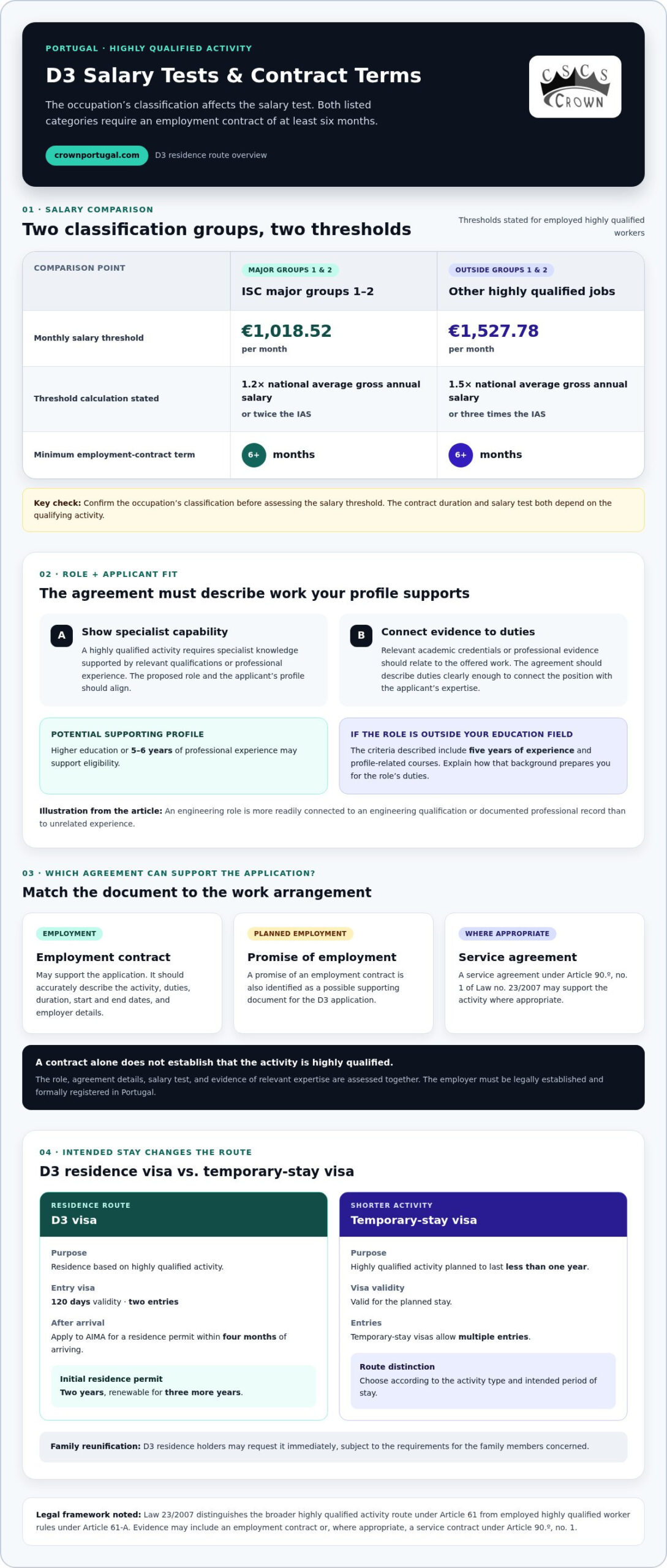
Salary thresholds for employed highly qualified workers depend on the occupation’s classification. For jobs in International Standard Classification major groups 1 and 2, the checklist states a threshold of 1018,52 euros/month, using 1.2 times the national average gross annual salary or twice the IAS. The employment contract must last at least six months for these groups.
For a highly qualified job outside International Standard Classification major groups 1 and 2, the stated threshold is 1527,78 euros/month, using 1.5 times the national average gross annual salary or three times the IAS. The employment contract must also last at least six months. These tests make the job’s classification and agreement terms material to the application.
Portugal also separates a residency visa for highly qualified activity from a temporary-stay visa for highly qualified activity lasting less than one year. The residency route is relevant when the intended stay is longer; the temporary option is designed for a shorter activity period. D3 residence holders may request family reunification immediately, subject to the requirements for the family members concerned.
What is the D3 Visa in Portugal?
Portugal’s D3 is a residence visa for people undertaking highly qualified activity, including eligible work and research. The applicable contract term depends on the activity’s classification, while consulates process applications under Portugal’s visa framework.
Yes. Occupation can affect both the salary test and the minimum employment-contract duration. These requirements depend on the qualifying activity, not simply on which consulate handles the application.
Visa Duration and Entry Conditions
A D3 residence visa authorises entry to Portugal so its holder can pursue residence based on highly qualified activity. The visa is valid for 120 days and allows two entries, giving the holder a defined period to enter and complete the next immigration steps.
A temporary-stay visa for highly qualified activity is intended for work planned to last less than a year and is valid for the planned stay. Temporary-stay visas allow multiple entries. A residence visa, by contrast, is valid for four months and allows two entries. During that period, the holder must apply to AIMA for a residence permit.
Residence Permit Duration and Renewal
A residence permit is the document authorising residence in Portugal after entry on a residence visa. For the D3 route, the initial residence permit provides two years of residence and is renewable for three more years.
Plan the transition from visa to permit as a distinct immigration step: D3 visa holders should apply within four months of arriving in Portugal. The permit then governs residence beyond the entry visa’s 120-day validity. This distinction matters for family members too, because residence and family reunification depend on the relevant permit and applicable requirements.
Minimum Contract Duration
The minimum contract duration is the shortest employment period accepted for the relevant highly qualified activity. For D3 high-qualified work in International Standard Classification major groups 1 and 2, the employment contract must last at least six months.
For highly qualified work outside those groups, the stated minimum employment-contract term is also six months. The occupation’s classification therefore matters when assessing the contract duration, alongside the salary test for that category. For example, an agreement for a senior management role should clearly state the position and duration so they can be assessed against the relevant classification.
Check the agreement’s start date, end date, duties and employer details together. The employer must be legally established and formally registered in Portugal. A job offer or signed employment contract with a Portuguese employer supports the application, and the document should accurately describe the activity the applicant plans to perform.
Minimum salary thresholds
A salary threshold is the minimum remuneration used to assess whether a highly qualified role meets the applicable D3 test. The D3 visa contract requirements in Portugal depend partly on the occupation’s classification and the legal basis applied to the employment.
For employed highly qualified workers, one stated 2026 benchmark is €2,300 per month for a Portuguese employment contract. Other descriptions set occupation-specific thresholds under Article 61-A of Law 23/2007. These figures use different presentations, so applicants should identify the applicable test before comparing amounts.
For jobs in International Standard Classification major groups 1 and 2, the stated checklist threshold is 1018,52 euros/month. It describes the test as 1.2 times the national average gross annual salary or twice the IAS. The employment contract for these groups must last at least six months.
For highly qualified work outside major groups 1 and 2, the stated checklist threshold is 1527,78 euros/month. The test is 1.5 times the national average gross annual salary or three times the IAS. The employment contract must also last at least six months, so classification affects both remuneration and contract duration.
The IAS offers another reference point: Portugal’s 2026 IAS is €537.13, while three times the IAS is described as approximately €1,611 gross per month in 2026. These amounts differ from the checklist thresholds above. Keep each figure attached to its stated test rather than combining values from different presentations.
Before filing the visa application, compare the role description with its occupation category and the remuneration in the agreement. For a technical manager classified in major group 1, for example, assess the group 1 and 2 test rather than assuming the outside-group threshold applies. Gross salary, contract duration, and job classification should form a consistent account.
The minimum salary is not the only consideration. The agreement should clearly identify the employer, duties, remuneration and work period so it describes the proposed activity. A lawyer may help interpret the applicable legal test for a complex job classification, but the applicant’s documents must still support the stated role and pay.
Use a practical sequence: classify the occupation, identify the corresponding salary test, then compare the contract’s gross remuneration and duration with that test. This helps applicants distinguish the general €2,300-per-month 2026 benchmark from classification-based amounts. Applying that sequence is central to understanding the D3 visa contract requirements in Portugal without treating every figure as one universal threshold.
Employment contracts, promised contracts, and service agreements
An employment contract records the work relationship between a Portuguese employer and the applicant. A D3 application may rely on a job offer or signed work contract with a Portuguese employer, and the employer must be legally established and formally registered in Portugal. The document should identify the position and describe the highly qualified activity clearly, so the proposed duties can be assessed against the applicant’s qualifications and experience.
A promise of an employment contract is a written commitment to enter an employment relationship later. Portugal’s D3 application may be supported by this promise when it fits the qualifying activity and legal provision used. It should make clear who will employ the applicant, what position is offered, and the intended work terms. For example, a promise describing a technical specialist role is more useful when its duties and remuneration align with the applicant’s professional background.
A service agreement records an arrangement to perform services rather than an employment relationship. It may support a D3 application when appropriate to the qualifying activity and legal provision. The agreement should identify the parties, the services, and the professional role. A consultant providing specialised services, for example, would need an agreement that describes those services and connects them to the claimed highly qualified activity.
Contract duration depends on the applicable requirement and occupation classification. One D3 requirement describes a Portuguese job offer or employment contract as valid for at least 1 year. Separately, the stated rules for highly qualified work in International Standard Classification major groups 1 and 2 require an employment contract lasting at least six months. The same six-month minimum is stated for highly qualified jobs outside those groups. Applicants should therefore distinguish the route-specific contract requirement from the classification-based duration test.
Before filing, review the documents in a practical sequence:
- Confirm that the employer is formally registered and legally established in Portugal, where the agreement is for employment.
- Match the position and duties to the applicant’s qualifications or professional experience.
- Compare the contract period and remuneration with the relevant occupation classification and salary test.
- Check that the named parties, work arrangement, and proposed activity are consistent across the application documents.
These checks help keep the agreement aligned with the visa application. A Portuguese employer’s job offer, a promised employment contract and a service agreement describe different work arrangements and are not interchangeable. Use the document that accurately reflects the relationship and supports the applicant’s proposed highly qualified activity in Portugal.
Portugal’s temporary-stay and residency visa categories
Choose a Portuguese visa category that matches the work activity and intended length of stay. The distinction matters because temporary-stay and residence visas offer different pathways for work, entry and residence.
The D3 is a residence visa for highly qualified activity, while the EU Blue Card is a separate route for qualified professionals. Other Portuguese work visas cover different arrangements, including seasonal work and temporary transfers. Compare the role, contract, qualifications, and intended stay before choosing a category.
A temporary-stay visa permits a stay of less than one year and remains valid for the full stay. Portugal offers one for highly qualified activity planned for that period. Seasonal subordinate work has a temporary-stay option for work lasting more than 90 days, while other temporary visas cover transfers, training, and internships.
A residence visa is intended for a person who plans to establish residence in Portugal. The D3 falls within the residence visa framework for highly qualified activity, including higher education teaching, cultural purposes, and highly qualified subordinate work. Its four-month validity and two entries allow the holder to enter Portugal and apply for a residence permit during the visa period.
The EU Blue Card is a residence and work route for highly qualified employment with a specific mobility dimension. A D3 residence permit holder may apply for an EU Blue Card after 18 months of legal residence in Portugal. A Blue Card holder may move to another EU Member State for highly qualified work after 18 months from the card’s grant.
Other work routes address different needs. Portugal’s Skilled Job Seeker Visa allows highly qualified professional activity until the visa period ends or a residence permit is granted. Temporary-stay visas also cover seasonal subordinate work, transfers, training, and internships. These routes do not serve the same purpose as a D3 residence visa.
Start by identifying the planned work arrangement:
- Choose the D3 route for eligible highly qualified activity requiring residence in Portugal.
- Consider a temporary-stay category for activity planned for less than one year.
- Assess the EU Blue Card where highly qualified employment and later movement within the EU are relevant.
- Match seasonal work, a transfer, training, or an internship to the corresponding temporary-stay purpose.
A signed contract alone does not determine the visa category. The position, the applicant’s skills and education, the contract terms, and the intended period in the country must align with the route. The national average salary benchmark can also apply to D3 salary tests, while other categories have distinct eligibility rules. Select the category by purpose first, then assess the relevant employment and qualification evidence.
Crown Portugal: Portugal Digital Nomad D-8 Visa
Crown Portugal supports applications for the Portugal Digital Nomad D-8 Visa, a separate option to consider when comparing Portuguese visa categories. After reviewing the D3 requirements, you can discuss whether this route is more relevant to your work plans and the documents involved.
If you have chosen a visa pathway and are preparing to move to Portugal, Crown Portugal also assists with NIF Registration (Personal Tax Number). Keeping immigration steps and tax registration separate can help you organise the process clearly.
Contact Crown Portugal to discuss the Portugal Digital Nomad D-8 Visa or your next immigration step.
Prepare Your Next Step With a Clear Plan
Before moving forward, organise your application around one consistent account of your work: what the position involves, how the agreement supports it, and how your qualifications relate to the role. A focused review of the D3 visa contract requirements in Portugal can help you identify which documents need attention and where your proposed visa route fits your plans.
If you’re weighing alternatives, Crown Portugal offers the Portugal Digital Nomad D-8 Visa and Portugal Golden Visa D-9, as well as NIF Registration (Personal Tax Number). These are distinct services for different immigration and administrative needs, rather than substitutes for a D3 application. Crown Portugal can help you consider the relevant next step for your circumstances.
Contact Crown Portugal about your D3 visa to discuss your application pathway and the documents you’re preparing. A well-organised plan gives you a practical starting point for moving ahead with confidence.
Frequently Asked Questions
Can I apply for the D3 Visa without a college degree?
Yes, a college degree isn’t the only way to demonstrate suitability for D3 work. Professional experience may support an application, with 5-6 years cited as an alternative qualification pathway. The evidence should relate to the proposed role: for example, records of relevant employment and professional training can help explain how an applicant developed the skills required for a specialist position.
Can I apply for D3 with a service agreement instead of an employment contract?
Yes, a service agreement may support a D3 application when it fits the qualifying activity and legal provision being used. It should accurately describe the services, the parties, and the professional work. This differs from an employment contract, which documents employment with a Portuguese employer. The agreement type should reflect the actual working relationship, rather than being selected solely for visa purposes.
Can I change jobs while on a D3 Visa?
A change of job can affect the basis of a D3 residence application because the route depends on highly qualified activity and supporting employment evidence. Before moving to a new position, compare its duties, qualification requirements, contract, and salary classification with the basis of your existing status. A role that differs substantially from the original one may require updated immigration documentation or a different route.
Do I need a job offer for the D3 Visa?
Yes, the D3 employment route requires a job offer or work agreement connected to a Portuguese employer. The employer must be legally established and formally registered in Portugal. An applicant should ensure the offer identifies the role and describes its duties, rather than relying on a general expression of interest. A promise of an employment contract may also support an application when appropriate.
Understanding D3 Visa: what is it and why is it useful?
Portugal’s D3 is a residence visa route for people undertaking highly qualified activity, including eligible professional work, research, and teaching. It provides a pathway from entry to an application for a Portuguese residence permit. Its relevance depends on the applicant’s role and qualifications, so it is useful to distinguish it from temporary-stay routes intended for shorter activities.
What can make a D3 application difficult?
A D3 application can be more difficult to support when the applicant’s experience or education doesn’t clearly relate to the offered duties. Inconsistent job descriptions, unclear contract terms, or a salary test that doesn’t match the occupation classification can also weaken the application’s presentation. Regulated professions add another step: applicants must show qualifications compliant with Law no. 9/2009 or the rules for their profession.
What is needed to qualify for a D3?
Applicants need evidence that the proposed work is highly qualified, relevant qualifications or professional experience, and an appropriate work agreement. Together, these documents should tell a coherent story: the agreement describes the position, while academic or professional records demonstrate preparation for its duties. For an employment-based application, the employer must be legally established in Portugal.
What is Portugal’s D3 visa and who qualifies as a highly qualified professional?
Portugal’s D3 is a residence visa for eligible highly qualified activity. A highly qualified professional is an applicant whose proposed role requires specialist expertise and whose academic background or professional record supports that work. Higher education may provide relevant evidence; professional experience can also support eligibility. The assessment connects the applicant’s profile to the specific position, not just to a job title.