

How to Get a Student Residence Permit in Portugal

Could choosing the wrong study pathway delay your plans for Student Residence in Portugal? The process can be confusing because a student visa, a residence permit and student accommodation serve different purposes. The route you need depends on your course and personal circumstances.
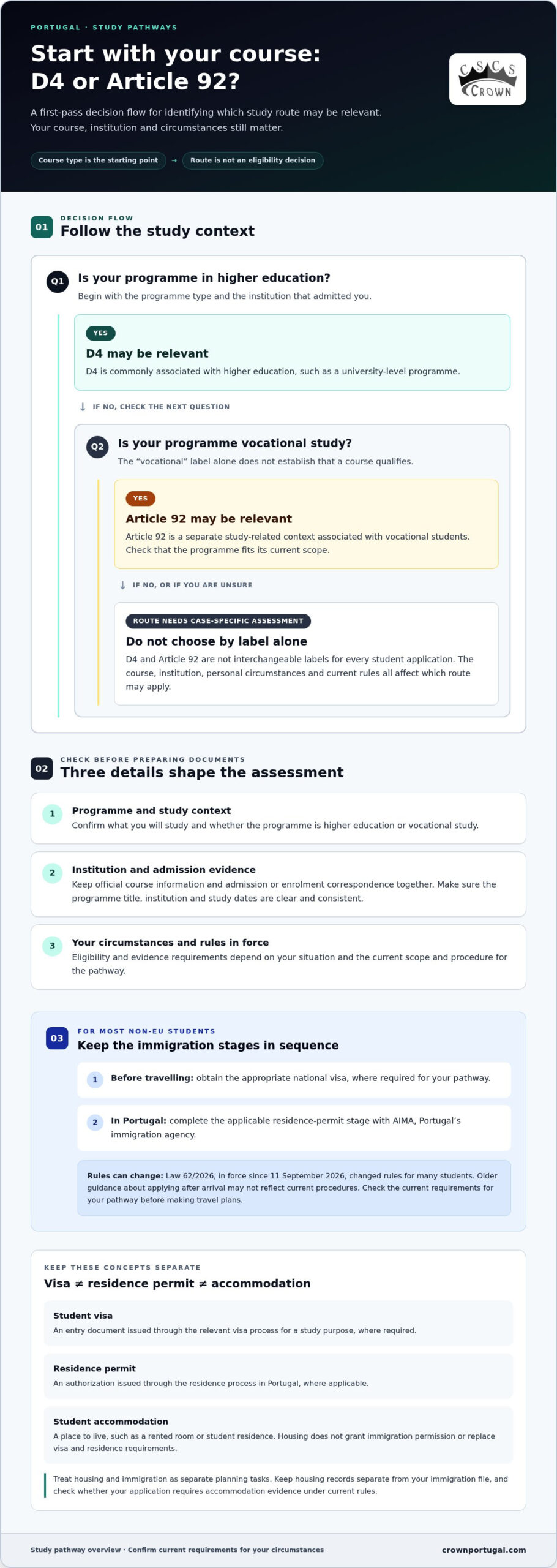
For most non-EU students, the process involves obtaining the appropriate visa before travelling and then completing the relevant residence-permit stage in Portugal. Higher education students commonly follow the D4 route, while vocational students may need to consider Article 92. To work out which pathway may apply, start with your programme, institution and current immigration status.
This guide explains how to identify the relevant route, organize your application and plan the main steps. It also clarifies why accommodation is a separate relocation matter, not proof of immigration status. Crown Portugal helps students prepare D4 and Article 92 applications through document review and application support.
Key Takeaways
- Separate immigration status from your living arrangements. Housing plans do not replace the requirements for Student Residence.
- Use your course type, institution, study duration and personal circumstances to identify which pathway may apply.
- Organize the process in sequence, and distinguish general preparation from requirements that depend on current official procedures.
- Document review and application preparation can help you organize your student visa planning and spot gaps in your file.
What does student residence in Portugal mean, and what does it not mean?
“Student residence” can mean either a place where a student lives or permission to reside in Portugal for study. In immigration terms, it refers to a study-related route through which an eligible international student may obtain permission to stay in the country, subject to the rules and procedures in force when they apply. It does not mean a room, student hall or rental arrangement.
A visa and a residence permit are also different. A visa may allow a student to travel to Portugal for a particular purpose, while a residence permit authorizes residence after the relevant application stage. A residence permit is generally an official document confirming permission to live in a country under specified conditions. The Portuguese process depends on the applicant’s circumstances and the rules in force.
- Student visa: an entry document issued through the relevant visa process for a study purpose, where required.
- Residence permit: an authorization issued through the residence process in Portugal, where applicable.
- Student accommodation: a place to live, such as a rented room or student residence. Housing itself does not grant immigration permission.
As of October 2026, the general route for most non-EU students involves obtaining the appropriate national visa before travelling, then completing the applicable residence-permit stage with AIMA, Portugal’s immigration agency. Law 62/2026, in force since 11 September 2026, changed the rules for many students. Older guidance about applying after arrival may not reflect current procedures. Check the current requirements for your pathway before making travel plans.
Student residence permit versus student accommodation
Immigration status and housing are separate planning tasks. You may need to arrange somewhere to live while also preparing the immigration documents required for your course. A lease, room booking or accommodation support relates to housing, but it is not a visa or residence permit. Keep housing records separate from your immigration file, and check whether your application requires accommodation evidence under current rules.
For example, you could have a confirmed place on a course but still need to arrange both suitable accommodation and the correct immigration process. Treating one as a substitute for the other can leave an important part of your move unaddressed.
Where student residence fits among Portugal residence permit types
Student residence is a study-related route within Portugal’s wider residence framework. It is distinct from permits based on other grounds, and the appropriate route depends on your purpose and circumstances. This section focuses on study rather than comparing unrelated permit categories. For a broader overview, see the Portugal residence permit types guide.
D4 and Article 92 relate to different study contexts. They are not interchangeable labels for every student application. Your course, institution and personal circumstances help determine which route is relevant, while eligibility and procedure depend on current rules. Start by describing your study plan precisely and keeping the terminology consistent across your documents.
Which Portugal student residence pathways apply to your course?
Your course is a practical starting point for identifying a study-related immigration route. Portugal’s D4 and Article 92 pathways relate to different study contexts, so do not assume one route applies to every programme. The relevant option depends on the course, institution and your circumstances, as well as the rules in force when you apply.
Use this comparison to guide your initial assessment, not as a final eligibility decision. Check the current legal scope and terminology before preparing an application. The EU guidance on residence rights for non-EU citizens offers broader context, but your Portuguese pathway still needs to be assessed against your study plans.
| Study context | Route to consider | Questions for case-specific assessment |
|---|---|---|
| Higher education | D4 may be relevant | What type of programme and institution have admitted you? What current requirements apply to your circumstances? |
| Vocational study | Article 92 may be relevant | Does the programme fit the current scope of this pathway? What evidence of admission or enrolment is required? |
When the D4 student pathway may be relevant
D4 is commonly associated with higher education, such as a university-level programme. Admission or enrolment evidence helps establish the purpose of your planned stay, but no single document checklist should be assumed to fit every student. Programme details, the issuing institution and your individual situation can affect the process. Check current eligibility and document requirements before relying on a general description of the route.
As a practical first step, keep official course information and admission or enrolment correspondence together. Check that the programme title, institution and study dates are clear and consistent across your records. This gives you a reliable reference when describing your study plan and preparing application materials.
How Article 92 relates to vocational study
Article 92 is a separate study-related context associated with vocational students. The name alone does not establish that a particular course qualifies. The programme and applicant must be assessed against the provision’s current scope and requirements. Check the applicable legal terminology and evidence requirements before submitting documents, since a broad label such as “vocational course” may not settle an individual eligibility question.
For vocational applications, organize the course description and admission or enrolment information so the programme is easy to understand. Crown Portugal assists students with D4 and Article 92 preparation, including document review and application organization. A structured review can help clarify which pathway your course points toward, while the final assessment remains subject to current rules and the competent authority’s decision.
How should you compare student residence pathways before applying?
Before preparing an application, build a clear picture of your study plan and personal situation. The goal is not to choose the route that sounds simplest. It is to identify which pathway may apply and which requirements you need to confirm under current Portuguese rules. A Student Residence assessment should begin with evidence about your course, not assumptions based on another student’s experience.
Separate confirmed information from details that still need verification. An admission letter, for example, can confirm that an institution has offered you a place, but it does not establish which immigration pathway applies or whether you meet every eligibility condition. Keep a short record of confirmed facts and open questions. This helps you address uncertainties before submitting documents or making travel arrangements.
Which course and enrolment details affect the route?
Start with the programme’s exact title, the institution delivering it, its study level and expected duration. Record whether you have an offer, conditional admission or confirmed enrolment, and keep the documents that show your status. These details help distinguish your actual course from broad descriptions such as “university study” or “vocational training.”
Course classification can affect whether D4 or Article 92 is relevant, but a label alone is not enough to determine eligibility. Programme-specific definitions, institutional criteria and any legal thresholds need to be checked against current rules. Do not treat a course advertisement or informal description as a definitive immigration classification.
What personal circumstances may change the assessment?
Your nationality, where you currently live and any existing Portuguese immigration status may affect the procedure. A student applying from outside Portugal may follow a different sequence from someone who already has permission to reside in the country. Previous permissions, a change in study plans or a change in personal circumstances can also affect which steps apply.
Describe your situation accurately and consistently. Note where you are applying from, the status you currently hold, its validity and any relevant changes. The course alone does not establish the correct route. Your study details and personal circumstances must be considered together under the rules in force. For broader context, review the current Portuguese immigration framework alongside guidance specific to your study pathway.
- Confirmed facts: course title, institution, study dates and documented admission or enrolment status.
- Personal details to assess: nationality, current location, existing immigration status and any previous permission relevant to the application.
- Points to verify: the course’s legal classification, pathway-specific eligibility and the current application procedure.
Plan accommodation separately. A room or housing reservation may help organize your move, but the type of student accommodation does not determine whether D4 or Article 92 applies. Keep housing records separate from immigration documents, and check whether your application requires accommodation evidence. This keeps your pathway decision focused on your course and circumstances, rather than assumptions about where you will live.
What are the main steps for a Portugal student residence application?
Plan the process in sequence, while treating each stage as subject to the rules and procedures in force when you apply. For most non-EU students, the general route involves obtaining the appropriate national visa before travelling, then completing the applicable residence-permit procedure in Portugal. Nationality, course and personal circumstances can affect the details. Law 62/2026, in force since 11 September 2026, changed the position for many students. Older advice about arriving as a visitor and applying later may no longer apply.
Prepare the study and application file
Start with a clear record of your course and applicant details. Admission or enrolment evidence helps show the purpose of your planned stay. Identity documents and other supporting records form part of the application file as required for your route. Do not assume that one checklist applies to every case. Check the current requirements for your nationality, course and application location before treating a document list as complete.
Organize your records so details such as names, programme title and study dates are consistent. Crown Portugal provides document review and application preparation for student pathways, including D4 and Article 92, helping you structure your materials and identify gaps to address. For wider procedural context, see the Portugal residence permit application guide.
Understand visa and post-arrival residence stages
A visa and a residence permit are separate stages where both apply. The visa process is generally handled before travel through the relevant Portuguese consular process. AIMA, the Agency for Integration, Migration and Asylum, is responsible for applicable residence-permit procedures in Portugal. Steps, appointment arrangements and documents can change, so follow the current instructions for your specific pathway.
- Confirm your study route. Match your course and enrolment evidence to the pathway that may apply, then check current eligibility and procedure.
- Prepare the application file. Assemble the documents required for your circumstances and review them for consistency before submission.
- Apply for the relevant visa, if required. Follow the current instructions for the appropriate consular process. As of October 2026, most non-EU students need the appropriate residence visa before travelling.
- Travel only when your documents allow. Check the visa decision and its conditions before arranging travel. Keep relevant application and study records accessible.
- Complete the residence stage, where applicable. Follow AIMA’s current instructions for the relevant procedure after arrival, including any appointment or document steps that apply to your case.
Use this sequence as a planning framework, not a guarantee of timing or outcome. A well-organized Student Residence file makes it easier to track completed tasks and steps that still depend on official instructions. Crown Portugal assists with student visa preparation, document review and appointment scheduling. Explore student immigration support to organize your application preparation.
How can Crown Portugal support your student residence planning?
Planning for Student Residence involves more than identifying a route. You also need to organize study information, prepare documents for the relevant procedure and keep track of appointments and next steps. Crown Portugal provides immigration consultancy and student visa assistance for D4 and Article 92 pathways, helping students prepare in a structured way.
What professional student visa support can cover
Support can include document review, application preparation and appointment scheduling. The appropriate pathway depends on your course and circumstances. D4 relates to higher education, while Article 92 is relevant to vocational student cases. Apply current eligibility criteria and procedures to your individual application rather than assuming a general description of either route is enough.
Document review can bring inconsistencies or gaps in your file to your attention before submission. For example, checking that names and course details align across records can make your application easier to follow. Application preparation helps organize the required information around the relevant process, while appointment scheduling supports coordination of that stage where applicable.
Consultancy assistance provides guidance with preparation and process organization. It does not determine the decision: the competent authority assesses the application, and support cannot guarantee approval or a specific processing time. You remain responsible for providing accurate information and following current official instructions.
Plan the related relocation tasks separately
Moving to Portugal may also involve arranging accommodation or registering for a NIF, Portugal’s tax identification number. These can be practical relocation needs, but neither is the same as immigration permission, and they are not requirements for every student residence applicant. Keep each task in its proper place: immigration documents support your application, while accommodation and tax registration relate to other aspects of settling in.
A practical starting point is to write down your course and institution, your current location and immigration status, and any application steps already completed. Then separate questions about the visa or residence process from housing and administrative tasks. This gives document review and application preparation a clearer focus, and helps you identify which details still need to be checked against current rules.
Crown Portugal, an immigration and relocation consultancy founded in 2018, provides guidance with student visa preparation, including D4 and Article 92 cases. Its document review and application support can help organize the process without replacing official instructions or the authority’s assessment. For help planning the relevant steps, discuss your Portugal student residence plans.
Turn your study plans into a clear next step
Turn your course plans into an application plan that reflects your circumstances. Set aside time to check the current requirements for your pathway, note unresolved questions and keep a record of updates as your plans develop. A clear working file helps you stay focused as you move from planning towards submission.
Student Residence preparation involves decisions specific to your course and situation. Crown Portugal can help you organize those decisions and plan your next steps. Discuss your Portugal student residence plans and move your application preparation forward.
Frequently Asked Questions
Can international students work in Portugal while holding student residence?
Some international students may work while studying, but the conditions depend on their residence status and the rules in force. Current guidance says students must inform AIMA of their employment. Before accepting work, check the conditions attached to your authorization and the current notification procedure. Confirm what information must be provided and whether your study pathway has additional conditions. Permission to study does not automatically answer every question about work.
Can a student bring family members to Portugal under a student residence pathway?
Family reunification may be possible, but eligibility and timing depend on the student’s status, the family relationship and current requirements. The process may involve a waiting period, so do not assume relatives can travel or join you immediately. Identify which family members you hope to include and check the rules that apply to their situation before making arrangements. Keep their travel and residence planning separate from your student application, since each person may have distinct steps. For guidance on Portugal residency for minor children, consider how the child’s relationship to the applicant and parental consent may affect the process.
How long is a student residence permit valid in Portugal?
For higher education students, current guidance states that a residence permit is valid for three years, or for the programme’s duration if it is shorter. This should not be assumed to apply to vocational study or every student pathway. Check the validity period stated in your authorization and note its expiry date. If your course or circumstances differ from the standard higher education case, check the applicable period under current rules.
Can I renew my student residence permit if my course takes longer than expected?
You may need to apply to renew or extend your permission if your studies continue beyond the period it covers, but an extension is not automatic. The applicable procedure and evidence depend on your pathway and current requirements. Keep records showing your continued enrolment and revised study timeline, then check the renewal instructions before your authorization expires. A course extension alone does not extend immigration permission, so confirm how the change affects your status.
What happens to student residence status if I change or leave my course?
Changing or leaving a course can affect the basis on which your student permission was granted. The impact depends on your current authorization, the new programme and the rules that apply to your case. Before making a change, review the conditions of your permission and check any notification or application steps. Keep written confirmation of your withdrawal or new enrolment, and do not assume your existing status is unaffected.
Do international students need a NIF to study or live in Portugal?
A NIF is Portugal’s tax identification number. Its usefulness for administrative or financial tasks does not make it an immigration document or a universal condition of student residence. Whether you need one can depend on practical matters, such as your arrangements in Portugal and the requirements of the institution or service you use. Clarify the NIF’s purpose in your situation, and keep tax registration separate from your visa and residence-permit file.
Can I stay in Portugal after completing my studies?
Completing a course does not by itself establish a right to remain in Portugal beyond the validity of your current authorization. If you plan to stay, identify whether another residence route may fit your circumstances and check its requirements before your student permission expires. Eligibility and procedures can change, so do not assume that a job offer or completed qualification automatically changes your status. Plan your next step early.
Portugal Residence Permit: Your 2026 Application Guide – Crown Portugal at 1:23 am, October 19, 2026 -
[…] How to Get a Student Residence Permit in Portugal […]