

Portugal Residence Permit: Your 2026 Application Guide

What if the main application mistake isn’t a missing document, but choosing a checklist that belongs to a different route? A Portugal Residence Permit application depends on why you’re moving and your circumstances, so there’s no single set of evidence that suits every applicant. It’s understandable to be unsure whether a visa and a residence permit are the same: for many non-EU routes, they’re separate stages, while EU nationals follow a different process.
This guide explains how the main stages fit together, from identifying the right route to preparing evidence and approaching the permit application. You’ll learn how to match documents to your purpose of stay, what to review when procedures change, and how to organize your paperwork to reduce avoidable gaps.
We cover common pathways, including work, study, family reunification, passive income, digital nomad and investment routes, and explain where AIMA fits into the process. You’ll also learn how professional document review, application preparation and appointment-scheduling support can help organize your case. No consultancy can guarantee an approval decision.
Key Takeaways
- Understand how a Portuguese residence permit and an entry visa serve different purposes in the application process.
- Compare common routes by purpose of stay, then identify which route-specific requirements apply to your circumstances.
- Use the official document list for your route as the basis for preparing identity, background and supporting evidence.
- Follow a clear workflow: identify your route, verify current instructions, prepare documents, submit and retain application records.
- Learn how tailored document review, application preparation and appointment scheduling can help organize a Residence Permit application.
What a Portugal residence permit is, and how it differs from a visa
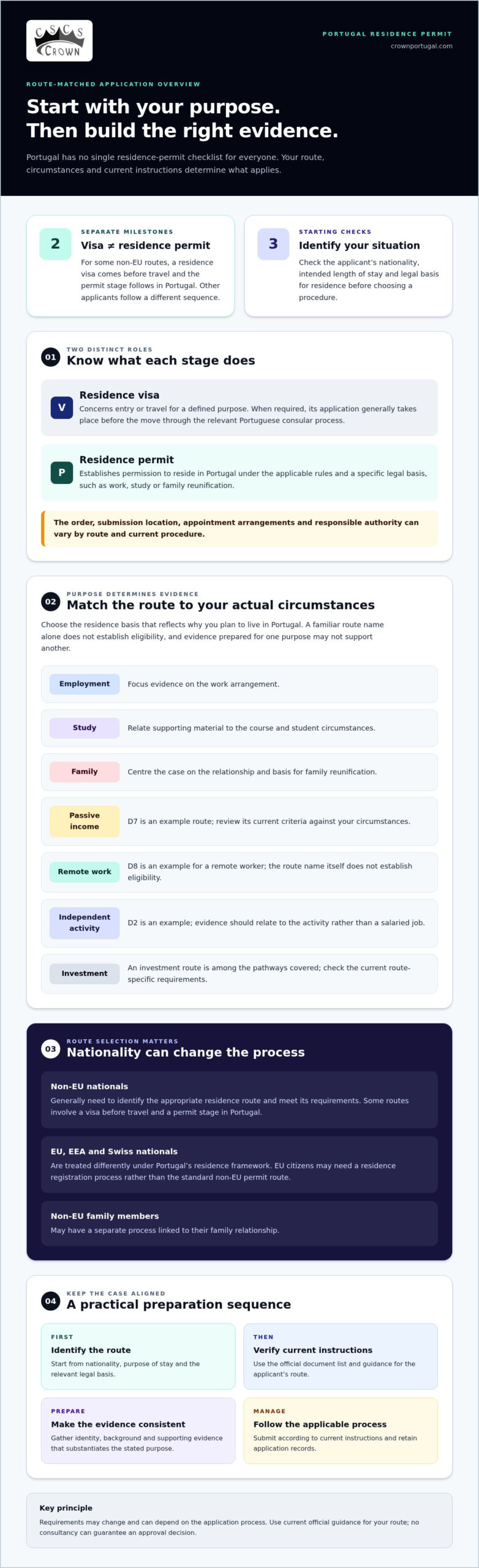
A Portuguese residence permit authorizes a person to live in Portugal under a specific legal basis, such as work, study, family reunification or another qualifying purpose. That basis determines which procedure and supporting evidence apply. A visa and a residence permit are not interchangeable: a visa concerns entry or travel for a defined purpose, while a permit establishes permission to reside under the applicable Portuguese rules.
For some non-EU nationals, the process involves applying for a residence visa before travelling and then completing the residence-permit stage in Portugal. The sequence is not the same for everyone. Nationality, intended length of stay and the legal basis for residence can affect the steps, so use the current official guidance for your route. The overview of Immigration to Portugal also provides context on different pathways and the distinction between visas and residence permissions.
This video discusses Portugal’s D8 Digital Nomad Visa, one route that may lead to a residence application:
Residence visa versus residence permit: what happens at each stage?
When a residence visa is required, its application generally takes place before the move through the relevant Portuguese consular process. The visa is linked to the applicant’s intended purpose of stay and is distinct from the residence authorization that may follow. The permit stage involves the relevant Portuguese authority and requirements for that route. Other applicants may follow a different sequence, so use the steps that apply to your case rather than copying another applicant’s process.
In practical terms, treat the visa and permit as separate milestones. Confirm whether your nationality requires a visa for the planned journey, then identify the residence procedure connected to your intended stay. Submission location, appointment arrangements and the responsible authority vary by route and current administrative procedure. Follow the instructions for your application before taking action.
Who needs to follow Portugal’s residence-permit process?
Non-EU nationals who plan to reside in Portugal generally need to identify the appropriate residence route and meet its requirements. Evidence varies by purpose: an employment-based case is not prepared in the same way as a study, family, independent-activity or remote-work case. Choosing a category based only on a broad label can leave you with documents that don’t establish the actual basis for your stay. For entrepreneurs and professionals exploring European business and talent pathways, firms like 360 Global Immigration assist applicants in matching their commercial background to the right international residency route.
EU, EEA and Swiss nationals are treated differently from non-EU nationals under Portugal’s residence framework. EU citizens may need to complete a residence registration process rather than apply through the standard non-EU permit route; the formalities depend on their circumstances. Non-EU family members may have a separate process linked to their family relationship. Before assembling paperwork, identify the applicant’s nationality, purpose of stay and relevant legal basis. These details are the starting point for selecting a category and following its current instructions.
Which Portugal residence route fits your purpose of stay?
Start with the reason you plan to live in Portugal, then assess which residence basis may apply. A route is not simply a familiar visa label: it connects your circumstances to specific eligibility rules and evidence. Employment, study, family reunification, independent activity and remote work are distinct purposes, and documents for one may not demonstrate another. Nationality, existing status and personal circumstances can also affect the procedure.
This overview can help you identify the right questions, but it isn’t an eligibility assessment. For broader context on rights and rules that may affect your case, read this guide to Portugal immigration law and rights. Compare general information with current official instructions for the applicant’s route.
Match the residence basis to your actual circumstances
Ask what will be the main basis for your stay: a job in Portugal, a course of study, joining family, operating an independent activity, or working remotely for an employer or clients outside Portugal? Then identify what evidence can substantiate that purpose. For instance, employment cases focus on the work arrangement, while study cases relate to the course and student circumstances. Family cases centre on the relationship and the basis for family reunification.
D8, D7, D2 and study pathways are examples, not interchangeable shortcuts. A remote worker considering D8, a person relying on passive income under D7, an entrepreneur exploring D2, and a vocational student may each need to demonstrate different facts. The route name alone doesn’t establish eligibility. Review the current criteria alongside the applicant’s nationality and circumstances before preparing documents. Requirements may change and can depend on the application process.
Evidence should tell a consistent story. If your stated purpose is study, for example, documents centred on an unrelated business activity may not support that purpose. Likewise, an independent activity route calls for evidence relevant to that activity, rather than papers prepared for a salaried job. Choosing a route by its familiar label before checking its underlying basis can lead to gaps or mismatched supporting material.
When a specific provision or applicant category matters
Some applications depend on a particular statutory provision, prior status or family circumstance, rather than a broad-purpose category alone. Vocational study is one example: where Article 92 is relevant, assess the applicant’s course and circumstances against that provision’s current scope. See the Portugal vocational courses and Article 92 visa guide for context. Other provisions, including Article 122, may apply only in defined circumstances, so they are not general alternatives to other routes.
Before settling on a category, note your nationality, current status, intended activity and any relevant family or prior-residence details. These facts help narrow the route and show what your application must substantiate. Crown Portugal’s residence application support can help organize documents around the selected route and your circumstances.
What documents should you prepare for a Portugal residence permit?
There isn’t one complete document checklist for every applicant. A Residence Permit file may include identity and background records, alongside evidence tied to the reason for residence. A passport and application form are examples of general items that may be requested, but they don’t replace the instructions for a particular route. Use the official checklist for your applicant category and current procedure as your primary reference.
Document requirements vary by residence basis and applicant circumstances. Treat each item as evidence for a specific requirement, rather than collecting paperwork without checking its purpose. Verify route-specific rules for financial means, insurance and criminal-record documents, including their required format and validity.
Build an evidence file around the purpose of residence
Begin with the official list for the route you’re applying under, then group documents according to what they demonstrate. This makes it easier to spot missing evidence and avoid relying on a document that doesn’t support your stated purpose. Examples vary by case:
- Employment: documents relating to the employment arrangement may support the work basis.
- Study: course or enrolment evidence may establish the study purpose.
- Family: civil records may be relevant to demonstrating a family relationship.
- Remote work: records about the work arrangement may help explain the remote-work basis.
These are examples, not universal requirements. The exact evidence depends on the applicable route and your circumstances. Include financial documents in the form required for your route rather than assuming one format meets every category’s rules. Apply the same care to insurance and criminal-record records: verify whether they’re required, what period or format applies, and whether additional formalities are specified.
Before submission, compare names, dates of birth, passport details and other personal information across forms and supporting records. Differences in spelling, name order or dates can prompt questions, so resolve discrepancies or prepare relevant supporting records where appropriate. Review expiry dates and any stated validity period too: an accurate document may still be unsuitable if it falls outside the current instructions.
Translation, apostille and legalization rules depend on the document and procedure. Don’t assume that a document in English is automatically accepted, or that every record needs the same certification. Follow the current official instructions for the required language, translator or authentication process before arranging these steps.
Prepare originals, copies and digital files according to the current submission process. Keep files clearly named and organized by requirement, and retain a copy of the complete set you submit. Crown Portugal’s document review and application preparation support can help structure evidence around your selected route, alongside the applicable official requirements.
How to prepare and manage a Portugal residence-permit application
A well-organized application starts with the correct route and continues through submission and follow-up. Procedures, responsible authorities, appointment requirements and submission locations can differ. Follow the current instructions that apply to your circumstances as you prepare your file.
Before submission: verify the route and assemble the file
Use this workflow to keep preparation in order:
- Identify the route. Record the applicant’s nationality, intended purpose of stay and circumstances that may affect the application. These details help establish which process and instructions apply.
- Verify official instructions. Check the relevant Portuguese authority’s current guidance for the route, including required documents, submission channel and appointment steps. Avoid relying on an old checklist or instructions intended for a different applicant category.
- Prepare and review the evidence. Match each document to a requirement and check that forms and records are complete and consistent. Review any specified rules for document validity, translation, certification or format before finalizing the file.
- Submit through the stated process. Follow the instructions for where and how to submit. If an appointment is required, use the designated booking procedure and bring or upload the materials requested for that stage.
- Keep a complete record. Retain copies of submitted forms and supporting documents, along with submission confirmations, appointment details and any reference numbers provided.
The authority, location and appointment process depend on the route and current administrative arrangements. AIMA is Portugal’s immigration agency, but its role and the steps applicants need to follow can differ by process. Use the instructions for your specific application rather than assuming every case follows the same submission steps.
After submission: follow official communications carefully
After filing, monitor the communication channels you provided and keep your contact details up to date where the procedure allows. If the authority requests additional information, read the full notice, note its deadline and follow the stated response method. Submit the specific material requested, then save a copy of your response and proof of delivery or upload.
Follow-up steps and processing times depend on the authority and route. Estimates or another applicant’s experience do not guarantee a timeline for your case. If you need to organize a response, review the official notice and your application records together to identify exactly what is requested and by when.
A practical file-management system can reduce avoidable oversights: keep a dated copy of the guidance used, a checklist of submitted items and a record of every official communication. Crown Portugal provides document review, application preparation and appointment-scheduling support tailored to the applicant’s route. Get support with your Portugal application.
How Crown Portugal can support a residence-permit application
Preparing a Portuguese residence application involves more than collecting documents. The evidence needs to fit the selected route, application forms must be consistent with supporting records, and procedural steps should follow current official instructions. Crown Portugal provides document review, application preparation and appointment-scheduling support to help applicants organize these elements around their route and individual circumstances.
What application-preparation support can include
Document review can help identify missing items, inconsistencies between records, or evidence that doesn’t clearly support the stated residence purpose. For example, an application based on study, family circumstances or a work-related route may require different supporting material. Reviewing the file against your situation helps clarify what each document contributes and where further preparation may be needed.
Application preparation can help organize information and records in line with the relevant process. Appointment scheduling supports the administrative steps when an appointment is required. The appropriate preparation depends on the route, your application stage and the documents involved; current official instructions remain the reference for requirements.
This is consultancy and administrative support, not legal representation in court. Crown Portugal helps prepare and organize applications, but no consultancy can guarantee the authority’s decision. The relevant Portuguese authorities assess applications and determine the outcome.
Prepare for a focused consultation
A clear starting point is a short summary of your nationality, intended purpose for residing in Portugal and current application stage. Note whether you’re identifying a route, assembling documents, preparing to submit or responding to an official request. This context keeps the discussion focused on the process you’re facing.
Before discussing your case, organize relevant identity records and documents connected to your route. A simple folder structure makes it easier to review what you have, identify gaps and distinguish current records from older versions. Include official correspondence or submission confirmation if you’ve already begun the process. Concentrate on materials that explain your circumstances and support the application’s purpose.
Use the consultation to clarify practical preparation: which route-specific instructions apply, how the evidence fits together, and what administrative steps may be required next. Requirements can change, and the responsible authority makes the decision, so prepare using current official guidance rather than assuming an outcome. Support can improve the organization and completeness of a file, but it cannot promise approval.
For tailored assistance with your documents and application preparation, discuss your Portugal residence application.
Take the next step with a clear plan
Turn the route that fits your circumstances into a practical preparation plan. Consider what stage you’re at and where you’d value help organizing the application. The Portuguese authority makes the decision, but a carefully prepared file can help you present your case clearly and respond to the applicable process.
Crown Portugal provides application preparation that includes document review and appointment scheduling. This support can help organize the steps around your situation without promising a particular outcome. Share your intended purpose of stay, nationality and current application stage to begin a focused discussion about your Portugal residence application.
Discuss your Portugal residence application and take a considered next step toward your Residence Permit. Crown Portugal can help you organize your documents and application preparation around your route.
Frequently Asked Questions
Is a Portugal residence permit the same as a residence visa?
No. A residence visa and a residence permit are different authorizations, and having one doesn’t automatically mean you hold the other. A visa may allow a person to travel to Portugal for a specified purpose and continue with the applicable residence process. A permit concerns authorization to reside. Check what your current document allows, including its validity and conditions, before making travel or residency plans.
Can EU citizens apply for a Portugal residence permit in the same way as non-EU citizens?
No. EU citizens generally follow a residence registration process rather than the standard permit route for non-EU nationals. The relevant steps can depend on the length and circumstances of the stay, so follow current official Portuguese guidance. A non-EU family member of an EU citizen may need a separate residence document and supporting evidence linked to the family relationship.
How long is a Portugal residence permit valid?
Validity depends on the permit category and the conditions in force for that route. Under the current general framework described for temporary permits, an initial permit is generally valid for two years, with successive renewals for three-year periods. This isn’t a rule for every category or individual case. Check the expiry date printed on your card and the official renewal instructions that apply to your permit.
Can I travel outside Portugal while my residence-permit application is pending?
Don’t assume that a pending application by itself gives you permission to leave Portugal and return. Your ability to travel and re-enter may depend on your nationality, current visa or residence documents, their validity, and the rules applicable when you travel. Before booking a trip, verify your position through current official guidance for your case. Consider the risk of being unable to return if your existing entry document expires while you’re away.
What happens if my Portugal residence-permit application is incomplete?
An incomplete file may lead the authority to request more information, delay its assessment or take another procedural step under the rules for that application. Read any official notice carefully, identify each missing item and respond through the stated channel by the deadline given. Keep copies of your response and proof of submission. If you receive no request, don’t assume missing material can be added later without following the applicable process.
Can my family apply for residence in Portugal with me?
Yes, family members may be able to seek residence through an applicable family-reunification or related route, but their process and evidence depend on the relationship and the principal applicant’s status. For example, a spouse and a dependent child may need different records to demonstrate their circumstances. Check whether applications can be submitted together or must follow separate steps, and use the current official requirements for each family member.
Article 122 Portugal: Residency Requirements Guide – Crown Portugal at 10:49 am, October 14, 2026 -
[…] Portugal Residence Permit: Your 2026 Application Guide […]
How to Get a Student Residence Permit in Portugal – Crown Portugal at 10:54 am, October 16, 2026 -
[…] Portugal Residence Permit: Your 2026 Application Guide […]