

Article 41 Portuguese Nationality Regulation Guide

Could a deadline in the regulation tell you when your Portuguese nationality application will be decided? Not necessarily. ARTICLE 41 OF THE PORTUGUESE NATIONALITY REGULATION sets out procedural steps, including an initial review period and time to respond to identified deficiencies. It does not guarantee when your case will be completed or whether you qualify.
Legal wording can be difficult to interpret, especially when procedural duties and eligibility requirements arise within the same process. Article 41 describes how an application is handled. Separate rules determine whether an applicant meets the substantive requirements for acquiring nationality. The regulation’s stated deadlines may differ from actual waiting times, so treat them as procedural timeframes, not as a completion date.
This guide explains Article 41 in plain English, clarifies what its deadlines mean, and shows how to distinguish process requirements from eligibility. It also considers the nationality-law changes that took effect on May 19, 2026, and why the application date may matter. You’ll learn what records to organize, how to respond if the registry identifies a deficiency, and when case-specific guidance can help you assess your next steps.
Key Takeaways
- ARTICLE 41 OF THE PORTUGUESE NATIONALITY REGULATION concerns procedural handling of nationality applications; it does not create an independent right to citizenship.
- Identify the procedural stage and what the relevant registry communication asks you to do.
- Read statutory deadlines as timeframes for specific procedural steps, not guaranteed dates for a decision or completion.
- Keep your application records together and compare any correspondence with the applicable official wording, especially if a deficiency is raised.
- Document review and application-preparation support can help clarify procedural steps. Eligibility and outcomes depend on the applicable nationality rules.
What Article 41 of the Portuguese Nationality Regulation covers
Article 41 of the Portuguese Nationality Regulation addresses the initial procedural handling of nationality applications. It concerns how an application is examined after receipt, including the identification and communication of deficiencies that may need attention. It is a rule about how a case is administered, not a separate route to Portuguese citizenship.
Procedural rules explain how an application is handled; substantive rules determine who may acquire Portuguese nationality. Keeping those questions separate helps you understand what a notice or legal reference establishes and what it does not. A procedural step may affect how a case progresses, but eligibility depends on the nationality rules that apply to the applicant’s circumstances and route.
Where Article 41 sits in Portugal’s nationality framework
The framework has two connected layers. Portugal’s Nationality Act, Law No. 37/81, sets out the legal grounds for acquiring and losing nationality. Its implementing regulation, Decree-Law No. 237-A/2006, provides rules for administering nationality procedures, including Article 41. The Act establishes the substantive framework; the regulation helps put it into practice.
For an up-to-date reading, consult the consolidated versions of both instruments in Portugal’s official legislation database, the Official Gazette of the Republic. Amendments can change the applicable wording, so check which version applies to the application and its submission date. A general overview of Portuguese nationality law can provide background, but it does not replace the official consolidated texts.
Article 41 should not be assumed to operate identically across every nationality route. The relevant substantive requirements and procedural provisions can depend on the basis of the application. An applicant relying on descent, for example, is addressing a different legal basis from someone seeking nationality through naturalization. Read the article’s procedural role alongside the Portuguese nationality requirements for the specific route.
Who may need to understand Article 41
Applicants, family members helping manage a file, and authorized representatives may encounter Article 41 when reviewing a registry notice, tracking a case, or reading about nationality procedure. The reference can help explain why an authority is examining an application or asking the applicant to address a deficiency. It does not, by itself, show whether the applicant qualifies or predict the final decision.
Use the provision as context, then relate it to the case record. For example, a family member comparing a notice with the regulation may identify that the communication concerns procedure. The applicant still needs to assess the request itself and the eligibility rules that apply. General information explains the framework; an individual assessment depends on the applicant’s route, documents, dates, and correspondence.
This distinction is useful when legal discussions use broad terms such as “nationality application.” The phrase can refer to different legal grounds and procedural circumstances. Before drawing a conclusion from Article 41, identify the nationality route and the version of the legislation relevant to the case.
How Article 41 fits into the nationality application procedure
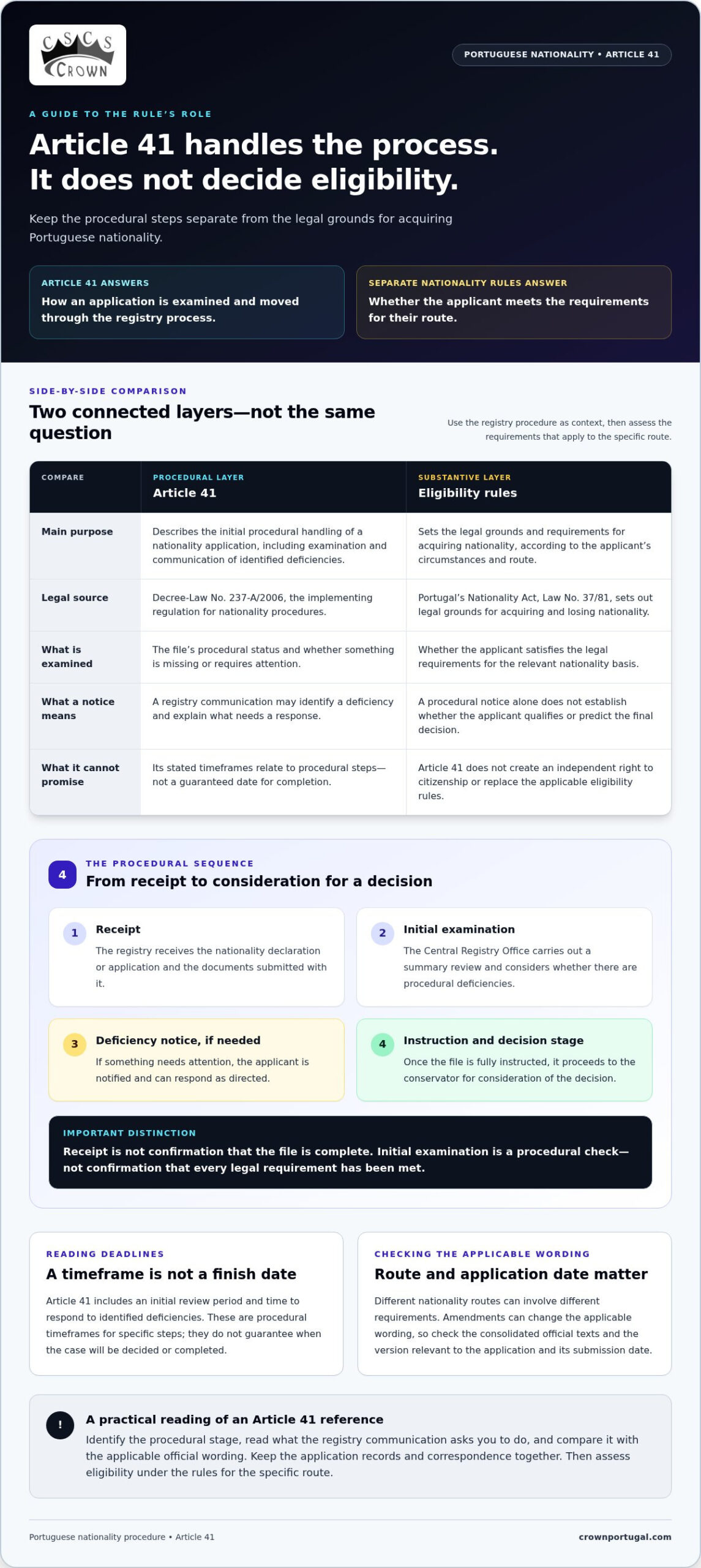
Article 41 sets out an administrative sequence for handling a nationality case after the relevant declaration or application is received. Under the procedure described in the regulation, the Central Registry Office carries out an initial summary examination, identifies any deficiencies that require attention, and proceeds with the case once it is fully instructed. The conservator then considers the matter for a decision. Each stage serves a different purpose.
In short, the registry receives and examines the case, communicates identified deficiencies for a response, and moves a complete file to the decision stage. This is a description of the procedural sequence, not a guaranteed completion date or promise about the outcome.
- Receipt: The registry receives the nationality declaration or application and the documents submitted with it.
- Initial examination: The Central Registry Office conducts a summary review and considers whether the case has procedural deficiencies.
- Deficiency notice, if needed: If the examination identifies something missing or requiring attention, the applicant is notified and can respond as directed.
- Instruction and decision: Once the file is fully instructed, it proceeds to the conservator for consideration of the decision.
What happens after a nationality declaration or application is received
The word “declaration” matters because some nationality routes begin with a formal declaration, while others may be described as applications. The declaration is the act through which the person makes the relevant request; supporting records provide information for its examination. Read Article 41’s procedural sequence alongside the rules for the particular route, since the legal basis and documents can differ.
Receipt does not mean the file has already been accepted as complete. The initial examination is a procedural check, not confirmation that every legal requirement has been met.
How procedural examination differs from the final decision
Instructing a case means assembling and examining the material needed for consideration. If a deficiency is identified, the applicant’s response may help complete that record. For example, a notice might point to an absent document or ask for clarification. Read the full notice to identify exactly what is requested and how the registry expects the response to be made.
After the file is fully instructed, the conservator considers the case’s merits under the applicable nationality rules. Sending requested material may address a procedural issue, but it does not by itself establish eligibility or ensure approval. An initial examination should not be mistaken for a final assessment of entitlement.
For practical tracking, keep the submission confirmation, copies of the documents filed, registry correspondence, and proof of any response together. Note which stage each communication relates to, and distinguish a request to complete the file from a decision on the nationality claim. Crown Portugal provides nationality document review and application-preparation support to help applicants organize their records and prepare their applications.
What Article 41 does not guarantee: deadlines, eligibility, and outcomes
A procedural timeframe can sound like a promise that an application will be decided by a particular date. Article 41 does not establish that. It sets periods for specified procedural acts, but those periods do not amount to a guaranteed overall completion date, establish that an applicant qualifies, or predetermine the result.
A nationality file can involve separate stages: an initial examination, a response to any identified deficiency, and consideration of the case once it is fully instructed. A period attached to one stage should not be read as the total time from submission to a final decision. Administrative estimates, where available, are a separate measure and may differ from statutory periods.
Does Article 41 set the total time to receive nationality?
No. Article 41 provides timeframes for particular procedural steps. As summarized in the regulation, these include 30 days for the registry’s initial summary examination and notification of deficiencies, 20 days for the applicant’s response, and 60 days for a decision once the file is fully instructed. These periods relate to specific acts, not the entire process from filing to nationality.
Read the current consolidated text before relying on a deadline in an individual case. The periods’ starting points and application depend on the provision’s wording and the case’s procedural circumstances. The distinctions below explain what each period relates to, not how a registry will handle a particular file.
| Procedural step | What it means | What it does not establish |
|---|---|---|
| Initial summary examination | The registry reviews the received file and may identify deficiencies. | That a decision will be issued within the same period. |
| Applicant response | The applicant has a specified period to address a notified deficiency. | That responding alone proves eligibility or completes the whole process. |
| Decision after full instruction | The conservator considers the case once it is fully instructed. | That nationality will be granted or that the entire case fits within this period. |
Does compliance with Article 41 mean an application will be approved?
No. Article 41 concerns procedural handling; the legal grounds for acquiring nationality are assessed under the applicable route and the applicant’s facts. A complete file can help the authority examine the case, but completeness does not replace the substantive requirements. Similarly, a request for further information is a procedural communication, not by itself a final rejection.
Keep two questions separate: “What procedural step is happening?” and “Do I meet the legal conditions for my route?” The second may depend on the basis of the claim, supporting evidence, and relevant dates. Neither the passage of a stated timeframe nor compliance with a request guarantees a particular outcome.
If you receive a notice, record its date, the action requested, and the response period stated in the communication. Compare it with the applicable official text and consider it in the context of your route. Article 41 can help explain the process, but assessing an individual case requires attention to its documents and circumstances.
How applicants can use Article 41 to organize their next steps
Article 41 is most useful when you apply it to the documents and correspondence in your own file, rather than treating a summary of the rule as a case update. Start by identifying the nationality route, the authority that sent the notice, and the procedural stage it describes. Then compare the notice with the current official wording of the regulation. This helps separate an instruction you need to act on from a general explanation of the process.
Keep nationality and residence matters distinct. A residence permit concerns permission to live in Portugal under an immigration route; Portuguese nationality concerns acquiring citizenship under the nationality framework. Having a residence permit may be relevant to certain nationality routes, but it is not itself proof that nationality has been granted or that all eligibility conditions have been met.
A careful checklist for reading an Article 41 notice
Before deciding what a notice means, record its key details and keep the original communication with your application documents. Read the complete notice, including instructions about how to respond, rather than relying on an informal summary or an isolated reference to Article 41.
- Note the date received, the issuing authority, and any case reference shown.
- Identify the procedural step described, such as an examination or a request to address a deficiency.
- Write down exactly what information or documents are requested and any response period stated in the notice.
- Compare the instruction with the applicable consolidated regulation and save a copy of the relevant official wording.
- Keep proof of what you submit and when, together with copies of your correspondence.
If dates appear inconsistent or the notice is unclear, do not infer a missed deadline or legal consequence from a general online explanation. The relevant rule, the date and method of notification, and the facts of the case may all matter. Preserve the documents and seek case-specific guidance before drawing conclusions.
When tailored guidance may be useful
A file review can help identify missing information, inconsistent personal details, or documents that do not clearly support the route being pursued. It can also help you organize correspondence chronologically, understand which procedural stage a notice refers to, and prepare focused questions about what remains to be addressed. These steps support clearer preparation, but they do not determine the authority’s decision.
Application-preparation support is administrative guidance. It is not a substitute for an individual legal assessment where one is needed, and it does not guarantee approval or constitute court representation. Its purpose is to make the file and its procedural history easier to understand and manage.
For help organizing your documents and preparing a Portuguese nationality application, explore professional nationality application support.
Getting professional support with an Article 41 nationality matter
Understanding the procedure is one step; preparing a clear, consistent file is another. Professional administrative support can help applicants review documents, organize application information, and understand procedural correspondence. If you are trying to work out how ARTICLE 41 OF THE PORTUGUESE NATIONALITY REGULATION relates to your case, this support can help clarify the next practical task without confusing application preparation with a decision on nationality.
A consultancy can help organize a file and explain administrative stages, but it does not decide whether an applicant qualifies. Nationality decisions belong to the competent authorities, and no consultant can guarantee a particular result. Administrative application support is distinct from legal representation in court, which is a separate function.
What application-preparation support can help organize
Document review can bring potential issues into view before or during preparation. For example, a reviewer may notice that names or dates differ across records, that a supporting document is difficult to connect to the stated nationality route, or that an item in the applicant’s inventory still needs attention. Identifying an issue does not resolve it, but it can clarify what needs further attention.
Structured preparation can also make the file easier to follow. Group documents by purpose, record key dates, and keep correspondence alongside the materials it concerns. This gives you a clearer view of what has been submitted, what the authority has communicated, and which questions remain open. It supports orderly preparation, not a guaranteed outcome or a substitute for official examination.
How to prepare for a case-specific discussion
Before discussing your circumstances, assemble a concise record of the case. It does not need to be elaborate. A clear inventory and a precise question are often more useful than a large, unsorted collection of files.
- Gather the nationality declaration or application and any submission confirmation you have.
- Arrange official correspondence by date, including notices and copies of responses sent.
- Prepare an inventory of supporting documents, noting which have been submitted and which remain outstanding.
- State the nationality route you are pursuing and describe the procedural question you want to resolve.
This preparation helps keep a discussion focused on your actual case rather than general explanations. It can also help distinguish a document-preparation question from one about eligibility or the interpretation of a notice. The competent authority remains responsible for assessing and deciding the application.
Crown Portugal assists with Portuguese nationality matters through document review and application-preparation support. Learn about Portuguese nationality support.
Take a clear next step with your nationality application
Use your understanding of ARTICLE 41 OF THE PORTUGUESE NATIONALITY REGULATION to identify a practical next step: determine which stage your case has reached, gather the related documents and correspondence, and write down the question you need answered. A focused case record can help distinguish an administrative issue from a question about eligibility.
If you would benefit from help organizing your file, Crown Portugal assists with Portuguese nationality matters, including document review and application preparation. The consultancy can help you bring relevant records together and understand procedural stages, while the competent authorities remain responsible for nationality decisions.
Discuss professional support with your Portuguese nationality application and take the next step with a clearer view of your file.
Frequently Asked Questions
What does Article 41 of the Portuguese Nationality Regulation say?
It sets out procedural steps for handling nationality cases, including an initial review, notification of identified deficiencies, an opportunity for the applicant to respond, and consideration of a file once it is fully instructed. The specific timeframes described in Article 41 apply to these stages, not necessarily to the entire case. Check the current consolidated regulation and the wording of any notice before relying on a particular period.
Does Article 41 apply to every Portuguese nationality application?
Do not assume that every nationality route follows identical procedural requirements. Article 41 is part of the regulatory framework for nationality matters, but the applicable process can depend on the legal basis of the claim and the documents involved. For example, a case based on descent may raise different route-specific requirements from one based on residence. Identify the route first, then read the relevant provisions alongside Article 41.
Does Article 41 guarantee a decision within a specific period?
No. Any period in Article 41 relates to a defined procedural act, rather than necessarily setting the total time from submission to a final decision. If a case appears inactive, record when it was filed and note the most recent official communication. Do not use an individual statutory period as a completion estimate; progress may depend on the case stage and the registry’s handling of the file.
Does Article 41 mean Portuguese nationality will be approved?
No. Completing a procedural step, such as providing a document requested by the registry, does not by itself establish that the legal conditions for nationality are met. The decision depends on the applicable nationality route and the facts and evidence in the individual case. Treat a request for further material as a procedural instruction, and assess eligibility separately against the relevant legal requirements.
What should I do if my nationality application has no recent update?
First, check your submission confirmation and any case reference, then review the latest correspondence and the contact or tracking method indicated by the competent registry. Make a dated record of any status enquiries and keep copies of replies. If you discover an unanswered notice or a change in your contact details, organize the relevant evidence before deciding how to proceed. A quiet period alone does not establish the case’s status or outcome.
Is Article 41 part of the Portuguese Nationality Act or its regulation?
Article 41 is in the Portuguese Nationality Regulation, approved by Decree-Law No. 237-A/2006. It is distinct from the Portuguese Nationality Act, Law No. 37/81, which sets out the legal framework for acquiring and losing nationality. The instruments work together but serve different functions. Check both consolidated texts when a question concerns a procedural step and the substantive basis for an application.
Can a consultancy represent me in court over a nationality application?
Administrative consultancy support is different from legal representation in court. A consultancy can assist with document review, application preparation, and understanding procedural stages; court representation is a separate legal function. For administrative preparation, gather your application, official correspondence, and a clear description of your nationality route and question.
Portuguese Nationality: Requirements and Path to Citizenship – Crown Portugal at 10:46 am, October 17, 2026 -
[…] Document rules can differ. Before relying on a record, verify whether the relevant authority requires a particular format, translation, legalisation or certification. These are procedural questions, separate from whether the underlying facts satisfy the route’s conditions. For a focused discussion of how a specific regulatory provision may affect document assessment, consult the Article 41 Portuguese Nationality Regulation guide. […]
Law No. 62/2026: Guide to Portugal’s New Nationality Rules – Crown Portugal at 10:48 am, October 19, 2026 -
[…] Portuguese Nationality: Requirements and Path to Citizenship – Crown Portugal on Article 41 Portuguese Nationality Regulation Guide […]