

Portugal D8 Visa Tax: 2026 Guide for Remote Workers

Could your D8 visa lead to Portuguese tax obligations sooner than you expect? The visa gives eligible remote workers a route to live in Portugal, but it doesn’t automatically determine their tax residency. Your time in the country and whether you maintain a habitual home there can affect whether Portugal treats you as a tax resident, with potential consequences for reporting income from around the world. Understanding your Portugal D8 visa tax obligations starts with separating your immigration status from your tax position.
If you’re unsure how your overseas salary or freelance earnings should be reported, the answer depends on several details: your tax residency, how you work, where your employer or clients are based, and whether social security coordination rules apply. This guide explains the tax obligations that may arise for D8 holders without treating immigration status and tax status as the same thing.
You’ll learn what can affect tax residency, how employee and self-employed income may be treated, and what registration and annual filing steps to consider. We’ll also cover useful records to prepare and why individual advice can matter when more than one country is involved. You can coordinate D8 immigration steps with practical preparations such as NIF registration and tax administration.
Key Takeaways
- Portugal D8 visa tax obligations depend on your tax residency and personal circumstances, not simply on holding a D8 visa.
- Review how your time in Portugal and living arrangements may affect your tax residency status.
- Assess your work arrangement carefully: employee and freelancer income can raise different tax and social security questions.
- Keep clear records of travel dates, work location, income sources, and contracts to support your tax assessment.
- Plan NIF registration and other administrative steps alongside your move, and seek individual tax advice for your circumstances.
Portugal D8 Visa Tax Obligations: Does the Visa Make You a Tax Resident?
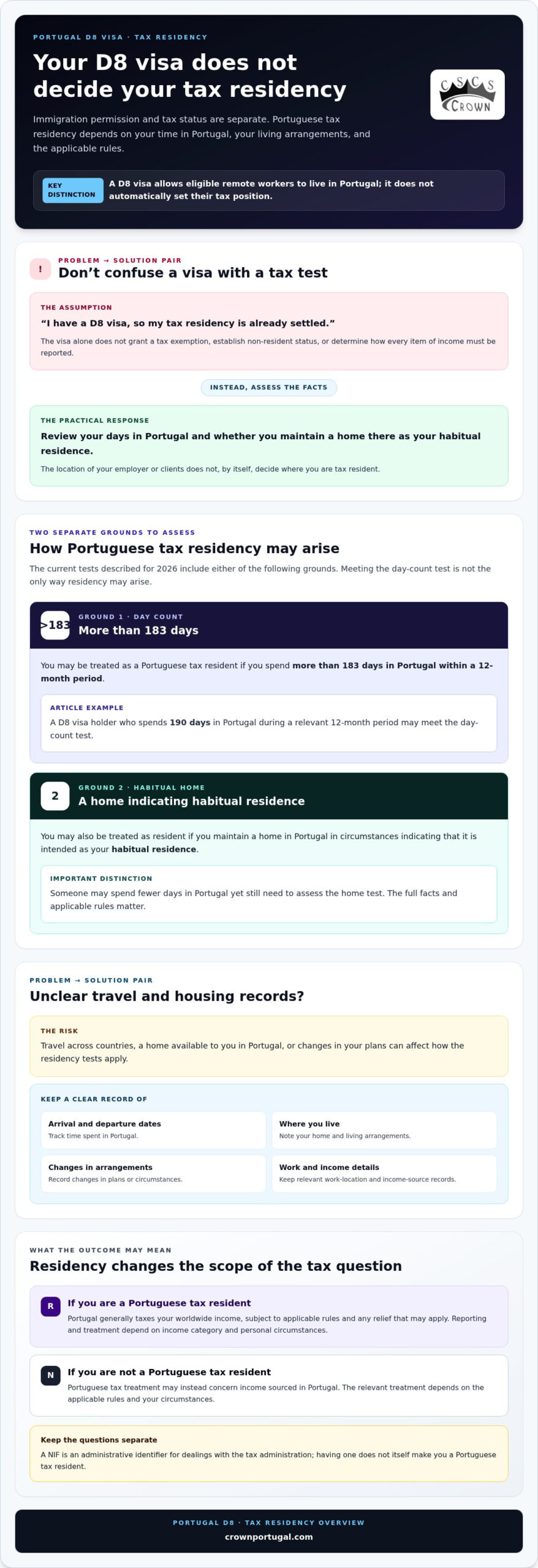
Holding a D8 visa and being a Portuguese tax resident are related to your move, but they are separate determinations. The visa concerns immigration permission. Tax residency is assessed under Portuguese tax rules using facts such as how long you stay and whether you have a habitual home in Portugal. The visa alone doesn’t settle your tax position.
A digital nomad can work remotely while living in a different country, but the location of the employer or clients doesn’t by itself decide where the worker is tax resident. For D8 holders, the practical question is how their time and living arrangements in Portugal fit the applicable tests.
How Portuguese tax residency is assessed
Under the current tests described for 2026, an individual may be treated as a Portuguese tax resident if they spend more than 183 days in Portugal within a 12-month period, or if they maintain a home in Portugal in circumstances indicating it is intended as their habitual residence. These are separate grounds. Meeting the day-count test is not the only way residency may arise.
For example, a D8 visa holder who spends 190 days in Portugal during a relevant 12-month period may meet the day-count test. Someone else might spend fewer days in Portugal but maintain a home there in a way that indicates it is their habitual residence. Their circumstances may still require careful assessment. Neither example determines every person’s status; the full facts and applicable rules matter.
Keep a clear record of arrival and departure dates, where you live, and changes in your arrangements. A pattern of travel across countries, a home available to you in Portugal, or a change in your plans may affect how the tests apply. The dates you spend in the country, the period being assessed, and your connection to any home can all be relevant.
What the D8 visa does and does not determine
The D8 route is designed for eligible non-EU remote workers seeking permission to live in Portugal while working remotely. It doesn’t automatically grant a tax exemption, establish non-resident status, or determine how every item of income must be reported. Those questions require a separate assessment of your tax residence, income, and work arrangement.
If you become a Portuguese tax resident, Portugal generally taxes your worldwide income, subject to applicable rules and any relief that may apply. If you aren’t resident, Portuguese tax treatment may instead concern income sourced in Portugal. These are broad principles, not a personal tax calculation. The Portugal D8 visa tax obligations that apply to you depend on your dates, living arrangements, and income. Immigration planning can begin with the complete Portugal D8 requirements guide, while tax residency should be considered separately.
What Portuguese Tax Obligations May Apply to D8 Remote Workers?
The D8 visa doesn’t create one standard tax outcome. Potential obligations depend on your Portuguese tax-residency status, the type and source of your income, how your work is organised, and the rules that apply to your circumstances. Tax reporting, tax registration, social security, and VAT are separate questions, even when they relate to the same remote-work activity.
Your residency, income sources, work status, and cross-border arrangements determine which Portuguese tax questions you need to resolve. Start by identifying those details rather than assuming every D8 holder has identical filing or contribution duties.
Income tax reporting and the Portuguese IRS
If you’re a Portuguese tax resident, you may need to report income from Portugal and abroad under the applicable personal income tax rules. The scope and treatment depend on the income category and your circumstances. Employment salary, income from independent professional services, and other income may be classified and reported differently, so the label used by an employer or client isn’t the whole analysis.
Tax paid in another country doesn’t automatically remove a Portuguese reporting obligation. A double-tax treaty or foreign-tax credit may provide relief in some cases, but the outcome depends on the countries involved, relevant treaty provisions, and how the income is classified. For a further overview of Portuguese tax topics, consult Deloitte’s Guide to Portuguese Taxation. It’s general reference material, not a determination of your personal filing position.
Social security, VAT, and registration are separate questions
Social security treatment depends on factors such as whether you’re an employee or independent professional, where the work is performed, and which cross-border coordination rules apply. Your tax-residency conclusion alone doesn’t resolve those questions. If you work across borders, the applicable arrangements and supporting documents can be especially important.
Independent professionals may also need to assess VAT obligations. Whether VAT registration, invoicing, or a particular treatment applies can depend on the activity, customer, and place-of-supply rules. Don’t assume every freelancer has the same VAT duties, or that an income tax classification answers the VAT question.
A Portuguese tax identification number, or NIF, supports dealings with the tax administration, but having one does not itself make you a Portuguese tax resident. It is an administrative identifier, not a residency test. Keep records of income, contracts, work locations, and tax paid abroad so each obligation can be assessed separately. Crown Portugal supports D8 move planning and NIF registration as part of administrative preparation. For more information, see D8 and NIF registration support. Individual tax treatment depends on your full circumstances.
Employee or Freelancer: How Work Arrangements Change D8 Tax Analysis
Your work arrangement helps determine which tax and compliance questions to investigate, but it doesn’t produce an automatic answer. A foreign employer, overseas clients, or a contract calling you an “independent contractor” won’t alone settle how Portugal treats your work. The substance of the relationship, where you perform the work, your tax-residency position, and relevant Portuguese and cross-border rules all matter.
| Question to assess | Employee | Independent professional |
|---|---|---|
| What is the work relationship? | Who employs you, and what do your employment agreement and duties say? | What services do you provide, and how do you manage your work and client relationships? |
| Where is the work performed? | Record the dates and locations where you carry out your job. | Track where services are performed and where your business activity is organised. |
| What administration may need review? | Consider Portuguese income reporting, payroll withholding, and possible employer obligations. | Consider activity registration, invoicing, income classification, and possible VAT treatment. |
| What cross-border issues arise? | Check social security coordination and whether treaty provisions affect income taxation. | Assess social security rules, customer location, service type, and any applicable treaty relief. |
If you work remotely as an employee
Start with your employer’s identity and location, your employment contract, where you physically work, and the dates you’re in Portugal. If you become a Portuguese tax resident, having an overseas employer doesn’t automatically remove questions about reporting employment income in Portugal. Payroll withholding and any employer obligations are separate matters that may require assessment under the rules applying to your circumstances. Keep employment documents, payslips, and travel records together.
If you invoice clients as a freelancer
Independent professionals should consider whether and how to register their activity, how income is classified, what invoicing requirements apply, and whether VAT rules affect their services. VAT treatment can depend on the service supplied and the customer’s location and status, so an overseas client does not, by itself, determine the answer. A contract’s wording is relevant, but the actual working relationship and activity also need consideration. For NIF and fiscal-registration context, see the Portugal NIF and fiscal setup guide.
Double taxation is another question to examine, not an outcome that can be assumed or dismissed. Domestic rules and any applicable tax treaty may affect which country can tax particular income and whether relief is available. The analysis depends on the countries involved, income category, and facts of the arrangement.
Finally, a D8 visa doesn’t automatically grant a special tax regime or exemption. Portugal’s former Non-Habitual Resident regime is closed to new applicants, while newer incentives have specific eligibility conditions. Treat the visa, your work classification, and any potential tax regime as separate parts of your Portugal D8 visa tax obligations assessment.
How to Prepare for Portugal D8 Visa Tax Compliance in 2026
A clear record of your move and work arrangements makes it easier to identify which Portugal D8 visa tax obligations need attention. Use this checklist to organise the facts and questions. It’s general preparation, not an individual tax assessment. Your residency position, income categories, employment status, and cross-border circumstances may lead to different requirements.
Build a record of residence, work, and income
Start a secure, organised file and update it as your circumstances change. Keep records that help explain your situation, while remembering that no single document necessarily determines tax residency.
- Track your time in Portugal. Record arrival and departure dates, including travel between Portugal and other countries. Keep relevant travel confirmations and accommodation records.
- Document where and how you work. Save employment contracts or service agreements, and note your work location and dates. Record changes in employer, client base, contract terms, or employment status.
- Organise income evidence. Keep payslips, invoices, payment records, and documents showing income sources. Retain foreign tax records and details of tax paid abroad where relevant.
- Review the file when facts change. A new employer, a shift from employment to freelance work, or a different pattern of time in Portugal may affect the questions you need to assess.
Prepare registration and filing questions early
Separate the administrative issues rather than treating them as one tax task. Make a list of questions about:
- NIF: whether your tax identification details and taxpayer information are in order.
- Tax registration: whether your income or work activity requires a particular registration or update.
- Social security: which rules apply to your employee or self-employed status and any cross-border arrangement.
- VAT: whether your activity, services, and customers raise registration or invoicing questions.
- Annual filing: which return and supporting information may apply to your income and tax-residency position.
Check current procedures through Portugal’s Autoridade Tributária e Aduaneira and Portal das Finanças, and consult official Portuguese Social Security information for contribution and registration matters. Before acting, verify the forms, deadlines, thresholds, and rules that apply to the relevant tax year. Requirements can change, and a previous year’s process may not be current.
Crown Portugal assists with D8 and NIF-related administrative preparation as part of planning your move. Arrange support with your D8 and NIF preparation, and seek individual tax advice for decisions that depend on your income and cross-border circumstances.
How Crown Portugal Can Support Your D8 Move and Tax Setup
Planning a move under the D8 visa involves connected but distinct processes. Immigration documents, relocation arrangements, NIF registration, and tax questions each have their own purpose and requirements. Crown Portugal is an immigration and relocation consultancy that assists with D8 visa applications and related administrative preparation, helping you organise these workstreams as part of your move.
Coordinate immigration and tax-registration preparation
NIF registration can be part of preparing to manage your affairs with the Portuguese tax administration. It supports tax-related administration, but it doesn’t determine your tax-residency status or establish how your income should be treated. Keeping that distinction clear helps prevent an administrative step from being mistaken for an answer to a personal tax question.
Before seeking guidance, gather a concise overview of your plans and circumstances. Include:
- Your expected arrival date and a timeline of time spent in Portugal.
- Your employment or service contract, employer or client details, and where you expect to work.
- The types and sources of income you receive, along with any relevant overseas tax records.
- Questions about D8 application steps, NIF registration, relocation administration, and issues that require individual tax advice.
This preparation can help identify which administrative tasks can be coordinated and which tax matters need a separate assessment. Crown Portugal supports immigration and NIF-related preparation. Individual tax advice and tax-return preparation are separate from this administrative support. Don’t assume a visa outcome, tax result, or eligibility for a particular tax regime in advance.
Choose a clear next step for your D8 plans
Start by establishing the relevant facts: your travel dates, living arrangements, work location, income sources, and contractual relationship. Organise the supporting records, then verify the current Portuguese rules and processes that apply to your situation. The Portugal D8 visa tax obligations you may face depend on those details, not on the visa label alone.
With your timeline and documents in order, you can plan the immigration and relocation steps more clearly and identify where tax-specific advice is needed. Discuss your Portugal D8 visa plans with Crown Portugal for support with D8 application planning and related relocation administration.
Plan Your Portugal Move With Clarity
The key distinction is that a D8 visa doesn’t automatically determine your Portuguese tax-residency position. Your days in Portugal, living arrangements, income sources, and work structure help shape the questions to assess. Keep records of travel, contracts, earnings, and work locations, then verify current tax, social security, and VAT requirements for your circumstances.
These details are the starting point for understanding your Portugal D8 visa tax obligations, but general guidance can’t replace advice tailored to your income and cross-border situation. Immigration and administrative preparation can still be organised alongside your tax planning.
Crown Portugal is an immigration consultancy founded in 2018 that assists with D8 visa applications and NIF registration. The consultancy can help coordinate those administrative steps as you prepare for your move, while individualized tax advice and tax-return preparation remain separate matters.
Prepare your timeline, work details, and questions, then discuss your Portugal D8 visa plans with Crown Portugal for support with your D8 application and related relocation administration.
Frequently Asked Questions
Does a Portugal D8 visa automatically make me a Portuguese tax resident?
No. A D8 visa gives immigration permission, but Portuguese tax residency is assessed separately. The tests include spending more than 183 days in Portugal within a 12-month period or maintaining a home in circumstances indicating it is your habitual residence. Consider your visa, time in Portugal, living arrangements, and other facts separately. Keep a record of your travel and housing arrangements to help assess your position.
How many days can I stay in Portugal before tax residency becomes an issue?
More than 183 days in Portugal within a 12-month period may meet the day-count test for tax residency. There isn’t a simple “safe” number of days to rely on, because maintaining a home in Portugal that indicates habitual residence may also be relevant. Track arrival and departure dates, and consider your accommodation and circumstances as a whole rather than relying on the day count alone.
Do I have to pay Portuguese tax on foreign income while living in Portugal on a D8 visa?
If you’re a Portuguese tax resident, foreign income may need to be reported in Portugal, and its treatment depends on its category and the rules that apply. Tax paid abroad doesn’t automatically remove a Portuguese reporting obligation. A tax treaty or foreign-tax credit may provide relief in some circumstances, but the result depends on the countries, income, and relevant treaty provisions. The Portugal D8 visa tax obligations that apply depend on your individual facts.
Can I keep working for a foreign employer while living in Portugal on a D8 visa?
The D8 route is intended for eligible remote workers, including people working for an employer abroad. However, the foreign employer’s location doesn’t settle your Portuguese tax or payroll position. If you become a Portuguese tax resident, income reporting may need assessment, and employer payroll obligations and social security coordination are separate questions. Review your employment agreement, where you perform the work, and your time in Portugal to understand which issues apply.
What happens if I become a Portuguese tax resident during the year?
Your tax obligations may change if you meet a Portuguese residency test during the year. The date residency begins and how income is treated for the relevant tax period depend on your circumstances and current rules, so don’t assume the same treatment applies to every part of the year. Keep evidence of travel, accommodation, and income dates, then verify the applicable reporting requirements and filing process for that tax year.
Do D8 visa holders need a Portuguese NIF?
A NIF is Portugal’s tax identification number and supports dealings with the Portuguese tax administration. It may be needed for tax-related and other administrative steps, depending on your situation. Having a NIF does not, by itself, make you a Portuguese tax resident or decide how your income is taxed. Crown Portugal assists with NIF registration as part of relocation administration and preparation for a move.
Does the Portugal D8 visa qualify me for a special tax regime?
No. A D8 visa does not automatically provide a special tax rate or exemption. Portugal’s former Non-Habitual Resident regime closed to new applicants in 2024. The newer IFICI regime has specific eligibility criteria aimed at certain qualified professionals and activities; remote work for a foreign employer without a qualifying Portuguese connection generally doesn’t qualify. Check current official requirements before relying on any tax incentive, as eligibility depends on your circumstances.