

EU Citizen Relocation Service in Portugal: How to Choose the Right Support

Moving to Portugal as an EU citizen isn’t an immigration-permission problem; it’s a coordination challenge. EU citizens can live and work in Portugal without a visa, but stays longer than three months require registration for the CRUE. Other practical steps may include arranging a NIF or NISS, accommodation and arrival support. An EU citizen relocation service Portugal offers should help clarify which tasks apply to your circumstances, not suggest that you need permission to move.
It’s understandable to have questions about deadlines, forms and how tax, social-security and settling-in arrangements fit together. Some administrative steps can also be managed independently, so the value of professional support depends on your needs and the provider’s confirmed scope.
This guide explains the difference between immigration rights and post-arrival administration, outlines tasks a relocation provider may assist with, and gives you a practical checklist for comparing scope, communication and service details. You’ll also learn what to verify before engaging a provider, so you can make informed decisions, check current requirements and understand your responsibilities during the move.
Key Takeaways
- Identify which parts of your move need support, then distinguish essential tasks from services you can manage independently.
- Use a written scope checklist to compare an EU citizen relocation service Portugal, including deliverables, exclusions, fees, communication and your own responsibilities.
- Prepare your nationality, intended length of stay, household details, work situation and known deadlines before a consultation.
- Confirm current requirements and the relevant authorities for your circumstances instead of relying on assumptions or outdated guidance.
- Consider whether Crown Portugal’s confirmed support with NIF, NISS, accommodation, airport transfers or residence matters matches your needs, and verify the precise scope before engaging.
EU citizens moving to Portugal: what relocation support is actually for
EU citizenship changes the permission question, not the practical work of settling in Portugal. In general, EU citizens can enter, live and work in Portugal without a visa under the EU principle of freedom of movement for workers. A stay beyond three months brings a separate residence-registration step: EU citizens must register for a Certificado de Registo de Cidadão da União Europeia (CRUE). This registration documents a right to reside; it isn’t a visa application.
Free movement establishes the right to move; professional relocation support is optional help with practical setup. A relocation service may coordinate agreed administrative and settling-in tasks, such as helping you prepare for registration or arrange accommodation. The provider’s role depends on the scope confirmed with you. You remain responsible for your decisions and for the accuracy of the information you supply.
Does an EU citizen need a visa to move to Portugal?
Generally, no. EU citizens don’t need a visa to move to Portugal, although registration and other requirements may apply after arrival, particularly for longer stays. The precise conditions and documents can depend on personal circumstances, so check current information with the relevant Portuguese authorities. If your situation involves an unusual residence history or another exception, use official guidance rather than treating general information as an individual legal assessment.
EU citizenship doesn’t automatically settle the procedures for a non-EU spouse or other family member. Their residence documentation may follow a different process, even when they’re accompanying an EU citizen. Confirm the applicable route and current requirements for each person in the household.
What a Portugal relocation service can and cannot do
An EU citizen relocation service Portugal provider may help organise tasks within its confirmed scope. For example, it might explain a process, help prepare information or coordinate agreed settling-in arrangements. Crown Portugal lists NIF and NISS support, accommodation assistance, airport transfers, and residence-permit support for EU nationals and non-EU family members. Confirm which services are available for your circumstances and what each includes.
Consultancy assistance doesn’t replace a decision by a Portuguese authority, and no provider should imply that it can guarantee an official outcome. Don’t assume that administrative support includes employment placement, legal representation or property brokerage. These are distinct activities. Ask what is included, what is excluded and whether any step depends on a third party. That clarity helps you assess whether the provider can coordinate the practical tasks you need, rather than relying on a broad promise of support.
Which Portugal relocation tasks may matter after an EU citizen arrives?
There isn’t one checklist that applies in full to every EU citizen. The tasks to consider depend on factors such as how long you plan to stay, whether you’ll work in Portugal, and whether non-EU family members are moving with you. For residence conditions, consult the Official EU residence rights guidance, then verify Portuguese procedures, documents and deadlines with the relevant authority. A relocation provider can coordinate agreed tasks, but confirm its scope instead of assuming every step is included.
Residence registration and family circumstances
For an EU citizen staying in Portugal for more than three months, the CRUE residence-registration certificate is a key post-arrival task. Current guidance states that registration is made through the local Câmara Municipal within 30 days after the initial three-month period. Check the applicable requirements and documents before acting, as details may depend on your circumstances. Non-EU family members may have a separate residence procedure; don’t assume the EU citizen’s registration covers them. For a broader explanation of permit categories, see the Portugal residence permit types guide.
NIF, NISS, accommodation, and arrival logistics
A NIF is Portugal’s tax identification number, while a NISS is its Social Security Identification Number. You may need to look into one or both depending on your plans, such as renting a home, managing tax matters or working. Assistance with obtaining an identification number is not the same as individual tax or social-security advice. For details about the tax number, consult the Portugal NIF registration guide.
Accommodation and airport transfers are practical settling-in needs, not residence registrations. A provider may offer help with these alongside NIF or NISS assistance, but ask which specific tasks are included and what remains your responsibility. Crown Portugal lists support in these areas; confirm the precise scope for your situation before relying on it.
Use this sequence as a planning prompt, not a substitute for checking current rules:
- Before arrival: Identify likely NIF or NISS needs and prepare questions about documents and appointments. Requirements and timing: verify.
- On arrival: Coordinate accommodation and any airport transfer you have arranged. Service arrangements: verify.
- After arrival: Check your CRUE registration deadline and whether work or family circumstances create additional steps. Deadline, authority and documents: verify.
How to compare EU citizen relocation services in Portugal
Compare providers by the work they agree to perform, not by broad promises of “complete support.” Assess an EU citizen relocation service Portugal against your actual needs, such as help preparing for registration, obtaining a NIF or NISS, or coordinating accommodation. Ask for the scope in writing and check who is responsible at each stage. When a provider describes its Portugal experience, ask how that experience applies to your particular circumstances rather than relying on general claims.
| What to compare | What to confirm |
|---|---|
| Task scope | Which tasks apply to your circumstances, and which are optional or outside the service? |
| Deliverables | What specific documents, coordination or follow-up will you receive? |
| Communication | Who is your contact, how are updates provided, and how will procedural changes be communicated? |
| Fees and exclusions | Request a written fee breakdown and check for separate third-party or other charges. |
| Responsibilities | Who prepares, checks, submits and follows up on each agreed item, and what information must you provide? |
Questions to ask before choosing a provider
Ask the provider to separate tasks relevant to an EU citizen from optional settling-in assistance. For each document or registration, clarify who prepares it, checks the information, submits it where applicable and follows up. Ask how you’ll be notified about changes to official procedures or appointment availability. The answers should be specific enough to include in the engagement terms, not left as verbal assurances.
Fees, scope, and realistic expectations
Before committing, request a written description of the service and its fee breakdown. Check whether translations, official or third-party charges, accommodation and travel logistics are included or excluded. Ask what could change the agreed scope and how additional work would be approved. Confirm cancellation and refund terms in writing before paying.
No consultancy can determine how an authority will decide a matter, so treat guarantees of official outcomes as a warning sign. A clear provider will explain dependencies, identify what remains your responsibility and avoid presenting third-party decisions as within its control. Compare documented responsibilities, not broad claims of complete support.
Finally, ask who will handle each stage, from initial preparation through any agreed follow-up, and what experience is relevant to your circumstances. The answers can help you judge whether the proposed assistance is practical and transparent. If you’re considering Crown Portugal, review its relocation and administrative support and confirm the precise scope for your situation before engaging the service.
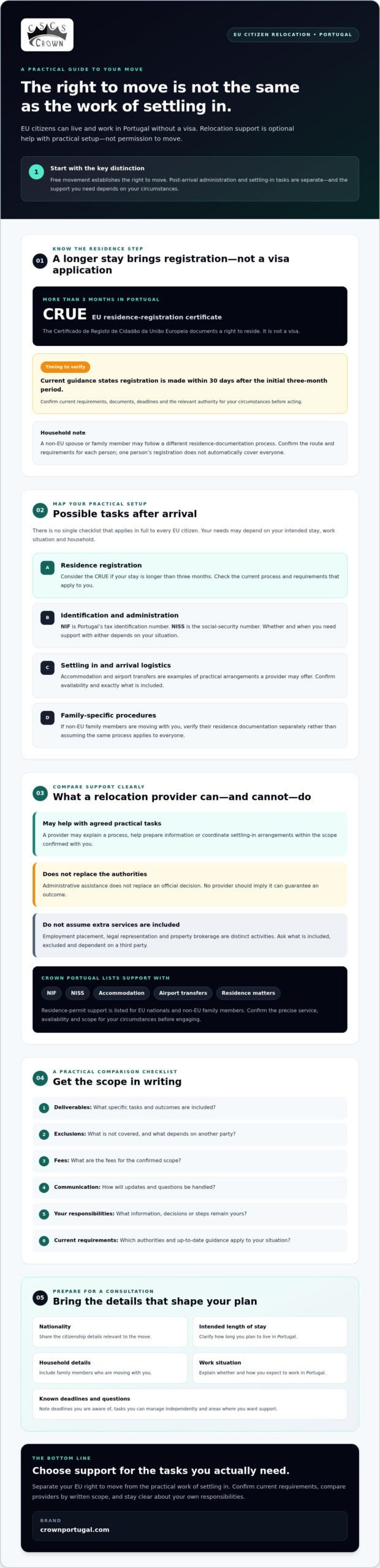
A practical checklist for preparing your relocation-service consultation
A focused consultation starts with a clear picture of your plans and the decisions you need help with. Before speaking with an EU citizen relocation service Portugal provider, prepare the information below, but don’t assume every document or registration will apply to you. Use the discussion to identify relevant steps and agree who will handle each one.
Information to prepare before an initial consultation
Note your nationality, intended length of stay, approximate move date, household members and work situation. If family members are moving with you, identify whether each is an EU citizen, since their procedures may differ. Gather relevant identification and existing administrative records for reference, but wait to send copies until you’ve verified the provider and understand how it handles personal documents.
Write down any questions about residence registration, NIF or NISS matters, accommodation and arrival logistics. For broader planning, use the Portugal moving checklist alongside your own notes.
How to agree a clear service plan
Use the consultation to turn a general request for help into a documented sequence of tasks. A written plan can show dependencies, clarify what you must supply and reduce misunderstandings if information or appointments change.
- 1. Define your needs. Separate tasks you want assistance with from decisions or arrangements you’ll manage yourself.
- 2. Share relevant context. Explain your nationality, intended stay, household circumstances, work situation and known deadlines. Flag uncertainties rather than guessing.
- 3. Confirm the scope. Ask which tasks are included, excluded or dependent on an authority or another third party. Identify who prepares, checks, submits and follows up on each agreed item.
- 4. Agree responsibilities and updates. Confirm what information and documents you must provide, how corrections will be handled, and how the provider will communicate progress or delays.
- 5. Verify before acting. Recheck current requirements, competent authorities and deadlines against official information. A provider’s plan is useful, but it shouldn’t replace verification of rules that apply to your circumstances.
Protect your personal information. Before sharing sensitive records, verify the provider’s identity, ask what documents are needed and why, and clarify how files will be transferred, accessed and retained. Don’t send documents through a channel you haven’t agreed is appropriate.
Once the plan is written down, review the next steps and resolve any open questions before proceeding. If you’d like to discuss whether Crown Portugal’s listed relocation and administrative support fits your needs, contact Crown Portugal about your relocation requirements and confirm the precise scope for your circumstances.
When Crown Portugal may be the right relocation-support partner
Crown Portugal may suit EU citizens who want practical help coordinating selected administrative or settling-in tasks, rather than help obtaining permission to move. The consultancy lists support with NIF and NISS matters, accommodation, airport transfers, and residence procedures for EU nationals and non-EU family members. The key question is whether the services it confirms match the tasks you actually need.
Match the service scope to your relocation needs
Your needs may be limited to understanding a registration step or may extend to coordinating several parts of arrival and settling in. An EU citizen moving alone may need a different combination of support from a household that includes non-EU family members. Their residence procedures can differ, so make sure the provider considers each person’s circumstances separately.
Don’t assume every service Crown Portugal lists is necessary for you or included together in one arrangement. Ask whether the consultancy can assist with the specific NIF, NISS, accommodation, airport-transfer or residence-related tasks you’ve identified. Confirm what each task involves, what you’ll need to provide, and which steps remain your responsibility. Assistance with an administrative number, for example, should not be mistaken for individual tax or social-security advice.
Next steps for assessing Crown Portugal
Before engaging an EU citizen relocation service Portugal, give the consultancy a concise outline of your nationality, intended stay, household, work situation and expected move timing. Ask it to confirm whether your circumstances fit the support available and to provide a written description of relevant deliverables, exclusions and fees. You can also ask who will handle each agreed stage, what experience or professional role is relevant, and how updates will be provided.
Ask how current Portuguese procedures will be checked, including applicable documents, deadlines and authorities. Confirm which matters fall outside the consultancy’s remit and whether any part of the plan depends on an authority or other third party. This helps set realistic expectations without suggesting that a provider controls official decisions or can guarantee an outcome.
If the proposed scope matches your needs and the responsibilities are clear, discuss your circumstances directly and request written details before committing. Discuss your Portugal relocation requirements with Crown Portugal.
Plan your Portugal move with clear responsibilities
Choosing an EU citizen relocation service Portugal provider is ultimately about matching practical support to your circumstances. EU citizenship means you don’t need a visa to move to Portugal, but registration and settling-in tasks may still require planning. Identify which steps apply to you, verify current requirements, and compare providers by written deliverables, exclusions, fees and responsibilities.
Crown Portugal lists support with NIF and NISS matters, accommodation, airport transfers, and residence-permit assistance. These services won’t all be relevant to every EU citizen, so confirm the exact scope, fees and who will handle each agreed task before engaging. You remain responsible for your personal decisions and the accuracy of information you provide.
To discuss which practical tasks may fit your move, contact Crown Portugal about your Portugal relocation requirements and request written details suited to your situation. With a clear plan and verified responsibilities, you can approach your move with greater confidence.
Frequently Asked Questions
Do EU citizens need to register their residence in Portugal?
Yes, if they stay in Portugal for more than three months, EU citizens must register and obtain a Certificado de Registo de Cidadão da União Europeia (CRUE). Current guidance says to register at the local Câmara Municipal within 30 days after the initial three-month period has passed. Confirm the current deadline, required documents and competent authority before applying, as procedures can change and individual circumstances may matter.
Can a relocation service help EU citizens obtain a NIF or NISS in Portugal?
It may, if the provider confirms that assistance with the relevant number is within its service scope. A NIF is Portugal’s tax identification number, while a NISS is the Social Security Identification Number. Administrative help with obtaining either number isn’t the same as personal tax or social-security advice. Ask what preparation or coordination is included, what information you must supply and whether any step depends on a third party.
What should an EU citizen relocation service in Portugal include?
There’s no standard package that every EU citizen needs. An EU citizen relocation service Portugal provider should clearly describe the tasks it will handle, such as agreed help with registrations, NIF or NISS matters, accommodation or airport transfers. Look for named deliverables, written fees and exclusions, communication arrangements, and a clear division of responsibilities. Confirm that the service fits your situation rather than assuming every listed task is necessary.
How do I choose a relocation consultancy for Portugal?
Compare providers by documented scope and relevant Portugal experience, not broad claims of complete support. Ask who prepares, checks, submits and follows up on each agreed item, and how changes or delays will be communicated. Request written details of fees, exclusions, cancellation terms and your responsibilities before committing. Be cautious of promises about official decisions, since a consultancy can’t guarantee how an authority will decide your case.
Can a relocation service help non-EU family members of an EU citizen?
Some consultancies, including Crown Portugal, list residence-permit assistance for EU nationals and their non-EU family members. However, a non-EU family member may need to follow a different residence procedure from the EU citizen. Ask the provider to assess each household member’s circumstances, explain the support it can offer and identify any steps outside its remit. Verify the applicable requirements and documents with current official guidance before proceeding.
Is hiring a relocation service necessary for an EU citizen moving to Portugal?
No. EU citizens can manage relevant administrative and settling-in tasks themselves if they prefer and have time to coordinate them. A service is optional support, which may be useful if you want help organising tasks such as NIF or NISS administration, accommodation or arrival logistics. Compare the assistance offered with your actual needs, and confirm the scope and fees in writing. You remain responsible for your decisions and supplied information.