

Portugal Residency for Retirees: Comprehensive 2026 Guide

Did you know that securing your Portugal residency for retirees in 2026 depends less on your choice of a scenic destination and more on the precise alignment of your monthly Social Security statement with the current Portuguese minimum wage? While the prospect of a Mediterranean lifestyle is enticing, the reality of relocating involves a complex series of administrative hurdles that require meticulous preparation. Many applicants feel a justified sense of anxiety when facing the Portuguese consulate, fearing that a single missing document or a misunderstood income requirement could derail their entire transition.
We understand that you’re seeking stability and clarity rather than bureaucratic frustration. This comprehensive guide provides the exact financial requirements, legal pathways, and administrative steps necessary to secure your retirement residency with confidence. We’ll clarify how your specific income sources, such as dividends and 401k withdrawals, qualify under the current €920 monthly passive income threshold. By following this expert-led roadmap, you’ll move from initial planning in your home country to a successful residence permit issuance in Portugal, ensuring every detail of your application meets the highest professional standards for a smooth relocation process.
Key Takeaways
- Identify the core differences between the D7 Passive Income visa and the Golden Visa to determine which residency pathway aligns with your financial structure and stay requirements.
- Learn the exact calculation for your Portugal residency for retirees based on the 2026 minimum wage, including specific percentage increases for spouses and dependent family members.
- Follow a structured two stage application roadmap that covers document preparation in your home country and the critical appointment at the Portuguese Consulate or VFS Global.
- Understand your rights within the SNS public healthcare system and the fiscal implications of the IFICI tax regime to ensure full legal and medical compliance.
- Discover how professional assistance with NIF registration, NISS acquisition, and initial accommodation can streamline your transition and mitigate the risk of document rejection.
Understanding Portugal Residency Options for Retirees in 2026
Portugal’s legal framework for immigration provides specific pathways for individuals seeking to transition into a new administrative status during their retirement. Under Lei n.º 23/2007, the government establishes clear protocols for non-EU nationals to obtain residency based on their financial self-sufficiency. Securing Portugal residency for retirees requires a clear understanding of these regulations to ensure that every document submitted aligns with the current expectations of the Portuguese authorities.
To better understand the nuances of these residency pathways, watch this helpful video:
The D7 Visa: The “Passive Income” Pathway
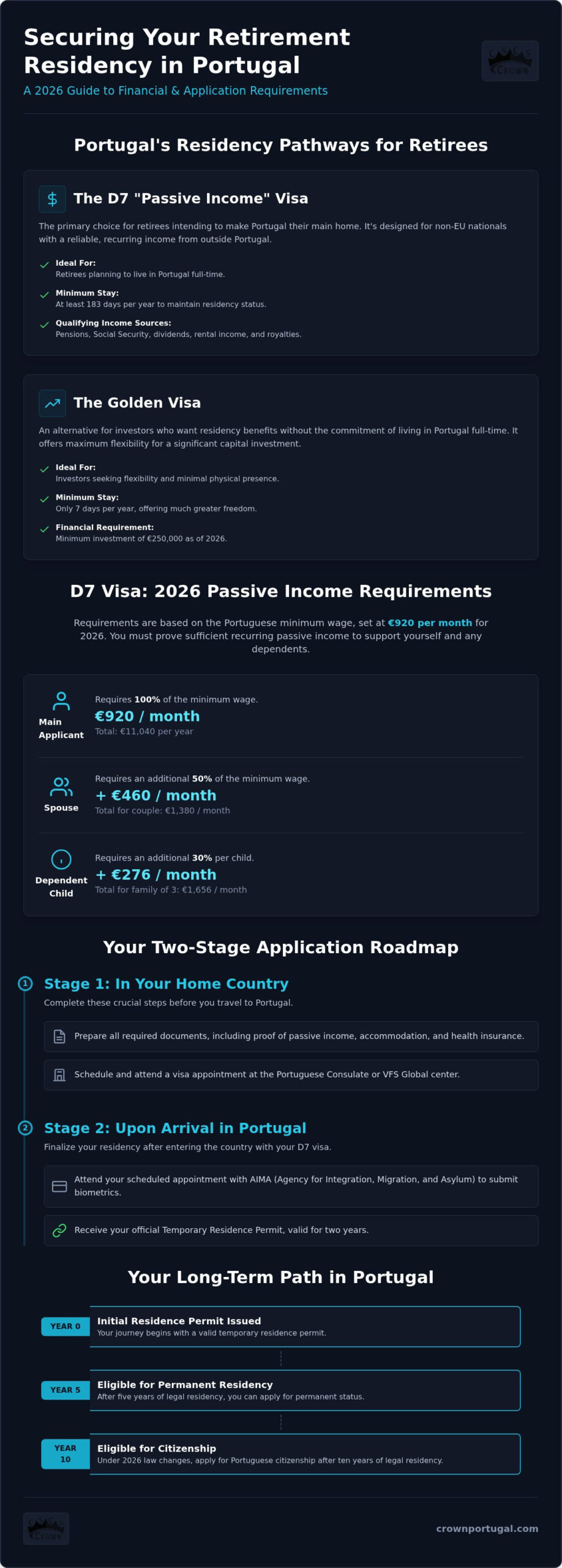
The D7 Visa, often referred to as the Passive Income Visa, remains the primary vehicle for Portugal residency for retirees. It’s specifically designed for non-EU, non-EEA, and non-Swiss nationals who possess a recurring, reliable income from sources outside of Portugal. This pathway is particularly advantageous for individuals who have already established their financial independence through various means. Qualifying income sources typically include:
- State or private pensions and Social Security distributions.
- Dividends from investment portfolios or interest from savings accounts.
- Rental income from real estate assets located in your home country.
- Royalties or recurring payments from intellectual property.
Because the D7 requires a significant physical presence in the country, it’s the preferred choice for those who intend to make Portugal their primary residence. For a detailed breakdown of the specific fiscal thresholds required for this year, consult our Portugal D7 Visa Passive Income guide.
Golden Visa vs. D7: Choosing the Right Investment Level
Choosing between the D7 and the Golden Visa depends largely on your lifestyle goals and financial strategy. The D7 Visa typically requires you to spend at least 183 days per year in the country to maintain your status. In contrast, the Golden Visa offers much greater flexibility, requiring only seven days of stay per year. However, the Golden Visa necessitates a significant capital commitment, with a minimum investment of €250,000 as of 2026. Many applicants explore Immigrant investor programs (Golden Visas) as an alternative to standard residency permits if they don’t plan to live in Portugal full-time initially.
The transition from temporary to permanent residency is a critical milestone in your relocation journey. After five years of holding a valid residence permit, you’re eligible to apply for permanent status. It’s important to note that under the 2026 nationality law changes, the required period of legal residency before applying for citizenship is now 10 years, calculated from the date of your first residence permit issuance. This long term roadmap provides a clear path toward security and stability within the European Union.
Passive Income and Financial Requirements for Retirees
The financial threshold for Portugal residency for retirees is intrinsically linked to the national minimum wage. For 2026, the Portuguese government has established the minimum wage at €920 per month. As a primary applicant, you’re required to demonstrate a guaranteed passive income that meets 100% of this amount, which totals €11,040 annually. If you’re applying with a spouse, you must show an additional 50% of the minimum wage (€460 per month), while each dependent child requires an additional 30% (€276 per month).
Qualifying income must be regular, recurring, and passive in nature. This includes state-funded Social Security, private pension distributions, dividends from brokerage accounts, and documented rental income from properties you own. Consulates place heavy emphasis on liquidity; simply possessing high-value assets isn’t sufficient. You’re typically expected to show that a full year’s worth of the required income is already deposited in a Portuguese bank account to prove you can support yourself without seeking local employment. Working with a specialist offering Portugal D7 visa assistance can help ensure your financial documentation meets every current consulate requirement without error.
Securing Your NIF and Portuguese Bank Account
The Numero de Identificação Fiscal (NIF) is the first administrative requirement for any retiree. You cannot open a bank account, sign a lease, or finalize a residency application without this personal tax number. While it’s possible to obtain a NIF in person, many retirees prefer to secure it remotely through a fiscal representative to avoid travel before their visa is granted. Managing the administrative prerequisites for Portugal residency for retirees involves more than just showing a balance; it requires a strategic arrangement of your fiscal affairs. You can streamline this process by utilizing professional services for NIF registration and fiscal representation, ensuring your fiscal identity is established correctly before you initiate your banking paperwork.
Documenting Your Financial Stability
Consulates require a meticulous paper trail to verify your financial claims. You’ll need to provide original bank statements from the last six months and official proof of pension letters. Tax returns from your country of origin serve as vital secondary evidence of your income’s consistency. To prevent rejection at the consulate, you must provide apostilled or officially translated documents that clearly link every deposit in your bank statement to a specific, recurring passive income source. This level of documentation ensures that the reviewing officer can easily verify the stability and origin of your funds without ambiguity.
Step-by-Step Application Process for Retirement Residency
Securing Portugal residency for retirees is a multi-stage procedural journey that begins in your current country of residence and concludes with the issuance of a physical residency card in Portugal. This process is designed to be thorough, ensuring that every applicant meets the legal standards for a long-term stay. The transition is divided into two distinct phases: the consular phase, where you obtain a temporary entry visa, and the national phase, where you register with the Agency for Integration, Migration and Asylum (AIMA). Following these steps in a logical hierarchy prevents administrative delays and ensures your relocation stays on track.
Navigating the Consulate Stage
The initial stage requires the meticulous assembly of a document file that proves your eligibility and character. You’ll need an apostilled FBI or national police clearance certificate, proof of private health insurance that covers your initial stay, and evidence of long-term accommodation in Portugal, such as a signed one-year lease agreement. One of the most common pitfalls in the passive income visa Portugal application is submitting incomplete financial records or documents that haven’t been properly legalized. Once your file is ready, you’ll attend an appointment at a VFS Global center or the Portuguese Consulate. Processing times for the initial 120-day double-entry visa typically range from 60 to 90 days, though the entire journey from your first application to the final residence permit can take up to six months.
The AIMA Appointment and Residency Card
After your entry visa is granted, you’ll travel to Portugal to finalize your administrative status. Your visa usually includes a pre-scheduled date for your AIMA appointment, which is the successor to the former SEF agency. During this session, officials collect your biometric data, including fingerprints and a digital photograph. This is also the stage where you can initiate family reunification under the D-6 visa for eligible dependents who didn’t apply simultaneously. It’s a critical moment where the temporary status in your passport transitions into a formal Residency Permit, also known as the Title of Residence. This physical card serves as your primary identification within the country and grants you the right to travel freely throughout the Schengen Area. The methodical nature of these steps ensures that your relocation is grounded in full legal compliance from day one.
Relocation Essentials: Healthcare, Tax, and Social Security
Establishing a clear legal and fiscal footprint is a mandatory requirement for any individual finalizing their Portugal residency for retirees. This stage of the relocation involves integrating into the national administrative infrastructure through the acquisition of specific identification numbers and the registration of your local address. Beyond the residency card, you must secure a Social Security Number (NISS) to ensure full administrative compliance. These steps are not merely formalities; they’re the mechanisms that allow you to access public services, manage your tax obligations, and maintain a valid legal status within the country.
Accessing the Portuguese Healthcare System
Retirees in Portugal typically utilize a combination of public and private medical services to manage their health. During the initial visa application phase, you’re required to hold comprehensive private health insurance to prove you won’t be a burden on the state. For a couple in their 60s, a robust private policy typically costs approximately €300 per month. Once your residency permit is issued, you gain the right to register for the Serviço Nacional de Saúde (SNS), which is the public healthcare system. This registration is completed at the local Centro de Saúde in your area of residence. While the SNS provides affordable care for emergencies and basic needs, many residents keep their private insurance to benefit from shorter wait times for specialists and access to private hospital networks.
Fiscal Setup and the IFICI Regime
The tax landscape for new residents has evolved following the discontinuation of the Non-Habitual Resident (NHR) program. The new Tax Incentive for Scientific Research and Innovation (IFICI) now serves as the primary incentive regime, though it’s more targeted than its predecessor. For most individuals seeking Portugal residency for retirees, foreign-sourced pension income is now generally subject to standard progressive tax rates, which range from 14.5% to 48%. It’s vital to consult with a professional tax representative to understand how international tax treaties, such as the one between the US and Portugal, apply to your specific income sources to prevent double taxation. You can access expert analysis on these recent regulatory shifts by visiting the Crown Portugal YouTube channel for daily updates and data.
Administrative oversights during the fiscal registration process can lead to significant delays in your residency timeline or unexpected tax liabilities. We provide expert facilitation for your transition, including the professional acquisition of your Social Security Number (NISS) and fiscal representation, ensuring every detail of your relocation is handled with meticulous organization.
Strategic Planning for Your Portuguese Retirement
Strategic planning is the differentiator between a stressful relocation and a seamless transition. While the initial visa is a significant milestone, maintaining your Portugal residency for retirees requires ongoing administrative vigilance. Success depends on more than just the initial approval; it requires a deep understanding of the long term obligations associated with your specific visa class. Professional oversight ensures that your status remains compliant with evolving regulations, such as the 2026 changes to residency protocols. Navigating these requirements alone often leads to preventable errors in renewal timelines or document legalization that can disrupt your retirement.
How Crown Portugal Facilitates Your Move
We provide a structured framework for your relocation, offering end-to-end consultancy for both D7 and Golden Visa applicants. Our methodology covers every administrative prerequisite, including the professional acquisition of your NIF and NISS, alongside the remote setup of a Portuguese bank account. We understand that the first few weeks in a new country are the most critical. To support this, we offer essential resettlement services like airport pick up in Portugal and assistance in securing your initial accommodation. This comprehensive approach allows you to focus on your lifestyle transition while we manage the procedural complexities of the immigration landscape with meticulous organization.
Long-term Compliance and Residency Renewal
Maintaining your legal status in Portugal is a process that extends well beyond your first year. Most residency permits follow a specific renewal cycle, typically structured as “2+3” years. The initial card is valid for two years, after which you must apply for a three year renewal. To maintain this status, D7 holders must adhere to minimum stay requirements, which generally involve spending at least 183 days per year in the country. We assist with the systematic organization of renewal files to ensure your right to remain is never jeopardized by administrative oversights.
As you approach the five year milestone, your strategic focus shifts toward permanent residency. This transition requires proof of social and linguistic integration, including the successful completion of a Portuguese language test at the A2 level. We provide ongoing guidance on family reunification for spouses and dependents, ensuring that your entire household benefits from the security of permanent status. By mapping out these steps early, you transform a temporary stay into a lifelong residency within the European Union, ultimately leading toward the possibility of citizenship.
Initiating Your Relocation Journey with Confidence
Achieving Portugal residency for retirees in 2026 requires a disciplined approach to both financial documentation and administrative timelines. Success hinges on aligning your passive income with the current €920 monthly threshold and navigating the multi stage transition from your home country to the final AIMA appointment. Whether you opt for the D7 visa’s focus on recurring income or the Golden Visa’s investment flexibility, the key is the meticulous organization of your fiscal and legal affairs from the very beginning.
Managing these requirements alone can be a significant administrative burden. With over seven years of expertise in Portuguese immigration law, our team provides the professional oversight needed to mitigate the risk of document rejection. We offer comprehensive relocation support that spans from NIF and NISS registration to securing your first accommodation and arranging airport pick up. This end to end assistance ensures that your transition is grounded in stability and legal compliance, allowing you to focus on your lifestyle goals.
Take the first step toward your new Mediterranean lifestyle today. Consult with Crown Portugal experts for your retirement residency to receive a personalized roadmap tailored to your specific financial and residency goals. We’re ready to facilitate your move with the precision and hospitality you deserve.
Frequently Asked Questions
What is the minimum passive income required for the Portugal D7 visa in 2026?
The minimum passive income required for a single applicant is €920 per month, which equals 100% of the 2026 Portuguese minimum wage. If you’re applying with a spouse, you must provide an additional 50% (€460), and 30% (€276) for each dependent child. Beyond the monthly income, consulates typically expect you to hold at least €11,040 in a Portuguese bank account to demonstrate immediate financial liquidity for your first year of residency.
Can I work in Portugal if I have a retirement (D7) visa?
Yes, you’re legally permitted to work in Portugal while holding a D7 residence permit. Although the initial application for Portugal residency for retirees is based on your ability to support yourself through passive income, the permit itself grants full rights to professional activity. This includes the right to seek local employment or establish a business as an entrepreneur. Your primary obligation remains maintaining the passive income levels that justified your initial residency status.
Do I need to buy property to get residency in Portugal as a retiree?
No, purchasing real estate isn’t a mandatory requirement for securing residency. You must provide proof of long term accommodation, which is typically satisfied by a registered rental agreement with a minimum duration of 12 months. While some retirees choose to invest in property, the D7 pathway focuses on your recurring income rather than capital assets. If you’re considering a property investment specifically for residency purposes, the Golden Visa remains a separate legal option with higher thresholds.
How long must I stay in Portugal each year to keep my residency permit?
To maintain a D7 residency permit, you must generally reside in Portugal for at least 183 days per year. This requirement ensures that you’re a tax resident and physically integrated into the country. If you spend more than six consecutive months or eight non-consecutive months outside of Portugal during your permit’s validity, your renewal application could be rejected. In contrast, the Golden Visa requires only seven days of stay per year to remain in good standing.
Is my US Social Security or UK State Pension taxable in Portugal?
Yes, foreign sourced pensions are generally taxable in Portugal under standard progressive income tax rates ranging from 14.5% to 48%. Because the NHR program was discontinued for new applicants in 2024, retirees now fall under the general tax regime. However, the US-Portugal tax treaty prevents double taxation by providing a foreign tax credit for taxes paid in the United States. It’s essential to coordinate with a fiscal representative to manage these international tax obligations correctly.
How long does the entire process take from application to residency card?
The entire process for securing Portugal residency for retirees typically takes between three and six months. This timeline begins with the preparation of your document file and the initial VFS Global or consulate appointment in your home country. Once your entry visa is granted, you’ll travel to Portugal for your biometric appointment with AIMA. The physical residency card is usually issued within 60 to 90 days following your successful biometric data collection in the country.
What is the difference between the D7 and the D8 Digital Nomad visa for retirees?
The primary difference lies in the nature of the income source. The D7 visa is designed for individuals with passive income, such as pensions, dividends, or rental earnings, making it the standard choice for retirees. The D8 Digital Nomad visa is specifically for those who are still professionally active and earn a salary from remote work for companies outside of Portugal. The D8 also requires a significantly higher monthly income threshold compared to the D7’s minimum wage requirement.
Can I bring my family with me on a retirement visa?
Yes, you’re entitled to bring eligible family members through the family reunification process, legally known as the D6 visa. This includes your spouse or legal partner, dependent children, and even dependent parents in certain circumstances. You must demonstrate that your total passive income is sufficient to support all family members according to the government’s percentage based thresholds. Each family member will receive their own residency card linked to your primary permit upon approval by AIMA.
Portugal D7 Visa Assistance: Professional Consultancy for 2026 Residency – Crown Portugal at 10:56 am, August 24, 2026 -
[…] Portugal Residency for Retirees: Comprehensive 2026 Guide […]
Portugal D7 Visa Passive Income: The Definitive 2026 Residency Guide – Crown Portugal at 10:52 am, August 26, 2026 -
[…] Portugal Residency for Retirees: Comprehensive 2026 Guide […]