

Passive Income Visa Portugal Application: The Step-by-Step 2026 Roadmap

What if the primary obstacle to your relocation isn’t the financial requirement, but the precise timing of your paperwork? Many prospective residents encounter a frustrating bureaucratic circularity where a Portuguese bank account is required for the visa, yet a NIF is mandatory for the account, and a local address is often demanded for both. This administrative loop, coupled with the recent transition to AIMA, often leaves applicants managing a delicate balance of expiring documents and shifting regulations.
We understand that securing your passive income visa Portugal application requires more than just a checklist; it demands a disciplined, step-by-step strategy. This 2026 roadmap is designed to eliminate administrative friction by providing the exact sequence of actions necessary for success. You’ll master the complete process, from the initial fiscal representation and NIF registration to the final residency appointment in Portugal. We’ll preview the updated 2026 income thresholds, the nuances of the current AIMA processing landscape, and the methodical approach required to transition from a visa holder to a legal resident with total confidence.
Takeaways
- Secure your NIF (Número de Identificação Fiscal) as the foundational step to enable essential transactions, such as opening a Portuguese bank account and signing a lease.
- Identify the 2026 financial thresholds and document requirements to ensure your passive income visa Portugal application meets the mandatory €920 monthly minimum for a single applicant.
- Execute a precise chronological roadmap for document preparation, including necessary apostilling and the coordination of your VFS Global or consulate interview.
- Differentiate between long-term residency requirements and short-term rentals to prevent common application rejections based on inadequate proof of accommodation.
- Navigate the post-arrival transition to the Agency for Integration, Migration and Asylum (AIMA) for your final biometric data collection and residency permit issuance.
Phase 1: Establishing Your Portuguese Administrative Foundation
The D7 Passive Income Visa serves as a primary residency pathway for non-EU, EEA, or Swiss nationals who possess a stable, recurring income from sources outside of Portugal. While the ultimate goal is a residency permit, the successful execution of a passive income visa Portugal application depends on a sequence of administrative steps that must be completed well before you step into a consulate. This initial phase involves securing your legal and financial presence within the Portuguese system. As Immigration to Portugal continues to evolve, the requirements for documentation have become more stringent, necessitating a methodical approach to your fiscal identity. You can’t skip these steps; they form the bedrock of your dossier.
Acquiring Your NIF and Fiscal Representative
The NIF (Número de Identificação Fiscal) is your Portuguese tax identification number, and it functions as the master key for all formal transactions. You’ll need this number to sign a lease, set up utilities, and open a bank account. For non-resident applicants in 2026, appointing a fiscal representative remains a legal requirement to bridge the gap between your current residence and your future home. A fiscal representative acts as your local point of contact with the Portuguese Tax Authority (Finanças), ensuring you receive critical tax notifications and remain compliant during the application process. Professional consultancy allows you to obtain this number remotely, ensuring your administrative foundation is solid before you begin gathering income evidence. This registration is the first official link between you and the Portuguese state.
Opening a Personal Bank Account in Portugal
A local bank account with a Portuguese IBAN is a non-negotiable component of your dossier. While digital-only platforms are convenient for daily spending, they typically don’t satisfy the requirements of a passive income visa Portugal application. Consular officers look for evidence that you’ve integrated into the local financial system by depositing a sufficient savings buffer into a traditional Portuguese institution. This demonstrates your financial autonomy and readiness to reside in the country.
To open an account, you’ll need your NIF, a valid passport, and detailed proof of profession and source of funds. Most banks require a minimum initial deposit, which often aligns with the 12-month savings buffer recommended for the visa. Having these funds in a local account provides the transparency that AIMA and consular officials require to verify your financial stability. It’s a clear signal that you have the means to support yourself without seeking local employment. Once the account is active, you can move toward the more complex task of documenting your recurring income streams.
Phase 2: Compiling the Passive Income Dossier
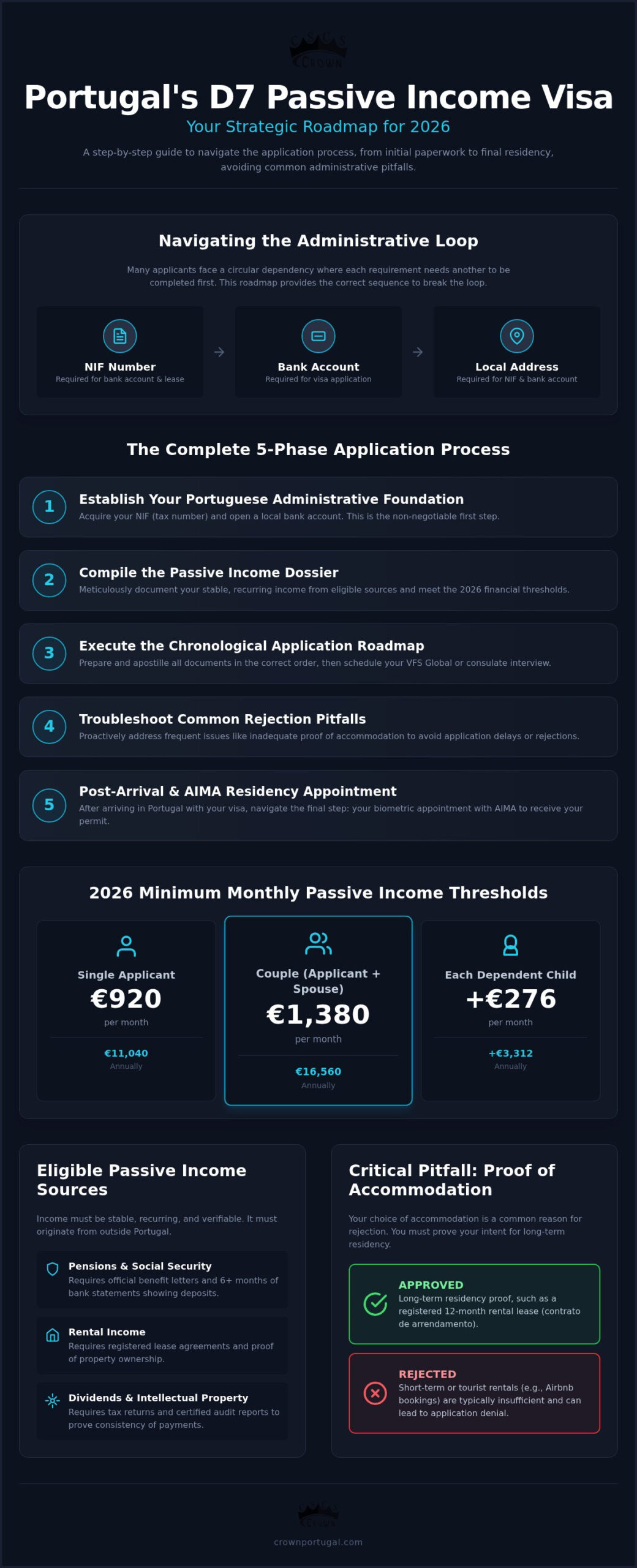
The success of a passive income visa Portugal application depends heavily on the meticulous organization of your physical dossier. Consular officers prioritize clarity and verifiable evidence. In 2026, the financial requirements are calculated based on the national minimum wage. For a single applicant, you must demonstrate a minimum monthly passive income of €920, which equals €11,040 annually. If you’re applying as a couple, the requirement increases to €1,380 per month. Each dependent child adds a further €276 to the monthly total. You should review the official visa information from the Portuguese Ministry of Foreign Affairs to ensure your specific income type aligns with current long-stay visa regulations. Beyond the numbers, you must provide a compelling personal cover letter. This document should detail your intent to reside in Portugal, your financial stability, and your plans for integration.
Documenting Eligible Passive Income Sources
Eligible income must be stable, recurring, and derived from sources outside of Portugal. Pensions and Social Security benefits are the most straightforward sources; you’ll need to provide official benefit letters and six months of bank statements showing the corresponding deposits. Retirees planning their move should consult our detailed overview of Portugal residency for retirees to understand exactly how pension income, Social Security statements, and 401k withdrawals are evaluated against the €920 monthly threshold. Rental income is also highly valued but requires a higher level of documentation, including registered lease agreements and proof of property ownership. If your income stems from dividends or intellectual property, you must present tax returns and, in some cases, certified audit reports to prove the consistency of the payouts. The authorities require proof that this income will continue for the duration of your residency.
Securing Your Portuguese Address
A 12-month lease agreement or a property deed is a mandatory component of your dossier. Many applicants encounter a bureaucratic "Catch-22" where landlords are hesitant to lease to those without a residency permit, yet the permit cannot be obtained without a registered lease. To be valid for the visa, your lease must be officially registered with the Autoridade Tributária (Tax Authority). Using professional services to secure accommodation in Portugal can resolve this administrative friction by ensuring your contract meets all legal requirements before your interview. Short-term or tourist rentals are generally rejected, as the D7 is intended for those establishing a permanent home. A properly registered long-term contract demonstrates your commitment to relocating and provides the stability that AIMA expects from new residents.
Phase 3: The Chronological Application Roadmap
The successful execution of a passive income visa Portugal application requires a precise chronological approach. Once your administrative foundation is set and your dossier is complete, you must transition into the active filing phase. This begins with the legalization of your foreign documents. Every official certificate, including criminal record checks and marriage licenses, must bear the Hague Apostille to be recognized by Portuguese authorities. This step is time-sensitive; many documents, particularly criminal background checks, have a limited validity period, often only 90 days. Coordination is essential to ensure no document expires before your scheduled interview. You’ll also need to pay the initial visa application fee, which is currently €110.
The Consulate Interview and VFS Process
Scheduling your appointment involves navigating the VFS Global portal or the local consulate’s booking system in your current country of residence. We recommend a meticulous approach to dossier organization. A tabbed, chronological folder allows the processing officer to verify your income and accommodation evidence without delays. This level of preparation reflects the "Crown" standard of administrative discipline. During the interview, expect questions regarding your specific relocation plans and your choice to reside in Portugal. Consistency between your personal cover letter and your verbal responses is vital. The officer’s goal is to verify that your passive income is stable and that you genuinely intend to establish a life in the country.
Understanding the Temporary D7 Entry Visa
If your application is approved, the consulate will issue a temporary "D" visa in your passport. According to the Portuguese Ministry of Foreign Affairs Visa Information, this national visa is typically valid for 120 days and permits two entries into the country. It’s not a permanent residency permit but a bridge that allows you to enter Portugal legally to finalize your status. This 120-day window is critical. It’s during this period that you must travel to Portugal and prepare for your biometric appointment.
A common concern for applicants is the possibility of this entry visa expiring before the residency appointment occurs. It’s important to understand that as long as you have a confirmed appointment with the Agency for Integration, Migration and Asylum (AIMA), your legal status in Portugal is protected, even if the sticker in your passport has surpassed its date. This temporary visa serves as the final administrative hurdle before you transition from a visa holder to a resident cardholder. Once you arrive, the focus shifts from proving your eligibility to finalizing your registration on Portuguese soil.
Phase 4: Troubleshooting Common Rejection Pitfalls
A successful passive income visa Portugal application requires more than just meeting the basic criteria; it requires an awareness of the technicalities that lead to administrative refusal. Consular officers exercise significant discretion when evaluating your dossier. If they perceive any ambiguity in your income source or the stability of your accommodation, they’ll likely deny the request. Most rejections in 2026 don’t occur because of a lack of funds, but because of a failure to categorize those funds correctly or a lapse in document validity. Precision in your paperwork is the only way to mitigate these risks.
Passive Income vs. Remote Work Salary
One of the most frequent causes for rejection is the confusion between the D7 and the D8 Digital Nomad visa. The D7 is strictly for those whose income is independent of active labor. If your bank statements show a monthly salary from an employer, even if you work remotely, your application will be rejected under the D7 category. Passive income is defined as recurring revenue derived from assets or entitlements that don’t require ongoing labor, whereas active income is earned through current employment or professional services. If your income is a hybrid of work and dividends, you must clearly isolate and prove the passive portion to meet the €920 monthly threshold for 2026.
Document Validity and Apostille Rules
Timing is often the greatest challenge for applicants. The Portuguese authorities enforce a strict 90-day validity window for criminal record checks and bank statements. If your FBI or national police check is 91 days old on the date of your interview, your file is considered incomplete. Every official document must be legalized with a Hague Apostille and, if not issued in Portuguese, must be accompanied by a professional translation. You can find a detailed breakdown of these specific requirements in our Portugal D7 Visa Passive Income: The Definitive 2026 Residency Guide.
Beyond document dates, the quality of your accommodation proof is vital. Consulates have grown increasingly wary of "short-term" or "tourist" rentals. A six-month Airbnb receipt isn’t sufficient; you need a 12-month lease registered with the tax office to prove a stable residency plan. Additionally, while the legal minimum is €11,040 annually for a single applicant, we advise maintaining a larger financial buffer in your Portuguese account. A higher balance demonstrates greater fiscal resilience and lowers the perceived risk of you becoming a burden on the state. For expert assistance in reviewing your dossier before submission, consider our Portugal D7 visa assistance consultancy to ensure every detail is compliant.
Phase 5: Post-Arrival and the AIMA Residency Appointment
Arrival on Portuguese soil marks the transition from applicant to resident. While your passport contains the entry visa, your legal status isn’t finalized until you complete the biometrics process with AIMA. The 2026 administrative landscape has shifted significantly following the transition from the former SEF to the Agency for Integration, Migration and Asylum (AIMA). This agency now handles all residency permits and has introduced more digitized notification systems for appointments. For most successful applicants, a specific date and time for this appointment are pre-scheduled and printed on the visa sticker or provided via a digital link upon entry.
The AIMA Appointment and Biometrics
During your appointment, an AIMA officer will collect your biometric data, including digital fingerprints and a formal photograph. You’ll also need to present the original documents previously submitted during your passive income visa Portugal application for final verification. This is also the critical moment to update your administrative records. You must transition your NIF and NISS from a non-resident status to a resident status by providing your new Portuguese residential address. Once the biometrics are captured and the fees are paid, including €99.80 for the application and €85.80 for card issuance, your physical residency card is typically mailed to your home address within 60 to 90 days. We recommend checking your mailbox regularly, as the card is the only legal proof of your right to reside and travel within the Schengen Area.
Maintaining Your Residency Status
Your initial residency permit is valid for two years and carries specific physical presence obligations. To remain compliant, D7 holders shouldn’t be absent from Portugal for more than six consecutive months or eight interpolative months during the permit’s validity period. Failure to adhere to these stay requirements can jeopardize your renewal. Under the updated regulations effective May 19, 2026, the timeline for citizenship eligibility has been extended to 10 years of legal residency, starting from the issuance of your first permit. This makes consistent residency more important than ever for those seeking a permanent European home.
Managing these final administrative hurdles requires local expertise and precise timing. Crown Portugal facilitates this final mile by coordinating address updates, ensuring your NIF is correctly registered, and preparing you for the biometric interview. Ready to begin your journey? Consult with Crown Portugal for expert D7 assistance.
Securing Your Future in Portugal
A successful passive income visa Portugal application is the result of disciplined administrative planning rather than a simple collection of documents. By prioritizing the acquisition of your NIF, securing a registered 12-month lease, and maintaining a clear distinction between passive and active income, you eliminate the primary causes of consular rejection. The transition to AIMA in 2026 has introduced new digital complexities, but a methodical approach ensures your relocation remains on schedule.
Since 2018, Crown Portugal has served as a steady partner for those navigating these intricate legal pathways. We provide comprehensive NIF and NISS registration services, professional document review, and expert guidance for the final mile of your AIMA appointment. Our process-oriented mindset accounts for every detail, from apostille validity windows to local bank requirements. Start your Portugal residency journey with Crown Portugal today and move toward your new life with total administrative security. We’re ready to help you navigate this transition with confidence and precision.
Frequently Asked Questions
Can I apply for the passive income visa Portugal application while already in Portugal?
No, you cannot apply for the D7 residency while physically in Portugal as a tourist. The passive income visa Portugal application process officially begins at the Portuguese consulate or VFS Global center in your current country of legal residence. You must remain in your home country until the temporary entry visa is issued in your passport. Attempting to bypass this by applying locally within Portugal is not permitted under current 2026 immigration regulations.
What is the minimum monthly passive income required for the D7 visa in 2026?
For 2026, the minimum monthly passive income requirement for a single applicant is €920, which is based on the current Portuguese minimum wage. If you’re applying with a spouse, you must show an additional 50% (€460), totaling €1,380 per month. Each dependent child requires an additional 30% (€276). We also recommend maintaining a savings buffer in a Portuguese bank account equivalent to at least 12 months of the required income.
Do I need a lawyer for the Portugal D7 visa application process?
You aren’t legally required to hire a lawyer to submit your passive income visa Portugal application, but professional consultancy is highly beneficial. Navigating the transition from SEF to AIMA and managing the strict 90-day document validity windows requires precise administrative coordination. Expert consultants facilitate the remote acquisition of your NIF and fiscal representation, ensuring your dossier meets every technical requirement before your interview. This methodical approach significantly reduces the risk of administrative refusal.
How long does the entire D7 visa application take from start to finish?
The entire D7 process generally takes between four to six months from the initial document preparation to the issuance of your residency card. This timeline includes approximately one month for NIF and bank account setup, two to three months for consulate processing, and another two to three months for the final AIMA appointment in Portugal. Factors such as consulate backlogs and document translation requirements can influence the specific duration of your individual application.
Can I include my spouse and children in my D7 application?
Yes, you can include your spouse and dependent children in your D7 application through the family reunification process. You must demonstrate sufficient passive income to support all family members based on the 2026 thresholds: 100% for the main applicant, 50% for a spouse, and 30% for each child. While the main applicant is the primary focus, each family member must provide their own set of legalized documents, including criminal record checks and valid health insurance.
Is the NIF number mandatory before I submit my visa application?
Yes, obtaining a NIF (Número de Identificação Fiscal) is a mandatory prerequisite that must be completed before you submit your application. You need this tax number to open a Portuguese bank account and sign a long-term lease agreement, both of which are essential components of your dossier. For non-residents, the NIF must be secured through a fiscal representative in Portugal, a service that can be handled remotely through professional consultancy before you begin other steps.
What happens if my passive income decreases after I get the visa?
If your passive income falls below the required thresholds, you may face difficulties during the residency renewal process. AIMA requires proof of continued financial stability every time you renew your residency permit, which typically occurs after the initial two-year period. You must consistently demonstrate that you meet the minimum income requirements for your household size. Maintaining a substantial savings buffer in your Portuguese account can help mitigate risks associated with minor fluctuations in recurring income.
Can I work in Portugal once I have my D7 residency permit?
Yes, you are legally permitted to work or engage in professional activities in Portugal once your D7 residency permit is issued. While the visa is granted based on your passive income, it doesn’t restrict you from local employment or starting a business as a resident. However, you cannot use potential local work income to meet the initial passive income requirements of the visa application itself, as those funds must originate from sources outside of the country.
Portugal Residency for Retirees: Comprehensive 2026 Guide – Crown Portugal at 10:59 am, August 23, 2026 -
[…] Passive Income Visa Portugal Application: The Step-by-Step 2026 Roadmap […]