

Portugal D8 Visa: 2026 Digital Nomad Guide for US Citizens

Moving your professional life to the Iberian Peninsula in 2026 requires more than a laptop; it demands precise alignment with the €3,680 monthly income threshold. You likely understand that Portugal offers an exceptional quality of life, yet the administrative gap between a US-based FBI background check and a Portuguese residency card often feels insurmountable. The complexity of the apostille process and the specific timelines for federal clearances can stall even the most prepared remote worker if they aren’t managed with professional precision.
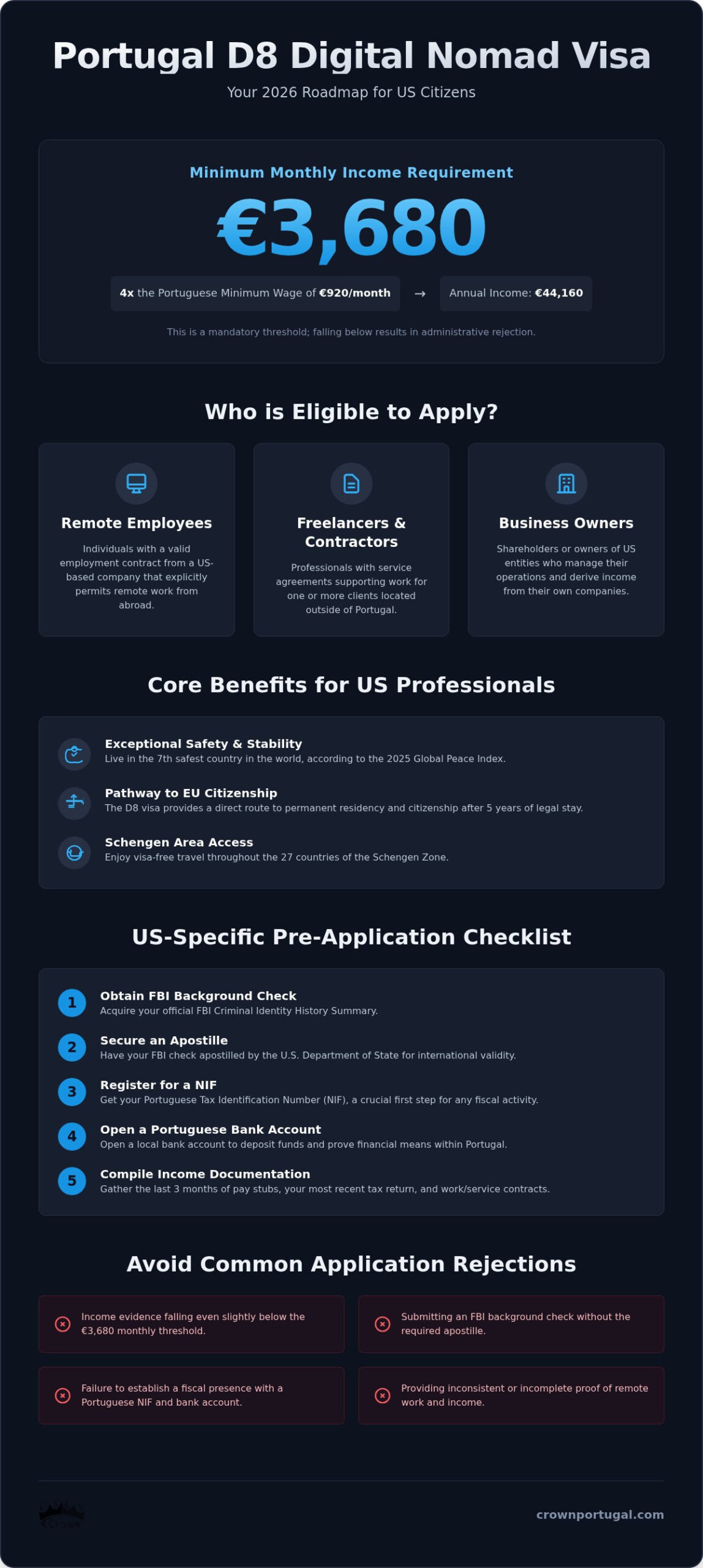
This guide serves as a definitive roadmap for the Portugal D8 visa for US citizens, providing the clarity needed to navigate updated 2026 regulations. We’ll examine the mandatory €3,680 salary requirement, which is calculated as four times the €920 monthly minimum wage. You will find a structured checklist of US-specific documents, a clear timeline for your relocation, and a breakdown of the essential fiscal steps like NIF registration. By following this expert-led sequence, you can transition from US remote work to Portuguese residency with absolute administrative certainty.
Key Takeaways
- Identify the 2026 financial eligibility requirements, specifically the €3,680 monthly income threshold based on four times the Portuguese minimum wage.
- Evaluate the structural differences between the temporary stay and residency pathways for the Portugal D8 visa for US citizens to choose the correct application route.
- Map the essential timeline for US-specific administrative tasks, including the acquisition and apostille of the FBI Criminal Identity History Summary.
- Recognize the importance of local fiscal setup, such as NIF registration and opening a Portuguese bank account, as prerequisites for a successful filing.
- Learn how professional consultancy and meticulous document review prevent common application errors and ensure full compliance with AIMA regulations.
Understanding the Portugal Digital Nomad Visa (D8) for Americans
The D8 visa, formally established through a 2022 amendment to the Portuguese Immigration Law, serves as the primary residency pathway for non-EU professionals who maintain remote employment or freelance contracts outside of Portugal. This specific category was created to provide a dedicated legal framework for the modern Digital Nomad, effectively separating active remote earners from those relying on passive income under the D7 visa. For US citizens, this distinction is vital; it ensures that your application is evaluated based on your professional output rather than just your savings. Portuguese law distinguishes between “Subordinate Remote Work,” which applies to employees, and “Independent Work,” which applies to freelancers. This distinction dictates the specific documents you must provide, such as a labor contract or a service provision agreement.
In 2026, the Portugal D8 visa for US citizens remains a premier choice for relocation due to the country’s social stability and professional infrastructure. While previous years saw some confusion between different visa types, the D8 now offers a transparent route that acknowledges the reality of the global remote workforce. It provides a structured bridge for those who want to maintain their US-based career while enjoying the lifestyle benefits of the Iberian Peninsula.
Who Qualifies as a US Digital Nomad?
Eligibility for the visa depends on the nature of your professional engagement. Portuguese authorities categorize applicants into three primary groups:
- Remote Employees: Individuals with a valid employment contract from a US-based corporation that explicitly permits remote work from abroad.
- Freelancers and Independent Contractors: Professionals providing services to one or multiple clients outside Portugal, supported by written service agreements.
- Business Owners: Shareholders or owners of US entities who manage their operations and receive dividends or a salary from their own companies.
Regardless of your specific role, the 2026 regulations require documented proof that your income is generated from sources outside Portuguese territory. You’ll need to demonstrate that your work can be performed entirely through information and communication technologies.
The Core Benefits for US Professionals
Choosing Portugal for relocation in 2026 offers stability that few other European destinations can match. Portugal was ranked as the 7th safest country in the world by the 2025 Global Peace Index, a factor that weighs heavily for US families and solo professionals. Beyond safety, the D8 residency visa provides a direct path to permanent residency and citizenship after five years of legal stay. This long-term security is coupled with immediate practical advantages, such as visa-free travel throughout the Schengen Area. US professionals also gain the right to live and work in a high-quality environment with access to local infrastructure; to truly appreciate the country’s natural beauty, you can visit Geographic Algarve for specialized cultural and nature-based excursions, all while maintaining your US-dollar-denominated income.
2026 Financial Requirements and Income Thresholds
The Portugal D8 visa for US citizens is strictly regulated by the “4x Minimum Wage” rule, a financial benchmark that ensures residents can support themselves without accessing local social welfare systems. In 2026, the Portuguese government has established the national minimum wage at €920 per month. Consequently, the minimum monthly income requirement for a single D8 applicant is €3,680. This annualizes to a requirement of €44,160. These figures are mandatory; providing evidence of income even slightly below these thresholds typically results in an immediate administrative rejection by AIMA authorities.
Acceptable sources of income include base salary from remote employment, dividends from a business you actively manage, or consistent fees from freelance service contracts. It is essential that this income is generated from entities located outside of Portugal. To satisfy the consulate, you must provide a Portuguese bank statement showing your financial means, which necessitates opening a local account before your final application submission.
Calculating the 2026 Income Benchmark
Applicants must present clear evidence of their earnings through US-based documentation, including the last three months of pay stubs and your most recent tax return. While these documents are standard, Portuguese authorities require them to be legible and often accompanied by a bank statement showing the corresponding funds entering your account. Since US income is earned in USD but evaluated against the EUR threshold, maintaining a financial buffer is a prudent strategy. Sudden fluctuations in the currency exchange rate can inadvertently drop an applicant below the €3,680 limit if their salary is too close to the minimum. As highlighted in Forbes on Portugal’s visa options, understanding these specific financial nuances is the difference between a successful relocation and a denied application.
Savings and Passive Income Nuances
Beyond the monthly income requirement, you must demonstrate financial stability by depositing a “safety net” into your Portuguese bank account. The standard recommendation is to deposit 12 months’ worth of the Portuguese minimum wage, which totals €11,040 for the main applicant. If you are applying with family members, these requirements increase according to a set percentage of the minimum wage: 50% (€460 per month) for a spouse or partner, and 30% (€276 per month) for each dependent child.
It’s vital to distinguish this professional income requirement from the D7 visa. The D8 specifically requires active professional income. While dividends from your own company are often acceptable, pure passive income like rental earnings or social security is usually redirected toward the D7 pathway. To ensure your financial documentation meets these rigorous 2026 standards, you may find it beneficial to secure NIF registration and local bank account setup services to lay the necessary groundwork while you are still in the United States.
Choosing Between Temporary Stay and Residence Permits
The Portugal D8 visa for US citizens offers two distinct legal pathways, each designed to accommodate different professional and personal objectives. While both require meeting the same €3,680 monthly income threshold, their structural impact on your long-term status in Europe varies significantly. Deciding between a temporary stay and a residency permit is a strategic choice that affects your tax liability, family reunification rights, and ultimate eligibility for a European passport. This decision should be based on whether your 2026 goals involve a short-term relocation or a permanent shift in your center of life.
The Temporary Stay Path (Under 1 Year)
The temporary stay visa is suited for professionals who wish to live in Portugal for a limited period without establishing permanent roots. Valid for up to one year, it allows multiple entries but does not lead to permanent residency or citizenship. According to the Portuguese Ministry of Foreign Affairs Visa Portal, this route requires meeting the same financial benchmarks but involves simpler documentation regarding long-term accommodation. A significant limitation is the lack of family reunification rights; each adult must qualify independently for their own visa, making it less practical for families.
The Residency Path (Long-term)
The residency path is the standard choice for US citizens seeking long-term stability and a route to a European passport. This process involves an initial four-month entry visa followed by a two-year residence permit, renewable for three-year increments. To maintain this permit, you must satisfy physical presence requirements, typically spending 183 days per year in the country. This path establishes tax residency and provides the legal basis for family reunification, allowing your spouse and children to join you under the same application umbrella. After five years of legal residency, you’re eligible to apply for permanent status or citizenship.
Selecting the correct pathway depends on your intended level of integration into Portuguese society. If your goal is to explore the country for a year while maintaining a primary residence in the US, the temporary stay visa provides the necessary flexibility. However, if you intend to make Portugal your permanent home, the residency visa is the only viable option. US remote workers must weigh the higher administrative requirements of the residency path against the long-term benefits of security, family rights, and eventual permanent status. Mapping out these goals early ensures your application aligns with your long-term professional and personal vision.
Step-by-Step Application Process for US-Based Applicants
Executing the application for a Portugal D8 visa for US citizens involves a meticulous sequence of administrative tasks that must be completed before your appointment at a VFS Global center. The process is divided into two primary phases: securing federal-level documentation in the United States and establishing your fiscal identity in Portugal. Failure to align these timelines often results in document expiration, as many certificates are only valid for 90 to 180 days. Understanding the full Portugal D8 visa processing time from initial NIF registration through to your final AIMA residency appointment is essential for keeping your relocation on schedule.
Essential US Document Procurement
For the criminal record requirement, only an FBI Criminal Identity History Summary is acceptable for residency purposes. State-level police checks do not meet the standards set by AIMA and will lead to a rejection of your dossier. Once you receive your federal summary, it must be sent to the US Department of State in Washington, D.C., for an apostille. This federal apostille confirms the document’s authenticity for use in Portugal. Additionally, your proof of remote work must be explicit. If you’re an employee, your company must provide a formal letter confirming your position, your salary, and a clear statement that you’re permitted to perform your duties from Portuguese territory. Freelancers must provide active service contracts that demonstrate a stable professional relationship with clients outside of Portugal.
Portuguese Administrative Setup
Simultaneously, you must initiate your Portuguese administrative setup. The first step is obtaining a NIF (Tax Identification Number), which serves as your primary identifier for all legal and fiscal transactions. Without a NIF, you cannot fulfill the mandatory requirement of opening a Portuguese bank account or securing a 12-month rental agreement. Portuguese consulates in the US strictly enforce the 12-month proof of accommodation rule, which typically requires a registered lease (contrato de arrendamento) filed with the Portuguese Tax Authority. To simplify this complex phase, you can secure your NIF registration through a professional representative while you remain in the United States.
The final stage is booking your appointment at the VFS Global jurisdiction corresponding to your US residence. You’ll present your compiled dossier, including your apostilled FBI check, proof of accommodation, and the financial evidence discussed in previous sections. Because appointment slots are limited and often booked months in advance, it’s advisable to monitor the VFS portal daily as soon as your primary documents are in process. This proactive approach ensures your relocation timeline remains on track for 2026.
How Professional Consultancy Streamlines Your Portuguese Residency
The administrative complexity of the Portugal D8 visa for US citizens often leads to avoidable rejections when handled without professional oversight. Common failure points in DIY applications include bank statements that don’t clearly demonstrate the source of funds or remote work contracts that lack specific legal clauses required by Portuguese immigration authorities. Expert consultancy provides a layer of rigorous document review that ensures every piece of evidence aligns with current AIMA standards. This methodical preparation minimizes the risk of a VFS rejection, which can otherwise delay your relocation by several months.
Coordinating your NIF registration, Social Security Number (NISS), and visa application as a single, unified strategy is the most efficient way to secure residency. Rather than treating these as isolated tasks, a managed approach ensures that your fiscal setup in Portugal supports your visa filing. Post-arrival support is equally critical; the entry visa granted in the US is merely a temporary permit. The process is only complete after attending your scheduled appointment in Portugal to secure your physical residency card.
The Value of On-the-Ground Portuguese Expertise
The 2026 regulatory environment requires a deep understanding of local administrative shifts, particularly following the transition from SEF to AIMA. Local representation is indispensable for navigating tax registration and ensuring that your US remote work contract meets Portuguese legal translation requirements. Professional consultants act as an active intermediary, facilitating communication with government bodies and ensuring your documentation is beyond reproach. This local presence is especially valuable when managing the 12-month proof of accommodation rule, as it allows for the verification of lease agreements before they’re submitted to the consulate.
Your Next Steps with Crown Portugal
Your journey toward Portuguese residency begins with a detailed assessment of your eligibility under the 2026 financial thresholds. We provide a managed timeline that maps out every milestone, from your initial FBI background check request to your final residency appointment in Portugal. This structured path removes the uncertainty of the US-to-Portugal transition, allowing you to focus on your professional responsibilities while we handle the bureaucratic intricacies. Our expertise in NIF and NISS acquisition ensures that your fiscal foundation is solid before you ever step foot in a VFS Global office.
To begin your relocation with administrative certainty, you can secure your Portuguese NIF and start your D8 journey with Crown Portugal. We provide the end-to-end support necessary to navigate 2026 requirements and secure your future in Portugal.
Securing Your Professional Future in Portugal
Successfully obtaining the Portugal D8 visa for US citizens requires a disciplined approach to both federal documentation and local fiscal compliance. By aligning your remote work income with the 2026 €3,680 threshold and securing your FBI background check within the required timelines, you’re establishing a strong foundation for residency. Choosing the long-term residency path ensures not only immediate stability but also a clear trajectory toward permanent status and citizenship after five years of legal stay.
Crown Portugal has provided comprehensive relocation services since 2018, offering specialized support for US remote professionals navigating these complex administrative landscapes. Our expertise in NIF and NISS registration ensures you don’t face unnecessary delays while you’re still managing your transition from the United States. To ensure your dossier meets every specific AIMA standard from the outset, start your Portugal D8 visa application with Crown Portugal today. We look forward to facilitating a predictable and secure relocation to your new home.
Frequently Asked Questions
What is the minimum income for the Portugal D8 visa for US citizens in 2026?
The minimum monthly income required for a single applicant is €3,680. This figure is based on the 2026 Portuguese national minimum wage of €920, multiplied by four as stipulated by immigration law. You must provide documented proof, such as pay stubs or bank statements, that this income is generated from professional activities performed for entities located outside of Portuguese territory.
Do I need to pay taxes in both the US and Portugal as a digital nomad?
US citizens are subject to citizenship-based taxation by the IRS, while residing in Portugal for more than 183 days typically establishes Portuguese tax residency. You’ll likely need to file tax returns in both jurisdictions. Fortunately, the tax treaty between the United States and Portugal helps prevent double taxation through the use of foreign tax credits or exclusions on your US return.
Can I bring my family to Portugal on a D8 Digital Nomad visa?
Yes, the D8 residency visa allows for family reunification for a spouse, dependent children, and even dependent parents. To include family members, you must demonstrate additional financial means beyond the primary €3,680 threshold. This generally requires an additional 50% of the minimum wage for a spouse and 30% for each dependent child, all deposited into your Portuguese bank account.
How long does the FBI background check take for a Portugal visa application?
The FBI Identity History Summary results are typically available within 3 to 5 business days when requested electronically. However, the mandatory US Department of State apostille process is the primary bottleneck and can take between 4 and 8 weeks to complete. It’s essential to factor in this federal processing time when planning your relocation timeline to ensure your documents remain valid.
Is a US remote work contract sufficient proof of income for the D8?
A US remote work contract is sufficient proof provided it explicitly mentions your salary and your ability to work remotely from abroad. If your standard contract doesn’t include a “work from anywhere” clause, you should obtain a formal letter from your employer’s HR department. This letter must confirm your employment status and grant permission for you to perform your professional duties while residing in Portugal.
What happens if my D8 visa application is denied?
If your application is denied, you’ll receive a formal notification from the consulate or AIMA detailing the specific reasons for the rejection. Common issues include insufficient financial proof or expired background checks. You generally have the option to file an administrative appeal or, in many cases, correct the specific documentation errors and submit a new application for the Portugal D8 visa for US citizens.
Do I need to speak Portuguese to apply for the D8 visa?
No, there is no Portuguese language proficiency requirement for the initial D8 visa or the subsequent residency permit. While basic language skills are helpful for navigating daily life and administrative tasks, they aren’t a prerequisite for approval. You’ll only need to demonstrate A2-level Portuguese proficiency if you choose to apply for permanent residency or citizenship after completing five years of legal residence.
Can I apply for the D8 visa while already inside Portugal as a tourist?
No, you’re generally required to apply for the D8 residency visa from your country of legal residence before moving to Portugal. For US citizens, this means submitting your application and attending an interview at a VFS Global center within the United States. While some administrative tasks like NIF registration can be handled while visiting, the actual visa must be processed by the consulate in your home jurisdiction.