

How to assess eligibility for a Portugal Schengen visa extension

A tourist stay in Portugal can sometimes be extended, but extra holiday time alone isn’t enough. The Portugal Schengen visa extension process requires a justified reason and supporting evidence, and you should apply before your permitted stay expires. An approved extension applies in Portugal only, not for travel in the other 26 Schengen states.
It’s understandable to focus first on whether you can stay longer. The key question is whether your circumstances meet grounds that may justify an extension, such as force majeure, humanitarian reasons, or professional reasons, and whether you can provide supporting evidence.
This guide explains how to assess your eligibility, when to submit a request, and what evidence to prepare. It also clarifies how an extension relates to the Schengen limit of 90 days in any 180-day period, so you can distinguish a possible extension from time you may still have available under the standard stay rules.
Key Takeaways
- Assess whether your reason is exceptional and supported by documents before preparing an extension request.
- Submit your application before your authorised stay or visa expires, and keep proof that you filed it.
- Prepare a reasoned written request alongside your passport, application form and evidence of accommodation, funds and travel insurance.
- Plan travel carefully: an extension granted by Portugal applies there only, while the Schengen stay limit counts days spent across the area.
- Review the application fee and any applicable exemption before submitting your request.
Is it possible to apply for an extension of a tourist visa in Portugal?
Yes, some visitors may request an extension, but they need a justified reason and supporting evidence. Whether you can remain in Portugal while your request is being examined depends on your circumstances. The decision timeline depends on the examination of your application and documents.
Use these steps to assess your eligibility and prepare a complete application for Portugal’s Migration Service.
To understand the risks of overstaying and the grounds for an extension, watch this video:
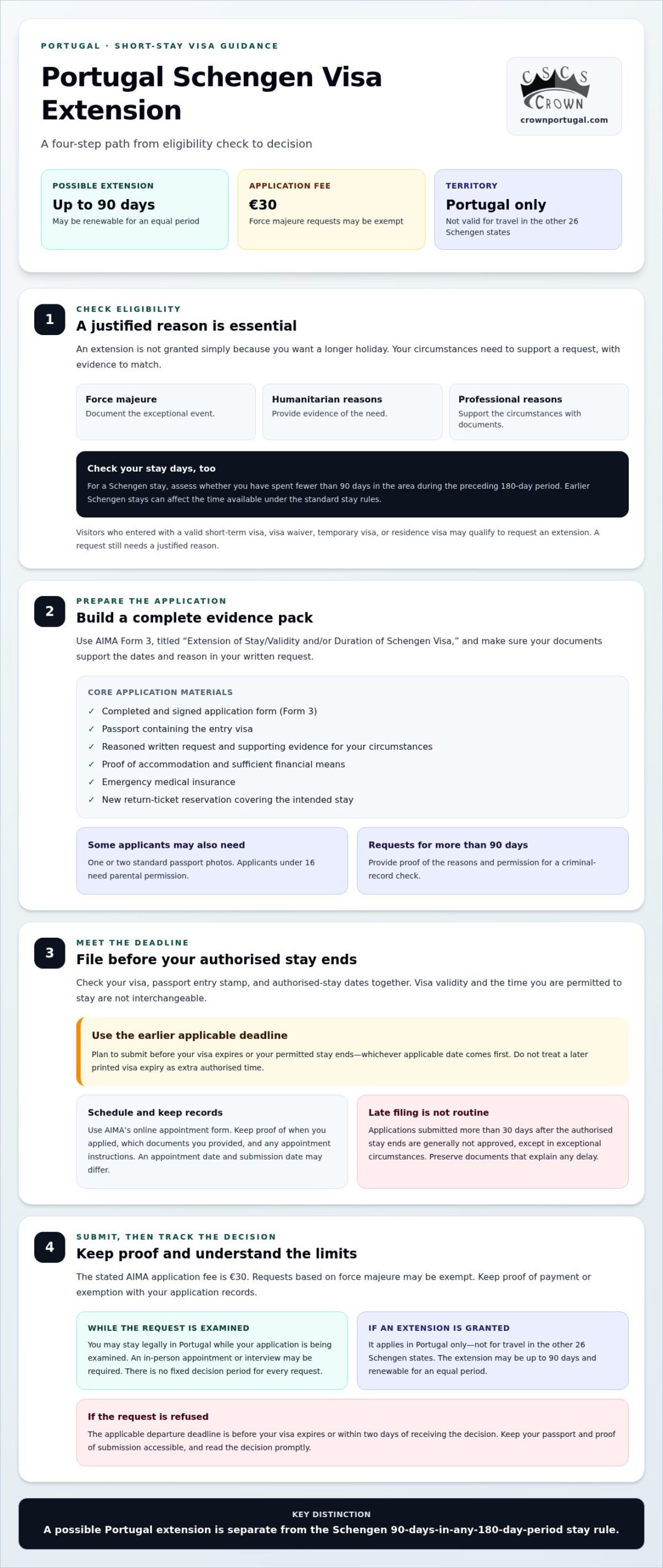
- Assess your eligibility. Foreign citizens who entered Portugal with a valid short-term visa, visa waiver, temporary visa, or residence visa may qualify to request an extension. For a Schengen stay, assess whether you have spent fewer than 90 days in the area during the preceding 180-day period and whether your visa remains valid. A request needs a justified reason, not simply a wish to extend a holiday.
Portugal’s process is described under Article 72 of Law no. 23/2007. A short-stay visa holder or visa-free visitor may be granted an extension of up to 90 days, renewable for an equal period. An extension granted in Portugal applies only within Portugal, not for travel in the other 26 Schengen states.
-
Gather required supporting documents
Prepare Form 3, the completed and signed application form, your passport containing the entry visa, and a reasoned written request. Add documents supporting your circumstances, such as evidence of force majeure, humanitarian need, or professional reasons. Include proof of accommodation, sufficient financial means, emergency medical insurance, and a new return-ticket reservation covering the intended stay.
Check that each document supports the dates and reason in your written request. An application may also require one or two standard passport photos. Applicants under 16 need parental permission; applicants seeking more than 90 days must provide proof of their reasons and permission for a criminal-record check.
-
Check the extension fee
Include the application fee when preparing your submission. According to the Agency for Integration, Migration and Asylum (AIMA), the stated fee for a Schengen visa extension application is €30. Requests based on force majeure may be exempt from the fee.
Keep evidence of any payment or exemption with your application records. AIMA’s Form 3 is titled “Extension of Stay/Validity and/or Duration of Schengen Visa”; use it to ensure the request is presented for the correct purpose.
-
Await the application decision
Keep proof that you submitted the request. While your application is being examined, you may stay legally in Portugal, the Schengen country where you applied. A Portugal-only extension does not permit travel to other Schengen states. Follow any appointment instructions, as an in-person appointment or interview with an official may be required.
There is no fixed decision period for every request. Timing depends on the examination of the reason, supporting evidence, and application. Keep your passport and proof of submission accessible, and read the decision promptly. If your request is refused, the applicable departure deadline is before your visa expires or within two days of receiving the decision.
Deadline for submitting an extension request
Plan around the end of your authorised stay, not the date you hope to leave Portugal. The application deadline depends on your visa validity and permitted stay.
- Identify the controlling expiry date. Check your visa, passport entry stamp, and authorised-stay dates together. A visa’s validity period and the time you may remain are not interchangeable. The relevant deadline is before your visa expires or your permitted stay ends. Record both dates, then use the earlier applicable deadline to organise your request.
For example, if your permitted stay ends before the visa’s printed validity, plan to submit your request before that stay ends. Don’t treat a later visa expiry date as extra authorised time. Compare the dates with your entry and travel records, since earlier Schengen stays can affect the time remaining under the stay rules.
- Submit before your authorised stay ends. Visitors in Portugal should file a stay-extension request before their authorised period expires. Allow time to prepare the reasoned request, supporting evidence, and appointment arrangements. Missing documents or an incomplete explanation can make it harder to present your case clearly before the deadline.
Use the AIMA online appointment form to schedule an appointment, and keep proof of your submission. The appointment date and the date you submit a request may not be the same. Keep records showing when you applied, which documents you provided, and any appointment instructions you received.
- Do not rely on a late filing as a routine option. In Portugal, applications submitted more than 30 days after the authorised stay ends are generally not approved, except in exceptional circumstances. That exception is not a standard extension of the filing period. Explain any exceptional circumstance with relevant documents and a clear timeline.
If an emergency prevents you from filing on time, preserve evidence showing what happened and when. For instance, medical records or travel disruption documents may help explain why you could not apply earlier. A late application does not erase the original expiry date, so don’t assume it automatically authorises you to stay longer.
- Act promptly if the deadline has passed. Compare the date your authorised stay ended with the date you can submit. If the gap exceeds 30 days, prepare a specific explanation and supporting records for the exceptional circumstances. Keep copies of your passport, visa, entry details, and communications with AIMA together.
Don’t wait until the final day to assemble evidence or arrange an appointment. A timely request is the practical route. Filing after expiry carries a different risk, even if circumstances have changed. Track the decision and follow its instructions. If your application is refused, the departure deadline may be before your visa expires or within two days of receiving the decision.
Exceptional grounds for extending a short-stay Schengen visa
Portugal considers extensions for serious, exceptional, and unforeseeable circumstances, not simply to prolong a tourist visit. Assess your reason and evidence before preparing your request.
- Match your circumstances to a recognised ground. Force majeure, humanitarian reasons, and professional reasons may be considered for a Schengen visa extension. Identify which ground best describes your situation, then explain why it prevents you from departing as planned. Wanting more time for sightseeing does not meet the exceptional-circumstances test.
Describe the event clearly and connect it to the time you are requesting. For example, explain how an unforeseen event disrupted your departure, rather than simply saying your travel plans changed. Seriousness, exceptional nature, and lack of foreseeability distinguish a request from an ordinary itinerary change.
- Document force majeure with a clear timeline. Set out what happened, when it occurred, and how it affected your ability to leave Portugal. Attach records supporting each important detail, such as official notices or correspondence related to the disruption. Ensure the dates in your evidence match those in your written request.
Distinguish the event itself from its consequences. Explain why it affects your departure or stay, and identify the period for which you need an extension. A document confirming an incident may not fully explain your request if it does not show how the incident affected your travel plans.
- Explain humanitarian or professional grounds precisely. For humanitarian reasons, state the urgent personal circumstances and provide directly relevant evidence. For professional reasons, describe the work-related event and why it requires you to remain. In either case, avoid broad claims that do not connect the circumstance to your requested stay.
Organise documents by ground and label them clearly. For example, keep correspondence supporting a professional obligation together rather than mixing it with unrelated travel records. A concise explanation helps show how your evidence supports the specific reason for your request.
- Show that the request is exceptional, not a holiday extension. The authority assesses the reason, financial means, and migration-compliance history. Explain why the circumstance was unforeseeable and serious, and include supporting records that address those points. Wanting extra time in Portugal alone does not establish an exceptional ground.
Keep your explanation consistent with your travel dates, accommodation evidence, and return arrangements. State the length of stay you are requesting and explain how it relates to the exceptional event. Submit your request before your authorised stay ends, and retain copies of the application and supporting documents.
Schengen 90-day stay limit within a 180-day period
Count your stays across the Schengen Area, not just your days in Portugal. Use these steps to understand how the rolling limit affects your travel plans.
- Count days across all Schengen countries. Visitors are generally limited to 90 days per semester in the Schengen Area. Portugal is part of that shared area, so time spent there combines with time spent in other member states. Moving from one Schengen country to another does not restart the count.
List every entry and exit date from your passport and travel records. Include each visit, even if it was short. The relevant total includes your stays from your first entry and adds later visits, rather than treating each country as a separate allowance.
- Check each day against the preceding 180-day period. The 90-day limit operates within a moving window, so assess the days before each planned stay. Don’t rely only on a calendar semester or a fresh calendar year. A date that was outside the calculation earlier may enter the relevant period as your travel dates move forward.
For a planned return to Portugal, count the days spent anywhere in the Schengen Area during the preceding 180-day period. Then check whether the proposed stay fits within the applicable limit. Keep your calculation tied to actual entry and exit dates, not flight bookings alone.
- Account for multiple visits and border records. Make a simple chronology of each Schengen entry, departure, and country visited. Compare it with passport stamps, tickets, and accommodation records. If you travel between several Schengen countries without leaving the area, count that as one continuous Schengen stay.
For example, a visitor who spends time in Portugal and then travels to another Schengen country has not left the area. The days continue to count until departure from the Schengen Area. This distinction helps prevent an inaccurate total when planning several trips.
- Separate the standard limit from a Portugal extension. An extension granted by Portugal applies in Portugal only and does not authorise travel in the other 26 Schengen states. It should not be treated as extra permission to tour the wider area. Plan any movement outside Portugal around the applicable stay rules and the decision’s territorial scope.
Before booking further travel, compare your planned dates with your Schengen day record and any extension decision. If you have used the standard allowance, an extension request needs a justified reason and supporting documents. A longer tourist visit does not create an additional Schengen-wide allowance.
What is the fee for extending a Schengen visa in Portugal?
Budget for the application fee separately from other costs related to preparing your request. AIMA states that the fee for a Schengen visa extension application is €30.
- Use the stated application fee as your starting point. According to the Agency for Integration, Migration and Asylum (AIMA), the stated fee for a Schengen visa extension application is €30. This is the application fee, not a total estimate of every expense connected with preparing an extension request.
Keep the amount tied to the application itself. Your supporting documents, travel arrangements, accommodation, or insurance may involve separate expenses, depending on your circumstances. Don’t treat those costs as part of AIMA’s stated application fee, and don’t assume the €30 figure covers them.
- Check whether force majeure applies to your request. Applicants may be exempt from the Schengen visa extension application fee when their request is based on force majeure. The basis of your request matters: describe the exceptional event and provide evidence linking it to your need to remain in Portugal.
Don’t assume an exemption applies automatically just because your plans changed. A personal preference to stay longer is different from force majeure. Clearly explain the circumstances in your written request, and retain documents showing what happened and how it affected your departure.
- Distinguish serious personal reasons from force majeure. The European Commission’s EUR-Lex information states that an extension for serious personal reasons costs EUR 30. That amount aligns with AIMA’s stated €30 application fee, but the reason for the request remains relevant when identifying the applicable basis.
Describe your circumstances accurately rather than choosing a category based on the fee. For example, explain a serious personal situation and provide relevant supporting evidence. If your circumstances involve force majeure, clearly present that basis and its documentation. Accurate classification helps keep your request and fee information consistent.
- Keep fee records with your application papers. Save any payment evidence, fee instructions, and application documents together. If you claim a force majeure exemption, keep evidence supporting that ground alongside your request. These records can help you respond to questions about the basis and handling of your application.
For help assessing a longer-term route beyond a short-stay extension, review Portugal immigration options and identify which pathway fits your circumstances. A Schengen extension and a longer-term immigration route serve different purposes, so keep the application fee separate from decisions about future status.
Crown Portugal: Portugal Digital Nomad D-8 Visa
Crown Portugal’s Portugal Digital Nomad D-8 Visa offering may be relevant if your plans involve establishing a longer-term stay rather than extending a short visit. A Schengen extension addresses exceptional circumstances; it isn’t a substitute for choosing an immigration route suited to your intended stay.
Turn to Crown Portugal when you’re exploring the D-8 route or comparing it with other available options, including the Portugal Passive Income D-7 visa or Portugal Golden Visa D-9. Crown Portugal can also assist with NIF Registration (Personal Tax Number) as part of your Portugal plans. The appropriate next step depends on your purpose for staying and the route you intend to pursue.
For assistance with the Portugal Digital Nomad D-8 Visa, contact Crown Portugal or visit crownportugal.com.
Plan your next step around your longer-term goals
Decide whether your priority is resolving an exceptional short-term situation or establishing a longer-term basis for living in Portugal. That distinction can shape which documents and immigration pathway to focus on next. Keep your intended purpose clear, whether it involves remote work, investment, or arranging your tax registration.
Crown Portugal offers the Portugal Digital Nomad D-8 Visa, Portugal Golden Visa D-9, and NIF Registration (Personal Tax Number). If your plans extend beyond a temporary visit, these may be relevant starting points to discuss alongside your circumstances. The right direction depends on your goals and the requirements of the pathway you pursue.
For guidance on your Portugal plans, contact Crown Portugal. A clear next step can help you approach the process with greater confidence.
Frequently Asked Questions
Can I extend my Schengen Visa if I want to continue my tourist visit?
No. Wanting more time for sightseeing or leisure is not, by itself, an exceptional ground for extending a short-stay visa. Portugal may consider requests based on force majeure, humanitarian reasons, or professional reasons when circumstances are serious, exceptional, and unforeseeable. Explain the specific event and provide documents showing how it affects your departure. A changed itinerary or desire to see more places does not establish these grounds.
Can I travel to other countries with an extended visa?
An extension granted by Portugal applies only in Portugal, so it does not authorise travel to other Schengen states. For example, don’t assume a Portuguese extension permits a side trip to Spain or France. Before making cross-border plans, review the territorial scope of the decision and your separate permission to stay elsewhere. Plan your itinerary around the authorisation you actually hold, rather than relying on the original visa’s travel scope.
Do I have to wait until the visa expires?
No. Submit your request before your visa expires or your authorised stay ends. Waiting until the final day leaves little time to prepare evidence or arrange an appointment. Check your passport, visa, and entry records, then plan filing around the earliest applicable end date. Applications submitted more than 30 days after the authorised stay ends are generally not approved, except in exceptional circumstances, so don’t treat late filing as a normal option.
How can I make an appointment with the Portuguese Migration Service?
Use AIMA’s online appointment form to request an appointment for a Portugal stay extension. Have your passport and visa details available while completing the process, and keep the appointment confirmation with your records. An appointment may involve an in-person visit or interview with an official. Follow the appointment instructions and bring the requested application documents, so the visit can address your extension request rather than missing paperwork.
What are the formalities to be completed for an application for a Schengen visa extension?
Complete and sign AIMA Form 3, “Extension of Stay/Validity and/or Duration of Schengen Visa,” and prepare your passport containing the entry visa. Include a reasoned written request and evidence supporting the stated ground. Applicants may also need proof of sufficient funds, accommodation, emergency medical insurance, a return-ticket reservation, and passport photos. Keep documents consistent: dates and explanations should support the same requested stay and reason.
What are the risks if I stay on the Schengen territory beyond the validity of my visa?
Overstaying may lead to a fine, departure from the territory, or an alert when leaving the Schengen Area. It may also make future visa applications more difficult. If your extension request is refused, read the decision immediately and follow its departure deadline. Keep your passport, proof of application, and decision together. Don’t assume an appointment or an unfiled request changes your authorised stay.
Can a Schengen visa be extended while in Portugal?
Yes, a visitor in Portugal may apply there if they meet the relevant conditions and have a justified reason. The Portugal Schengen visa extension process is handled by the competent authorities in the country where the applicant is located. Holders of a category C short-stay visa should apply to the competent authority in that country. Prepare evidence explaining why you need to remain, rather than treating an extension as a routine option for tourists.
What are the eligible reasons for extending a Schengen visa in Portugal?
Portugal may consider force majeure, humanitarian reasons, and professional reasons. The circumstances must be serious, exceptional, and unforeseeable; an ordinary wish to prolong a holiday isn’t enough. State what happened, why it affects your planned departure, and how long you need to remain. Attach evidence that supports those points, such as records or correspondence relevant to the event, and ensure your written explanation matches the documents.