

Portugal Residency for Minor Children: A Family Guide

Does your child automatically follow the same Portugal residence route as you? Not necessarily. Minor Children are generally under 18, but the right process also depends on the parent’s immigration status, the child’s relationship to the applicant, and the family’s circumstances. Consent and custody arrangements can affect which records to prepare, so it helps to consider them early.
This guide explains how to identify the relevant family-residence pathway and prepare the child-specific parts of an application. It covers how age and parent-child relationships can affect eligibility, which civil-status records may be relevant, and how parental responsibility and consent fit into planning.
Portugal’s family reunification rules changed on October 23, 2025. A two-year residence-permit requirement generally applies to sponsors bringing family members, but the waiting period is waived for a sponsor’s minor children. Other eligibility and document requirements still apply. The sections ahead explain the main considerations, including birth or adoption records and situations involving separated parents or custody arrangements.
Key Takeaways
- Identify whether your child will accompany you to Portugal or join a parent who already lives there. This helps clarify which residence pathway to review.
- For Minor Children, age and relationship to the applicant matter. Family circumstances also affect how an application should be prepared.
- Consider how both parents relocating, one parent relocating, or a child joining a resident parent affects the records and consent details to organize.
- Prepare by identifying the route, reviewing current instructions, gathering relevant identity and family records, and checking that details are consistent.
- Crown Portugal supports families with document review, application preparation, and appointment scheduling for family residence applications.
What does “minor child” mean in a Portugal residence application?
This section concerns residence arrangements for a child who will accompany a family member to Portugal or join a parent already living there. The relevant question isn’t simply how the parent’s home country defines a minor. Portuguese residence eligibility depends on the rules of the specific route, the child’s relationship to the applicant, and the parent’s immigration status.
In general, a minor is someone who has not reached the age of majority. The Age of majority varies between legal systems, so a definition in another country’s law should not be treated as the rule for a Portuguese application. For Portugal residence and family reunification purposes, a child is generally considered under 18. Check the age conditions for the relevant route before relying on that general threshold.
Information about family eligibility under Portugal’s Golden Visa route can provide context, but it doesn’t replace checking the requirements for a child’s specific application.
Why a child’s age matters to immigration planning
Age can affect which family pathway applies and whether a child meets its conditions. The general under-18 threshold is a starting point, not a substitute for reviewing the rules that apply to the parent’s residence route. Check whether the route sets specific age conditions or treats a child’s circumstances differently before preparing the application.
Pay particular attention to timing if a child is approaching an age threshold. The relevant date may depend on the route and stage of the process. Don’t assume that submitting a form before a birthday automatically settles eligibility. Check the current instructions and plan the sequence of preparation and submission around the applicable rules.
Residence questions are different from custody questions
Residence applications and disputes about custody, parental responsibility, or divorce are separate matters. Portuguese immigration authorities assess whether the child meets the residence route’s requirements. An immigration application does not decide the outcome of a family-law dispute.
Family circumstances can still affect which records are needed to explain a child’s relocation. If one parent moves with the child while the other remains abroad, for example, the application may need to address consent or the legal basis for the move. Relevant documents depend on the circumstances and the process. Treat this as an application-preparation issue, not a conclusion about custody or either parent’s legal rights.
Keep the questions distinct: identify the child’s relationship to the applicant and the parent’s residence route, then determine which identity, relationship, and consent records are relevant. Minor Children may fit a general age category, but their residence pathway depends on the applicable Portuguese process and the family’s documented circumstances.
How a parent’s Portugal residence status shapes a child’s pathway
Consider the child’s application in the context of the parent’s Portugal residence route. The parent may be preparing to move and applying for a visa, or may already hold a Portuguese residence permit. These situations can involve different procedures, evidence, and appointment arrangements. First record the parent’s current or intended status, then establish how the relevant route treats the child.
Permit categories are not interchangeable. The parent’s route helps determine which family rules and instructions to review, but it does not automatically establish the child’s eligibility. The Portugal residence permit types guide can help clarify the parent’s category as part of this initial planning.
A child applying alongside a parent
If the family plans to relocate together, establish whether the child’s case is included with, linked to, or handled separately from the parent’s application. There isn’t one process for every visa or residence route. The relevant instructions explain how to document the family relationship, what evidence is required, and whether the child has a separate appointment or submission step.
For example, a parent applying under a work-related route and a parent using a different residence pathway should not assume that their child’s applications follow identical steps. Review the child’s requirements against the specific parent route before booking appointments or arranging documents. This helps coordinate the applications without treating a general family plan as a confirmed procedure.
A child joining a parent who already lives in Portugal
When a parent already resides in Portugal, family reunification may be the relevant pathway. It allows an eligible resident to request that qualifying family members join them. This is distinct from the parent’s original visa application: the child’s case is assessed in relation to the resident sponsor and the family relationship.
As of October 2026, a sponsor generally must have held a residence permit for two years before bringing family members, with that waiting period waived for the sponsor’s minor children. The waiver does not remove other eligibility or document requirements. The parent’s status and evidence of the relationship remain important under the applicable instructions.
The family reunification process is initiated in Portugal by the legal resident through AIMA. If approved, family members can then apply for residence visas at a Portuguese consulate. The sequence and evidence depend on the case. For wider procedural context, see the Portugal residence permit application guide.
To organize the application, record the parent’s permit category, whether the child is accompanying or joining them, and the documents that establish the relationship. Crown Portugal provides family reunification application support, including document review and application preparation, to help structure the child’s case around the relevant process.
Which family circumstances can change a minor child’s residence application?
The child’s relationship to the applicant is only one part of the application. Whether both parents are moving, one parent is relocating with the child, or the child will join a parent already living in Portugal affects which records to prepare and how to explain the family’s circumstances.
Use these situations as a planning aid, not as a decision about eligibility. The residence route and current official instructions determine the requirements. Don’t assume that one custody arrangement or a particular form of consent is sufficient for every application.
- Both parents relocating: Plan how each parent’s role and the child’s relationship to them will be represented in the applications and supporting records.
- One parent relocating with the child: Consider whether consent, parental responsibility, or custody documentation is relevant to the proposed move and application.
- A child joining a resident parent: Assess the resident parent’s status and the documents that establish the child’s family relationship as part of the applicable process.
These distinctions help identify questions to resolve before submission, but they don’t replace route-specific eligibility checks. Review civil-status records for consistent names, dates, and relationships. If a spelling difference or surname change appears in the documents, identify a record or explanation that connects the details rather than assuming the relationship is self-evident.
When both parents are involved in the move
When both parents are relocating, coordinated planning helps keep family information aligned. It doesn’t mean every family uses the same filing method. The route’s instructions determine whether applications are linked, submitted separately, or arranged through different appointments. Check how each parent is identified in the child’s records, and compare names and family details across passports and civil-status documents.
When one parent applies or relocates with the child
If one parent is moving with the child, the file may need to explain the other parent’s role, including any relevant consent or custody records. The immigration application documents the child’s residence circumstances; it does not decide a dispute about parental rights. Don’t treat a consent letter or a particular custody document as universally sufficient. Requirements depend on the case and current instructions.
Documents issued outside Portugal may have specific formatting, translation, or authentication requirements. Review the instructions before arranging translation or certification. If the child will join a parent already resident in Portugal, include the parent’s residence status and evidence of the family relationship in the preparation review. For each record, ask what fact it establishes and whether that fact matches the rest of the file.
A structured review helps organize these details before submission. Crown Portugal supports family residence applications through document review and application preparation, helping parents consider how their circumstances fit the relevant process. This support does not guarantee approval. Family reunification application support can help bring the child’s records and family context into a coherent application plan.
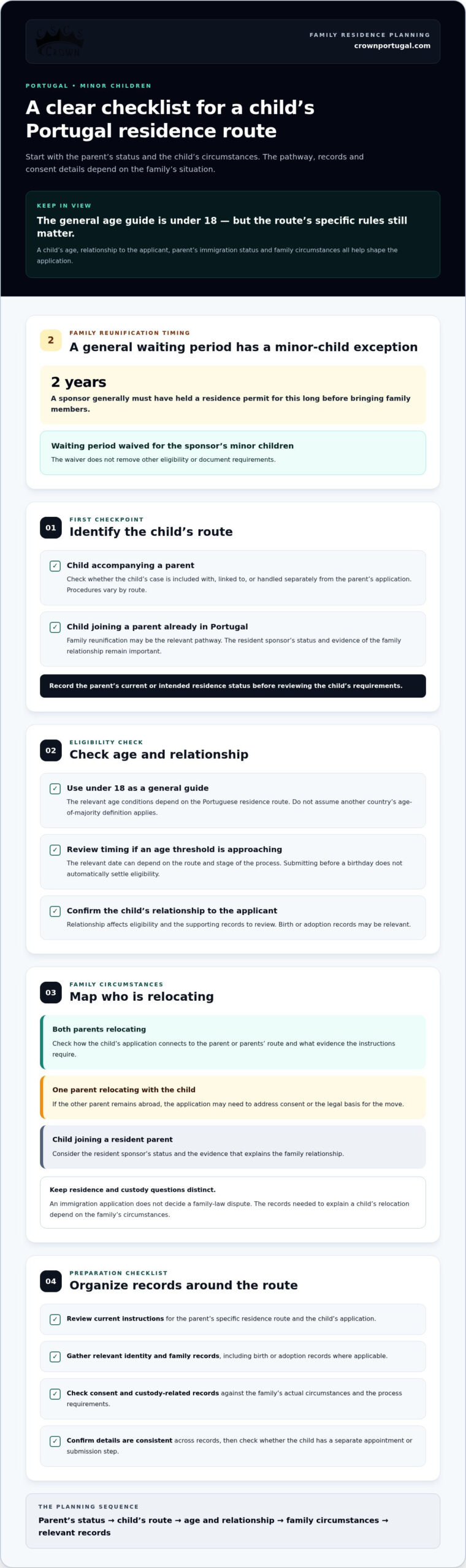
How to prepare a minor child’s Portugal residence application
Start with the child’s specific residence pathway, not a generic checklist. Requirements can differ depending on whether the child accompanies a parent applying to move or joins a parent already resident in Portugal. Use this sequence to organize preparation, then compare each step with the current official instructions for the selected route.
- Identify the route. Record the parent’s current or intended immigration status and whether the child is applying alongside the parent or through a family process to join them. This identifies which requirements to review.
- Review current instructions. Check the official application sequence, document requirements, appointment process, and competent authority for that route. The Portugal immigration law guide provides broader context, but it doesn’t replace checking current procedures.
- Gather relevant records. Organize documents that establish identity, the relationship between child and applicant, the parent’s residence status, and, where relevant, parental consent or custody circumstances.
- Check consistency. Compare names, dates, and other family details across records. Note discrepancies and identify what documentation may explain them.
- Plan submission. Confirm where and how to submit the application, who must attend any appointment, and how the child’s file fits into the parent’s process.
Build a child-specific document file
Keep the child’s identity document and civil-status evidence together. Add any relevant records about parental consent or custody, based on the family’s circumstances, and information about the parent’s residence status if the route requires it. These are document categories to investigate, not a fixed checklist for every application. Minor Children’s files should reflect the individual route and family situation.
Review details across the file before submission. If a child’s surname differs between a passport and a birth record, for example, identify the record or explanation that connects them. Check that documents remain valid for the relevant stage of the process. A clear file shows what each document establishes and where further evidence may be needed.
Review official requirements before submission
Document rules can depend on where a record was issued and which procedure applies. A civil-status document from another country may have translation, legalization, or authentication requirements, but don’t assume which formality applies. Check the current instructions before ordering translations or certifications so the format matches the application requirements.
Before finalizing the file, verify the checklist, submission sequence, appointment arrangements, and competent authority. Avoid relying on old online lists or fixed processing estimates that may not apply to the child’s route. For structured help organizing records and preparing the application, get support with your child’s residence application through Crown Portugal’s immigration consultancy.
How Crown Portugal helps families plan residence applications for minor children
Planning a child’s residence application involves more than collecting documents. Families need to understand how the child’s case relates to the parent’s Portugal residence route, identify records that support the relationship, and organize the process around current requirements. Crown Portugal provides immigration consultancy for Portuguese visa and residence applications, including family reunification, with practical support for these preparation tasks.
What professional application preparation can cover
Each family has a different starting point. A parent may be preparing an initial visa application or may already hold a residence permit and be planning for a child to join them. Consultancy support can help clarify which family-residence process to consider and organize the parent’s status details alongside the child’s supporting records. The goal is a clear application plan based on the family’s circumstances and applicable instructions.
Document review helps identify issues to address before submission. A child’s name may appear differently across records, for example, or the file may not yet include a document showing a relevant family relationship. Reviewing the documents together can reveal inconsistencies or missing categories early, giving the family time to organize follow-up steps.
Application preparation and appointment scheduling are also practical parts of the process. Depending on the route and family’s situation, support can include organizing application materials and coordinating the appointment steps required by the procedure. Documents and sequences vary, so preparation should follow current official requirements rather than rely on one template for all Minor Children.
Plan the next step with clear expectations
Before seeking guidance, gather the parent’s current or intended residence status and the child’s identity and family-relationship records. If one parent will relocate with the child, note any consent or custody documents that may be relevant. This gives the application review a clear starting point and focuses attention on the family’s circumstances.
Crown Portugal supports families through structured document review, application preparation, and appointment scheduling. This assistance can help organize an application, but it cannot guarantee approval. Eligibility is assessed under the applicable rules, and decisions rest with the competent Portuguese authorities.
For families planning a move or reunification, discuss the parent’s residence route and the child’s circumstances together. Discuss your Portugal residence application with Crown Portugal.
Set a clear plan for your family’s next step
Before moving from research to action, decide how your family will coordinate decisions and application updates. Agree who will collect records, track questions about the child’s route, and maintain current document versions. A shared record can help prevent inconsistent information as plans develop, particularly if both parents are involved or the child will join a parent later. Keep a short list of pending decisions and the basis for each one, so family members can distinguish confirmed steps from assumptions.
For Minor Children, planning works best when it reflects the family’s circumstances rather than a generic checklist. If the parent’s status, timing, or family arrangements change, revisit the plan against current Portuguese instructions before submitting. This helps you respond to changes without assuming that earlier guidance or paperwork remains suitable.
When you’re ready to discuss your family’s circumstances and the relevant residence process, discuss your Portugal residence application with Crown Portugal.
Frequently Asked Questions
What age is considered a minor in Portugal?
For Portuguese residence planning, a child is generally considered a minor if under 18, but confirm the applicable definition and any route-specific age conditions under current Portuguese rules. Don’t rely on a definition taken from another country’s law, including United States statutes. Age can affect eligibility or timing, especially if the child is close to the relevant threshold. Review the current official instructions for the parent’s route before deciding when to submit.
Can a minor child apply for residence in Portugal with a parent?
A child may have a residence pathway connected to a parent, but inclusion isn’t automatic. The process depends on the parent’s immigration status, the child’s circumstances, and current requirements. A child accompanying a parent who is moving may follow different steps from a child joining a parent who already resides in Portugal. Check the route’s eligibility criteria and instructions to establish how to arrange the child’s application and supporting evidence.
Does a child need parental consent to move to Portugal?
Consent or custody records may be relevant if one parent is relocating or applying with a child, but the requirements depend on the family’s circumstances and the applicable immigration route. Immigration paperwork is separate from resolving parental rights or a custody dispute. Don’t assume consent is always required, or that one letter or court document will satisfy every case. Review the current instructions for the child’s route and consider what the documents need to explain.
What documents may be needed for a minor child’s Portugal residence application?
Possible document categories include the child’s identity records, evidence of the parent-child relationship, information about the parent’s residence status, and relevant consent or custody records. These categories aren’t a definitive checklist, and requirements differ by route and family situation. A document issued abroad may also have translation or authentication requirements. Compare each record with the current official instructions and check that it supports the facts stated in the application.
Can a child join a parent who already has residence in Portugal?
Family reunification may apply when a child joins a parent who already resides in Portugal, subject to the parent’s status and current eligibility rules. This differs from a child accompanying a parent who is applying to move. The process and evidence depend on the specific case, so reunification should not be treated as automatic. Verify the current requirements for the parent’s permit and the child’s circumstances before planning submission.
What happens if a child turns 18 during the residence process?
Turning 18 during preparation or processing may affect eligibility, depending on the legal route and rules in force. Don’t assume that applying before the birthday preserves eligibility or that reaching 18 automatically ends the case. Review the route’s age conditions and timing rules against current official requirements. Because the answer can be case-specific, get guidance before making decisions based on an assumed outcome for the child’s application.
Do minor children need separate residence applications in Portugal?
It depends on the visa or residence route and the family’s circumstances. A child’s case may be handled alongside a parent’s, or the procedure may require a separate application, supporting file, or appointment. Separate paperwork doesn’t necessarily mean the child has an independent immigration route. Check the current instructions for the parent’s category to establish whether the child needs an individual submission and which steps apply.
How to Get a Student Residence Permit in Portugal – Crown Portugal at 10:56 am, October 18, 2026 -
[…] Portugal Residency for Minor Children: A Family Guide […]