

Vocational Courses in Portugal: Article 92 Visa Guide

The course that best fits your career plans may not be the one that supports a residence application. When comparing Vocational Courses in Portugal, consider the course level, duration, certification and your immigration objective together.
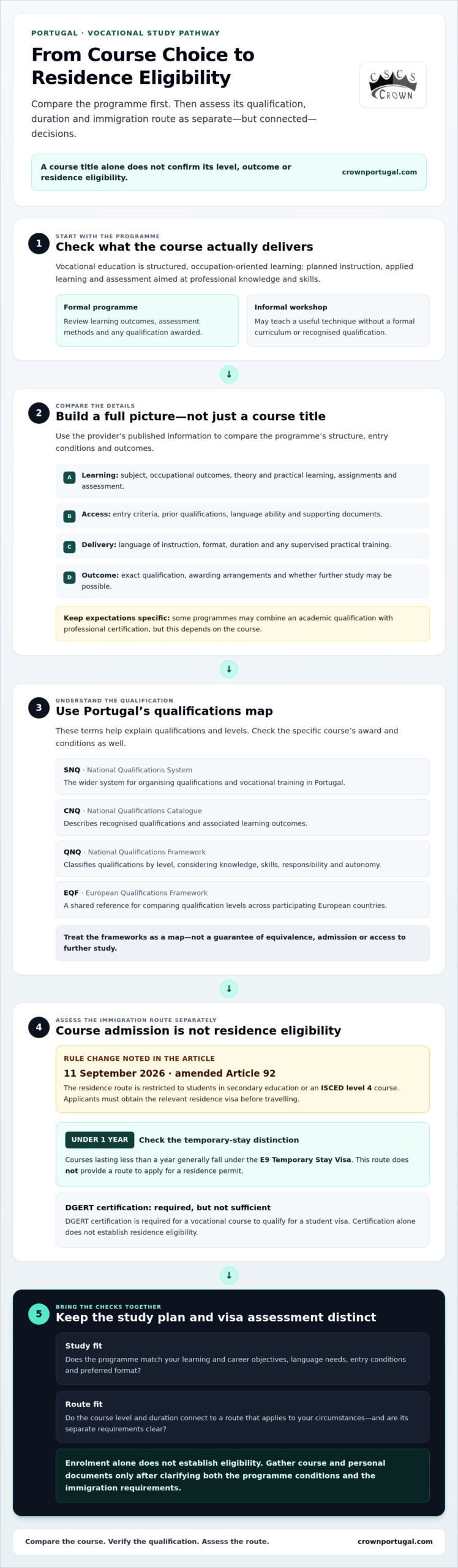
If you’re unsure what counts as vocational education or whether enrolment could support an application to live in Portugal, note that the rules changed on 11 September 2026. Under the amended Article 92, the residence route is restricted to students in secondary education or an ISCED level 4 course, and applicants must obtain the relevant residence visa before travelling. Courses lasting less than a year generally fall under the E9 Temporary Stay Visa, which does not provide a route to apply for a residence permit. DGERT certification is also required for a vocational course to qualify for a student visa, but certification alone does not establish residence eligibility.
This guide explains Portugal’s vocational education pathways and the practical details to compare, including course content, language of instruction, qualification and progression options. It also outlines how course choice connects to the relevant visa or residence route, and what to clarify before preparing an application. Crown Portugal assists with Article 92 applications, helping you assess the immigration steps alongside your study plans.
Key Takeaways
- Distinguish occupation-focused Vocational Courses from informal workshops by reviewing the programme’s learning outcomes, qualification and assessment.
- Use Portugal’s qualifications framework to understand how a course level relates to recognised qualifications and possible progression.
- Compare programmes systematically, including subject, entry criteria, teaching language, format, duration and practical training.
- Treat admission to a course and eligibility for a residence route as separate steps, then assess how they connect before preparing an application.
- Organise the process by gathering course and personal documents, then use structured support with Article 92 application preparation.
What Are Vocational Courses in Portugal, and Who Are They For?
Vocational courses are structured programmes of practical, occupation-oriented education. They develop knowledge and skills for a professional area through planned instruction, applied learning and assessment. They differ from short, informal workshops, which may teach a useful technique but do not necessarily follow a formal curriculum or lead to a recognised qualification. For a general explanation of this type of learning, see the Vocational Education Overview.
In Portugal, a course title alone does not tell you its level or outcome. Content, certification, admission conditions and progression opportunities vary by programme and provider. Review the published course information to understand what you’ll study, how your skills will be assessed, what qualification may be awarded and whether further study is possible. Some programmes may combine an academic qualification with professional certification, but this depends on the specific course. Do not assume every vocational programme offers both.
How vocational education differs from general academic study
Vocational education is generally organised around occupational learning outcomes: what students should know and be able to do in a professional context. A broader academic pathway may place more emphasis on general subjects and preparation for further academic study. Neither route is inherently better. The right fit depends on your goals and the programme’s structure.
Compare the balance of theory and practical learning rather than relying on the course title. Look for information about practical assignments, supervised training, examinations and other assessment methods. These details show how the programme develops and measures skills. If the course lists a qualification or professional certification, check what it covers and how it relates to progression.
Who may consider vocational training in Portugal?
Vocational training may suit school leavers seeking a structured introduction to a professional field, career changers looking for practical skills, or international applicants planning occupation-focused study. It can be a good fit if you prefer applied learning, but admission is not automatic. Providers may set different entry criteria and require particular prior qualifications, language ability or supporting documents.
International applicants should plan for the course and immigration process together, while treating them as separate decisions. First confirm the programme’s language of instruction and admission requirements. Then assess whether its level and duration connect to a suitable visa or residence route. Under the rules in force from 11 September 2026, Article 92 residence eligibility is restricted to students in secondary education or an ISCED level 4 course, and the relevant residence visa must be secured before travel. Vocational courses lasting less than one year use the E9 Temporary Stay Visa, which does not provide a route to apply for a residence permit. Enrolment alone does not establish eligibility for either route.
Keep your priorities clear: identify a course that matches your learning and career objectives, then assess its admission conditions and the immigration requirements that apply to your circumstances. Compare programmes in detail, including qualification, language, format and progression options, before deciding how to proceed.
How Portugal’s Vocational Education and Qualifications System Works
Portugal’s vocational education system includes different programme types and qualification levels, so a course title may not tell you what you’ll receive at the end. Four terms can help you interpret programme information: the National Qualifications System, the National Qualifications Catalogue, the National Qualifications Framework and the European Qualifications Framework. These provide context for understanding qualifications, but they do not replace the specific admission and award conditions set by a course provider.
What SNQ, CNQ, QNQ, and EQF mean for applicants
- SNQ: The National Qualifications System, or Sistema Nacional de Qualificações, is the wider framework for organising qualifications and vocational training in Portugal.
- CNQ: The National Qualifications Catalogue, or Catálogo Nacional de Qualificações, describes recognised qualifications and their associated learning outcomes. It can help you understand the knowledge and skills linked to a qualification.
- QNQ: The National Qualifications Framework, or Quadro Nacional de Qualificações, classifies qualifications by level, using factors such as the knowledge, skills and responsibility or autonomy expected.
- EQF: The European Qualifications Framework provides a shared reference for comparing qualification levels across participating European countries. The QNQ is referenced to the EQF, helping readers interpret levels beyond Portugal.
Use these terms as a map, not as a guarantee of equivalence, admission or access to further study. Compare the stated level and learning outcomes, then check the qualification’s exact title and awarding arrangements. If a provider describes a programme as double certified, identify which certifications it awards and under what conditions. This feature does not apply to every course.
Programme formats, certification, and progression
Courses in the same subject area can differ in duration, teaching format, balance of classroom and practical learning, assessment methods and certification. For example, tourism and hospitality training may focus on operational skills, while other vocational programmes prepare learners for different sectors and occupations. The national framework helps explain qualifications in broad terms; the provider’s course information sets out the actual curriculum, timetable, assessment and award.
Portugal’s education pathways can allow movement between vocational and general education routes. This permeability means progression may be possible, not that every qualification automatically gives access to a particular next course, transfers credits or meets its entry requirements. A receiving institution may set its own conditions. Before treating a course as a stepping stone, compare the qualification level and learning outcomes with the published admission rules for the next programme.
For a practical review, note the qualification’s exact name, level, learning outcomes, assessment method and any stated progression route. Then distinguish national classification from provider-specific information: a framework level can help you compare programmes, but it does not establish that two courses have identical content or outcomes. Crown Portugal assists with Article 92 vocational-student applications and related document preparation if your study plan is also connected to a residence application.
How to Compare Vocational Courses in Portugal Before Applying
Compare programmes against the same criteria instead of judging them by title or subject alone. This makes differences in learning outcomes, practical training, language, qualification and admission conditions easier to spot. It also helps you identify missing details before committing to an application or making plans around a course.
Use this comparison grid for each programme, filling it in from the provider’s published course information:
Subject and learning outcomes: What topics and occupation-related skills does the course cover? Do the stated outcomes match your intended field?
Qualification: What exact qualification is awarded, at what level, and by whom? Record any professional certification separately.
Entry criteria: What prior education, experience, language ability or documents are required for admission?
Language: What language is used for teaching, assessments and course materials? Are separate student-support languages stated?
Format and practical learning: Is teaching in person, online or blended? What practical activities, placements or supervised work are described?
Duration and attendance: How long does the programme run, and what attendance or participation expectations are published?
Progression: Does the course information identify further study or professional progression, and what conditions apply?
Course content, language, and qualification
Read the learning outcomes alongside the syllabus. Courses with similar names may devote different amounts of time to technical instruction, practical tasks or workplace-based learning. Look for examples of exercises, projects and assessment methods. These details show how students are expected to demonstrate what they’ve learned, not just which subjects appear in a description.
Keep teaching language separate from general support languages. A provider may offer administrative assistance in a language that is not used in lessons or exams. For international applicants, that distinction can affect their ability to follow instruction and complete assessments. Check the course information for the precise qualification and conditions. Do not rely on a broad course label or assume the qualification, language or certification is the same across programmes.
Admission, duration, format, and progression
Check the published admission requirements and application dates, then compare them with your qualifications and preparation timeline. Record the course start and end dates, delivery format and attendance expectations. If the programme includes practical training, find out how it is scheduled and assessed. Do not infer these conditions from another course at the same institution.
Review progression claims just as carefully. A stated route to further education may depend on meeting additional entry conditions, and a provider’s description does not establish admission or credit transfer elsewhere. Keep a short list of unanswered questions, such as whether a specific prior qualification meets entry criteria or how an assessment is conducted. This gives you a clearer basis for comparing options and planning next steps.
For international students, course suitability and immigration eligibility are connected but distinct. After identifying a programme and reviewing its conditions, assess the residence route separately. Crown Portugal assists with Article 92 vocational-student applications and related document preparation. Its Portugal immigration support can help connect a study plan with the relevant application process, without guaranteeing an outcome.
How Course Choice Connects to Portugal’s Article 92 Residence Route
Choosing a programme and qualifying for permission to reside in Portugal are connected, but they are separate decisions. A course may suit your study plans without meeting the requirements for a particular immigration route. Assess the education offer first, then check the rules that apply to your course type, duration and individual circumstances before making travel or enrolment plans.
For a non-EU applicant, a careful sequence is:
- Identify the course and the institution offering it.
- Review admission conditions, course level, duration, qualification and language of instruction.
- Assess the relevant visa or residence route against current official requirements.
- Prepare the application using the current instructions and documents applicable to your case.
What to establish before relying on an Article 92 route
Under the 2026 rules, Article 92 residence eligibility is restricted to students in secondary education or an ISCED 2011 level 4 course, and applicants must obtain the relevant residence visa before travelling to Portugal. For vocational training, the course must be offered by a DGERT-certified institution to qualify for a student visa. Certification alone does not establish eligibility for an Article 92 residence permit.
Courses lasting less than one year fall under the E9 Temporary Stay Visa, which does not give the holder a route to apply for a residence permit. The broad label “vocational course” is not enough to determine which category applies. Establish the programme’s precise level, duration and provider, then compare those details with the current rules. Check the applicable requirements, competent authorities, deadlines and document instructions against official information before relying on them. Approval is never automatic; the decision depends on the applicable rules and your circumstances.
Keep education planning and residence preparation aligned
Keep course records and immigration preparation organised as related but distinct files. Course materials may include the programme description, qualification details and admission correspondence. Separately, collect identity records and any other documents required by the relevant official checklist. This is not a universal document list: required evidence and procedures can depend on the route and applicant.
Check current instructions from the competent Portuguese authorities and the official visa application channel for your place of residence. For context on other routes, consult a Portugal residence permit types guide; for a focused overview, use an Article 92 vocational student residence guide. Assess the precise route and application steps against the rules in force when you apply.
Crown Portugal assists with Article 92 applications for vocational students, including immigration consultancy and document preparation. If you’re aligning a course plan with a potential residence application, get structured Article 92 application support before preparing your file.
Plan Your Vocational Study and Residence Application with Structured Support
A well-organised plan keeps two decisions in view: whether a course suits your education goals, and whether your circumstances meet the requirements for a Portuguese visa or residence route. Crown Portugal is an immigration consultancy that assists with Portuguese applications, including Article 92 cases for vocational students. Its role is to structure the immigration process, not to decide whether a course is academically right for you or determine the outcome of an official application.
What immigration consultancy can contribute
Application preparation involves more than gathering documents. A structured review can help identify missing information, inconsistencies between records and application details, or evidence that may need clarification. Support can include organising relevant documents, preparing application materials and scheduling appointments as part of the process.
The value is procedural clarity. You can understand which information relates to your course and which documents concern your identity or individual circumstances, while keeping the application aligned with current requirements. Immigration consultancy does not replace official instructions or guarantee approval. The competent authority assesses each application under the applicable rules.
Prepare a clear next-step plan
Before preparing an application, assemble a concise picture of your study plan and circumstances. This sequence can help organise the work:
- Define the study plan. Record the course title, provider, qualification, level, duration, teaching language and admission status using the programme’s published information.
- Organise relevant records. Gather admission correspondence, course documents and identity records. Treat these as preparation materials, not a definitive list of required documents.
- Assess the residence route. Compare your course and circumstances with current official rules. In particular, distinguish a course’s suitability from its relevance to a residence application.
- Prepare the application. Use current official instructions to check the required evidence, process and appointment arrangements before submission.
Keep a record of unanswered questions, such as a discrepancy in a document or an unclear course detail. Resolving these points early can make preparation more orderly. Requirements can change, and the documents, authority and procedure relevant to an application depend on the route and individual case. Review official Portuguese information before submitting, even if you’re receiving professional assistance.
If you’re planning Vocational Courses in Portugal and want support aligning your study information with an Article 92 application, Crown Portugal assists with application preparation and related document organisation. Discuss your vocational-student residence plans with Crown Portugal to plan the next steps with a clearer understanding of the process. The final decision remains with the competent authority.
Make Your Next Step a Clear One
Your study plan can move forward with purpose when course decisions and residence planning are assessed side by side, without treating one as proof of the other. Before taking action, bring together the course information and personal records relevant to your circumstances, then use current official requirements to guide the application steps. This preparation can help you identify what remains unresolved and avoid assumptions about how Vocational Courses connect to residence eligibility.
For support with the immigration side, Crown Portugal assists with Article 92 vocational-student applications, including document review and application preparation. Guidance can help you organise your file and understand the process, while the competent authority remains responsible for the decision.
Request structured support for your Article 92 application and take the next step with a clearer plan. Careful preparation can help you pursue your education goals while approaching the residence process with informed expectations.
Frequently Asked Questions
What are vocational courses in Portugal?
Vocational courses in Portugal provide structured learning for practical skills linked to occupations, unlike general academic study, which typically covers broader subjects, or informal workshops, which may not lead to a formal qualification. Levels, course lengths, awards and entry conditions vary. Portugal’s wider qualifications system provides context for interpreting courses, but the course title alone does not establish its outcome. Review the programme description and confirm the precise qualification awarded.
Can international students take vocational courses in Portugal?
International applicants may apply to vocational programmes, subject to each course’s admission conditions. Check whether your prior qualifications meet the entry criteria, what language is used for teaching and assessment, how the course is delivered, and which documents the provider requires. Admission and immigration permission are separate matters: an acceptance letter does not itself grant a visa or residence permit. Verify current eligibility and application requirements through official Portuguese information before making travel plans.
Does every vocational course qualify for an Article 92 residence permit?
No. Under the Article 92 rules in force from 11 September 2026, the residence route is limited to students in secondary education or an ISCED level 4 course, and the relevant residence visa must be obtained before travel. Shorter vocational training may fall under the E9 Temporary Stay Visa, which does not provide a route to apply for a residence permit. Check current official rules and your individual circumstances before relying on any course; approval is not automatic.
How do I compare vocational courses in Portugal?
Compare the syllabus and learning outcomes with the skills you want to develop, then check the exact qualification and level. Review teaching and assessment languages, admission requirements, duration, delivery format, practical training and stated progression options. For example, a course description may mention hands-on learning without explaining how it is assessed. Use detailed, provider-published information, and assess immigration eligibility separately rather than treating the course title as proof.
Are vocational courses in Portugal taught in English?
Some vocational programmes may offer English-language teaching, including examples in tourism and hospitality, but availability depends on the individual course and provider. Do not infer the teaching language from a provider’s general information or from another programme it offers. Check separately the languages used in lessons, course materials, examinations and practical placements. Also distinguish these from the languages available for general student support, which may not match the language of instruction.
What is the difference between Portugal’s SNQ, CNQ, and QNQ?
SNQ is the National Qualifications System, the wider structure for qualifications and training. CNQ is the National Qualifications Catalogue, which describes recognised qualifications and related learning outcomes. QNQ is the National Qualifications Framework, which classifies qualifications by level. These terms help applicants interpret course information, but they do not determine a provider’s admission decision or an applicant’s residence eligibility. Check current official terminology and the specific qualification named by the course provider.
Does vocational training in Portugal guarantee a job after graduation?
No. Completing a course does not guarantee employment. Career prospects can depend on the field, qualification, language skills, prior experience, labour-market conditions and individual circumstances. To judge how a programme may support your goals, compare its practical content and learning outcomes with the work you intend to pursue. Treat employment-rate or career-progression statements as provider-specific information, and check what they measure and which graduates or outcomes they refer to.
Where can I find help with an Article 92 application for vocational study?
Crown Portugal provides immigration consultancy support for vocational-student Article 92 cases, including document review and application preparation. For a focused discussion, organise your course details, admission information and relevant personal records. Requirements depend on current rules and individual circumstances, and assistance cannot guarantee the authority’s decision. Review official Portuguese guidance alongside your preparation, then discuss your vocational-student application with Crown Portugal.
Portugal Residence Permit: Your 2026 Application Guide – Crown Portugal at 10:13 am, October 15, 2026 -
[…] Vocational Courses in Portugal: Article 92 Visa Guide […]