

Portugal Self-Employed Residence Visa: Understand the D2 Route in 2026

Working for yourself in Portugal doesn’t automatically point to one visa route. The right option depends on the substance of your work: who your clients are, where they’re based, and whether you plan to establish professional activity in Portugal or work remotely for clients abroad. If you’re researching the Portugal self employed residence visa, this distinction is a useful starting point.
It can be difficult to separate the D2 and D8 routes, especially when you also need to prepare financial evidence, describe your work, and follow application procedures. Calling yourself a “freelancer” isn’t enough on its own. Your application should explain how you earn a living and include evidence that supports that account.
This guide compares work arrangements that may warrant investigating each route, outlines evidence to consider gathering, and explains which financial and procedural requirements to verify for 2026. It also covers how to check current instructions with the relevant Portuguese authorities and organise your preparation before applying.
Key Takeaways
- “Portugal self employed residence visa” is a search phrase, so check which official route matches your actual work arrangement.
- Compare where you work and who your clients or employer are when deciding whether to investigate D2 or D8.
- Organise potential evidence by category, then confirm the current document checklist for the consular jurisdiction where you’ll apply.
- Follow a clear sequence: confirm the route, verify official instructions, prepare supporting evidence, and follow the applicable submission and appointment procedures.
- For a complex route or evidence question, document review and application preparation may help you organise your file, but cannot guarantee an outcome.
Portugal self-employed residence visa: identify the route that fits your work
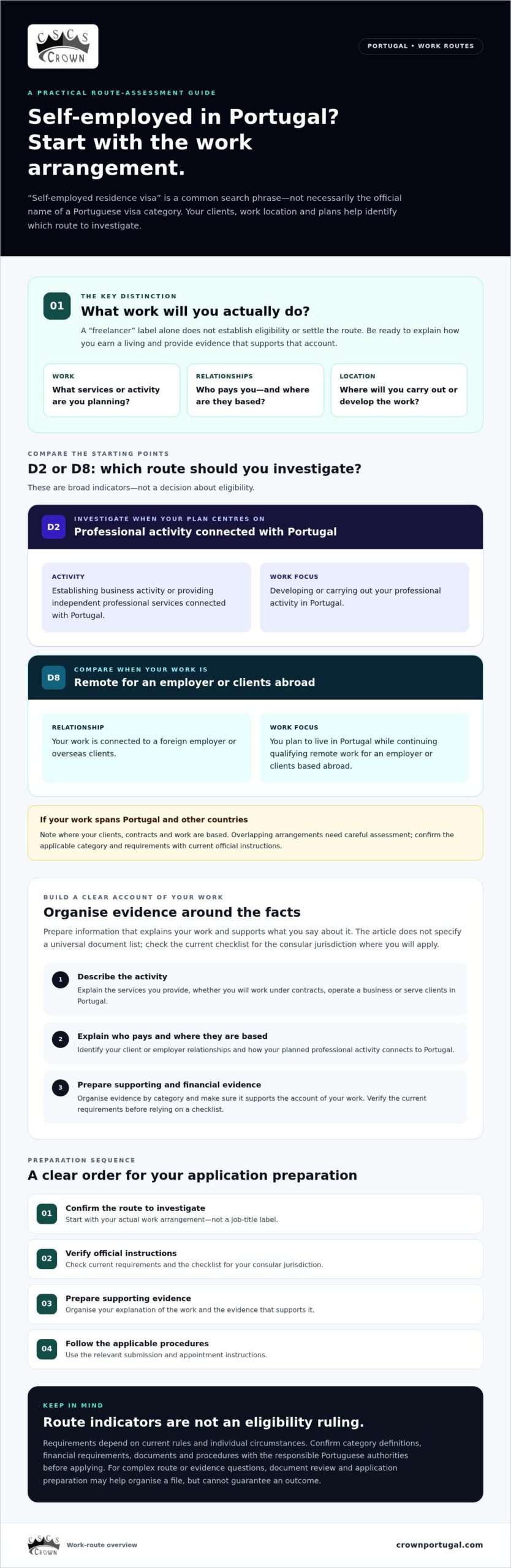
“Self-employed residence visa” is a common search phrase, not necessarily the official name of a Portuguese visa category. Independent professionals and entrepreneurs may need to investigate the D2 route. People working remotely for an employer or clients abroad may need to compare their circumstances with the D8 route. Check the applicable category and requirements against current official instructions.
The nature, location, and commercial relationships involved in your work help determine which Portuguese residence route to investigate. A freelancer label alone doesn’t establish eligibility or settle the choice. Be ready to describe the services you provide, who pays you, where your clients are based, and whether you plan to develop professional activity in Portugal. For broad background on immigration and legal frameworks, see Immigration to Portugal. Use official Portuguese guidance to verify application requirements.
For additional context on work visas and job offers, watch this video:
What does self-employed work mean for a Portuguese visa application?
Describe the work you actually intend to do rather than relying on a job title. Explain whether you’ll provide services under contracts, operate a business, or serve clients in Portugal. Identify your client relationships and how your planned professional activity connects to Portugal. These details help you prepare a clear account of your work, but they don’t by themselves determine eligibility. Requirements depend on current rules and individual circumstances.
D2 or D8: which route should an independent worker investigate?
The D2 route may be relevant if your plan centres on entrepreneurship or independent professional activity connected with Portugal. The D8 route is generally considered for qualifying remote work performed for an employer or clients abroad. These descriptions are a starting point, not a decision about which route fits every applicant. Review the Digital Nomad Visa Portugal requirements guide when assessing D8, and consult Portugal residence permit types for a wider overview. Confirm current category definitions and requirements with the responsible authorities before applying.
For a Portugal self employed residence visa application, assess your documented work arrangements rather than relying on a label. If your clients, contracts, or work location span Portugal and other countries, note how each detail may affect the route you investigate, then verify the applicable rules before preparing your application.
How to assess D2 eligibility for self-employed residence in Portugal
Start by describing the work you intend to do, who will pay for it, and where the activity will take place. Route fit depends on your real working arrangement, not simply on the label “freelancer.” The Portuguese Ministry of Foreign Affairs outlines national visa categories on its Portuguese National Visa Types page. Use it alongside current instructions from the authority handling your application.
| Factor | May point toward investigating D2 | May make D8 relevant to compare |
|---|---|---|
| Activity | You plan to establish business activity or provide independent professional services connected with Portugal. | You perform your work remotely and the activity is connected to an employer or clients abroad. |
| Client or employer relationship | Your plan involves building a professional activity or serving clients through work based in Portugal. | Your existing work is for a foreign employer or overseas clients. |
| Work location | You intend to develop or carry out the activity in Portugal. | You intend to live in Portugal while continuing eligible remote work for an employer or clients based abroad. |
This table is a route-assessment aid, not an eligibility ruling. Work arrangements can overlap, and the authorities assess applications against applicable criteria and individual circumstances.
When should a freelancer investigate the D2 route?
Investigate D2 more closely if you plan to provide independent professional services in Portugal or develop business activity there. Client agreements, service proposals, a description of your offer, or other records of professional activity may help explain your plan. These are examples of possible supporting evidence, not a definitive checklist. Confirm which documents are required for your circumstances with the responsible authority.
When might the D8 route be a closer comparison?
D8 may be worth comparing if you’ll work remotely from Portugal for an employer or clients abroad, rather than building your activity around the Portuguese market. Having overseas clients alone doesn’t establish that you qualify. The route has its own criteria. Consult the Digital Nomad Visa Portugal requirements guide for a focused look at remote-work considerations.
Before deciding, check the current requirements for financial means, professional activity, accommodation, and any applicable background documents. Use the official checklist for the consular jurisdiction where you’ll apply, since requirements and procedures may depend on location. Crown Portugal provides consultancy for D2 and D8 applications, including document review and application preparation, to help applicants organise complex cases. This support cannot guarantee an outcome.
Documents for a Portugal self-employed residence visa: prepare evidence, not assumptions
A well-organised file should explain who you are and how your proposed professional activity will work. The checklist below is a preparation aid, not an official or exhaustive list. For a Portugal self employed residence visa, confirm the current requirements with the Portuguese consular authority responsible for your application, including which items are mandatory for your route and location.
How can applicants evidence independent professional activity?
Choose evidence that directly supports the work you describe. Depending on your circumstances, this might include client agreements or letters, invoices, a service proposal, a portfolio, relevant qualifications, or a business plan. You may not need every item, and no single document guarantees eligibility or approval. Check for consistency across your file: names, dates, services, and business descriptions should match between the application and supporting records.
- Identity: Passport and any application forms or photographs specified by the relevant authority. Verify the current checklist, format, and passport-validity rules.
- Professional activity: Relevant contracts, client correspondence, proposals, invoices, portfolio materials, qualifications, or business information. Verify which evidence applies to your activity and route.
- Financial means: Records that demonstrate your available funds or income, as applicable. Verify the required evidence, calculation method, and any current thresholds. Don’t rely on older figures.
- Accommodation: Evidence addressing where you plan to stay, if requested. Verify acceptable evidence and whether it is required at the application stage.
- Background and civil status: Police or criminal-record documents, and civil-status records where relevant to your application. Verify which countries’ records are needed and any certification or validity rules.
- Insurance: Insurance documentation if the current instructions require it. Confirm the required type, coverage, and period directly with the responsible authority.
Which personal and financial documents should applicants check?
Use this list as a prompt, not a substitute for official instructions. Requirements can differ by consular jurisdiction and individual circumstances. Before obtaining documents, confirm whether each must be original, certified, translated, legalised, or issued within a specified period. Checking first can help you avoid paying for translations or certification that don’t meet the relevant instructions.
Keep a simple document index showing each item’s purpose, issue date, and any action still required. This makes gaps easier to spot, such as financial records that don’t clearly support the activity described or client documents that use inconsistent service descriptions. For related entrepreneur-route context, consult the Portugal D2 visa process guide and check its guidance against current official instructions.
How to apply for a Portugal self-employed residence visa step by step
Approach the application as a sequence of checks, not as a task completed by following one general checklist. For a Portugal self employed residence visa, the submission channel, appointment arrangements, and later residence-permit steps may depend on your location and current official procedures. Verify each stage before booking or submitting documents.
What should applicants do before submitting an application?
Before filing, confirm the route and current document checklist with the Portuguese authority responsible for your application. Check whether documents need translation or certification, and follow the appointment instructions for your jurisdiction. Keep copies of completed forms and supporting evidence, along with receipts and official correspondence.
Use this practical sequence:
- 1. Confirm the route. Check whether your actual work arrangement points toward investigating D2 or D8. Resolve uncertainties before preparing the application.
- 2. Check official requirements. Confirm current forms, evidence, fees, submission channel, and appointment procedures with the relevant authority.
- 3. Assemble and review your evidence. Make sure names, dates, and descriptions match across forms and supporting records. Check format, translation, certification, and validity instructions before submitting.
- 4. Submit through the applicable channel. Follow the instructions for your place of residence. Don’t assume every applicant uses the same service provider or appointment process.
- 5. Keep records and follow instructions. Save a copy of your submission and monitor the official channel for requests, updates, or next steps.
What happens after submission and arrival in Portugal?
Processing arrangements and follow-up instructions can vary. Rely on communications from the authority handling your case rather than assuming a fixed timeline. A visa decision and any subsequent residence-permit procedure are separate stages. If your application requires further steps after arrival, verify the current process and division of responsibilities with AIMA and the relevant authorities.
Relocation planning can involve tasks beyond the visa file. A moving-to-Portugal checklist may help you organise practical arrangements, but confirm immigration procedures through official sources. Keep visa and residence-permit paperwork together in case you need to refer to it or provide further information.
If you’d like help reviewing your application plan, request support with your D2 or D8 application preparation. Document review and application preparation can help organise your submission, but no adviser can guarantee a decision.
Choose informed support for your Portugal self-employed residence visa
You can prepare an application yourself or seek consultancy support. Which option suits you depends on the complexity of your work arrangements, the time you can spend checking official instructions, and how confident you feel interpreting the requirements. If you have several sources of income or aren’t sure whether to investigate D2 or D8, structured guidance may help you identify questions to resolve before submission.
When may professional visa application support be useful?
For a Portugal self employed residence visa application, support may be useful when your contracts, clients, or planned activities don’t fit neatly into one description. Depending on the agreed scope, a consultancy may review documents for consistency, help prepare application materials, or schedule an appointment. Confirm what’s included before proceeding. You remain responsible for providing accurate information and following official instructions. Professional assistance can help organise an application, but cannot guarantee a visa decision.
What should you confirm before engaging an immigration consultancy?
Ask clear questions before sharing documents or agreeing to a service. For example:
- Scope: Which services are included, such as route guidance, document review, application preparation, or appointment scheduling?
- Responsibilities: What information and documents must you provide, and which steps must you complete yourself?
- Fees: What are the consultancy’s fees, what do they cover, and could any additional charges apply?
- Updates: How will you receive progress updates, and who should you contact with questions?
- Current requirements: How are official forms, document checklists, and procedural changes verified for your consular jurisdiction?
These questions help set expectations and clarify who is responsible for each part of the process. Check that any guidance is based on current official instructions, particularly if requirements change while you’re preparing your application.
Crown Portugal provides consultancy support for D2 and Digital Nomad D8 applications, including document review, application preparation, and appointment scheduling. If you’re weighing the routes or want to clarify what support may suit your circumstances, discuss your Portugal visa options. The relevant authorities assess each application.
Take your next step with a clear application plan
The right Portugal self employed residence visa route depends on the work you’ll actually do, your client or employer relationships, and where the activity takes place. Assess D2 and D8 against those details, then verify the current official requirements for your application. Prepare evidence that tells a consistent story, and check document formats and submission procedures before filing.
If your circumstances are complex or you’d value help organising your application, Crown Portugal provides immigration consultancy. The consultancy supports D2 and D8 applications, including document review and application preparation. This can help you approach the process methodically, but the relevant authorities make the visa decision.
Discuss your Portugal visa options with Crown Portugal to clarify which route may be worth investigating for your work arrangement. Careful preparation and current information can help you approach the next step with a clearer plan.
Frequently Asked Questions
Is there an official Portugal self-employed residence visa?
“Self-employed residence visa” is a search phrase, not necessarily the official name of a Portuguese visa category. Independent professionals and entrepreneurs commonly investigate the D2 route, while remote workers for employers or clients abroad may compare their circumstances with the D8 route. The right category depends on the actual work arrangement and current requirements. Check the official visa terminology and instructions that apply to your application before choosing a route.
Can freelancers apply for a Portugal D2 visa?
Yes, freelancers may investigate the D2 route if their planned activity involves independent professional work or entrepreneurship connected with Portugal. The word “freelancer” alone doesn’t establish eligibility. Be prepared to explain your services, client relationships, planned activity, and relevant supporting evidence, such as agreements or proposals where applicable. The authorities assess each application against current requirements and individual circumstances, so verify the official checklist before applying.
What is the difference between Portugal’s D2 and D8 visas for self-employed workers?
The D2 route may be relevant to independent professional activity or business development in Portugal. The D8 route is designed for qualifying remote work connected with an employer or clients abroad. A freelancer with overseas clients doesn’t automatically qualify for D8, and arrangements that span countries or markets may need closer assessment. Compare the actual activity, client relationships, and work location, then check the current official criteria for each route.
What documents do I need for a Portugal self-employed residence visa?
The required documents depend on the route, your circumstances, and the consular jurisdiction where you apply. A Portugal self employed residence visa file may involve identity and application documents, evidence of professional activity, financial means, accommodation, insurance, and applicable background or civil-status records. Contracts, proposals, or a business plan may support your explanation of the work when relevant. Confirm the current checklist, including translation, certification, and document-validity rules, with the responsible authority.
How much income do I need for a Portugal self-employed visa?
The figures cited for 2026 are minimum means of subsistence of €920 per month for an individual applicant, or €11,040 for the first year. Additional annual amounts are listed as approximately €5,520 for a spouse or partner and €3,312 per dependent child. These figures concern means of subsistence and don’t replace any route-specific evidence of professional activity. Verify current calculations and accepted proof with the authority handling your application.
Can I apply for a Portuguese residence visa while already in Portugal?
For a new standard application, don’t assume you can enter Portugal as a tourist and then apply for residence from within the country. The in-country Manifestação de Interesse route for new applications was abolished in 2024. Applicants generally need to obtain the appropriate national visa through the Portuguese consulate responsible for their country of residence before moving. Confirm your specific circumstances and the current procedure with official authorities.
How long does a Portugal self-employed residence visa application take?
There isn’t one processing time that applies to every application. Timing may depend on the consular jurisdiction, appointment availability, the completeness of the file, and whether the authority requests further information. Check current estimates and appointment arrangements with the office or service provider handling your application. Build flexibility into your plans, keep copies of submitted documents, and follow official updates rather than relying on an unverified timeline.