

Portugal D2 Visa 2026: Independent Worker Guide

Could your freelance work support a Portuguese residence application, or might another visa route fit better? The D2 visa Portugal for independent workers may suit professionals planning an independent activity connected to Portugal. Working online alone doesn’t establish that fit. The key is to explain your professional activity and why it belongs in the Portuguese market.
If you’re unsure whether your circumstances point to the D2 or the remote-work D8 pathway, focus on how your work is arranged, who your clients are and what you plan to do in Portugal. This guide explains when the D2 route may be worth exploring, what business and personal evidence to organise, and how to prepare a coherent application. Requirements and procedures can depend on your circumstances and consular jurisdiction, so check current official guidance before applying.
You’ll find practical ways to organise contracts or service proposals, a business plan and evidence of financial means, plus a comparison of the D2 and D8 routes. We’ll also cover application preparation and when professional guidance may help you review your documents.
Key Takeaways
- Assess whether the D2 visa Portugal for independent workers fits your planned activity and its connection to Portugal.
- Build an evidence plan that connects your professional background, potential clients and operating model.
- Compare the D2 and D8 by looking at how and where you’ll work, not just whether you call yourself a freelancer.
- Identify the application channel for your place of residence and verify current official instructions before submitting documents.
- Review your file for gaps and decide whether professional support with document review and application preparation could help.
Does the Portugal D2 Visa Fit Independent Workers?
The D2 route may be relevant if you plan to establish or carry out an independent professional activity connected to Portugal. Freelancers and self-employed professionals can explore it, but their work status alone doesn’t establish eligibility. Your application needs to explain what the activity is, how it will operate and why it is a credible basis for your proposed move.
Remote work and independent activity aren’t automatically the same immigration case. A consultant with a service proposal for a Portuguese business may present a different situation from an employee who works online for a foreign employer. Consider the full arrangement, including your role, clients, contracts and intended activity in Portugal, against current requirements.
Portugal’s national long-stay routes sit within a broader visa framework. The general Visa policy of Portugal overview can provide background on national visas and the Schengen context, but it can’t determine whether an individual D2 application fits. Check current official guidance for your circumstances before relying on any eligibility interpretation.
What does independent work mean in a D2 application?
For a freelancer, consultant or other self-employed professional, the task is to describe a real, coherent activity rather than simply claim an independent-worker title. Depending on the proposed work, useful supporting evidence may include a service agreement or written proposal, professional credentials, relevant experience and a practical explanation of how the activity will be carried out. These are preparation examples, not a universal official checklist. Confirm activity-specific requirements against current guidance.
The D2 visa Portugal for independent workers may be worth exploring when your plan describes a credible professional activity in Portugal. It doesn’t guarantee approval, and a business plan or client connection isn’t a substitute for meeting the applicable requirements.
How is the D2 route different from Portugal’s D8 visa?
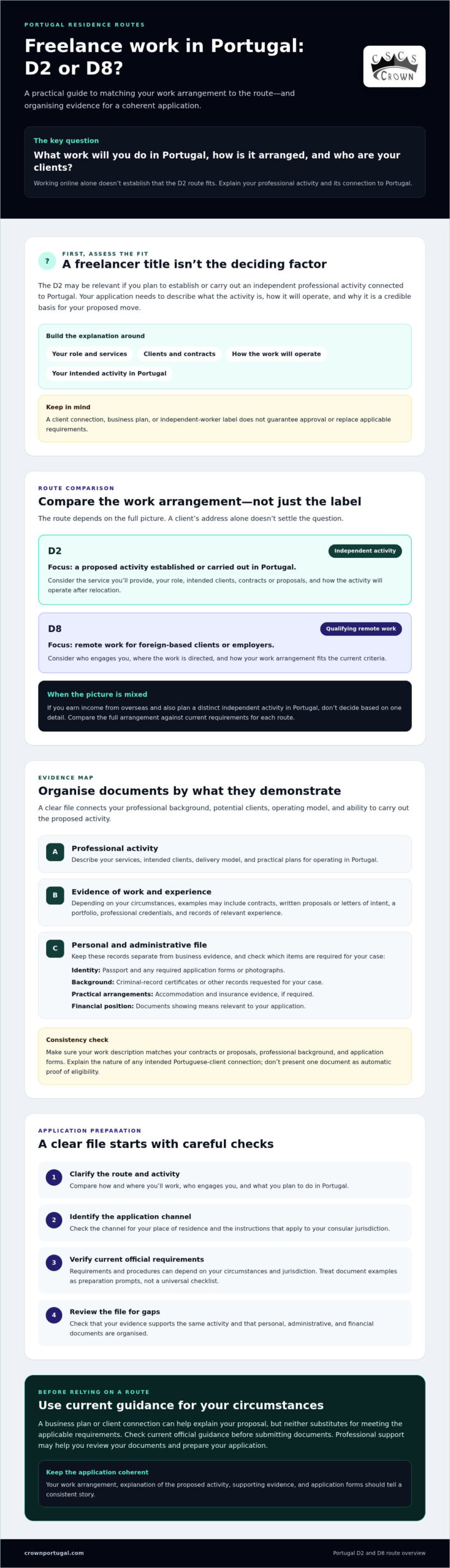
At a high level, the D2 focuses on a proposed independent activity established or carried out in Portugal. The D8 is designed for qualifying remote work for foreign-based clients or employers. A client’s address alone doesn’t settle the question. Consider who engages you, where the work is directed, how your activity will operate after relocation and what your move involves.
If your income comes from overseas but you’re also planning a distinct independent activity in Portugal, don’t assume one route applies based on a single detail. Compare your full work arrangement with the current criteria for each pathway. For the remote-work side of that comparison, consult the guide to Digital Nomad Visa Portugal requirements.
What Evidence Can Help Support an Independent Worker’s D2 Case?
A well-organised application should make it easy to understand both your proposed professional activity and your ability to carry it out. For the D2 visa Portugal for independent workers, arrange documents by purpose instead of submitting a loose collection of records. The examples below are preparation prompts, not a definitive or universally applicable checklist. Confirm current requirements with the Portuguese authority responsible for your application.
How can applicants present a credible professional activity?
Start by describing your service, intended clients, delivery model and practical plans for operating in Portugal. Then gather evidence that supports those points. Depending on your circumstances, this might include contracts, written proposals or letters of intent, a portfolio, professional credentials, or records of relevant experience. Check which evidence is appropriate for your activity and application route against the official D2 visa requirements.
Make sure the description of your work matches your contracts or proposals, professional background and application forms. If you intend to serve Portuguese clients, explain the nature of that connection. Don’t present a prospective client or a single document as automatic proof of eligibility.
Which personal and administrative documents should applicants check?
Keep personal and administrative records separate from evidence about your business activity. Create a second file for items such as:
- Identity: Passport and any required application forms or photographs.
- Background: Criminal-record certificates or other records requested for your case.
- Practical arrangements: Evidence relating to accommodation and insurance, if required.
- Financial position: Documents showing the means relevant to your application.
This list identifies categories to investigate, not documents that apply to every applicant. Requirements may depend on your circumstances, the consular jurisdiction handling your application and current rules. Before submitting, check whether documents need translation, certification or legalisation, and confirm their required format and validity period. Follow the responsible authority’s process rather than assuming that instructions for another country or application location apply to you.
A document review can help identify gaps and inconsistencies before submission, but it can’t guarantee an outcome. If you’d like help organising your application materials, you can discuss D2 application preparation with Crown Portugal.
D2 or D8 for Independent Workers: How to Compare the Routes
D2 and D8 are separate visa routes, not interchangeable labels for people who work independently. Compare your actual work arrangement with the purpose of your planned move. A client’s location can be relevant, but it doesn’t decide the answer on its own. Review your full circumstances against current official criteria before choosing which route to investigate.
| Factor | D2 route to investigate | D8 route to investigate |
|---|---|---|
| Work arrangement | A proposed independent professional or business activity connected to Portugal. | A qualifying remote-work arrangement for foreign-based clients or an employer. |
| Activity location | Consider how the activity will be established or carried out in Portugal. | Consider whether the work remains remote for clients or an employer based outside Portugal. |
| Evidence to examine | Activity plan, professional background, client or service evidence, and operating arrangements. | Evidence of the remote-work relationship and any other items required under current D8 criteria. |
| Intended move | Does the move support a planned independent activity in Portugal? | Does the move allow you to continue qualifying remote work from Portugal? |
This table is a comparison framework, not an eligibility test or official checklist. Mixed arrangements, such as working for an overseas company while developing a separate Portuguese client base, need careful assessment. Don’t assume that one contract, job title or client address settles which route fits.
When should an independent professional investigate the D2 route?
Explore the D2 if your move is tied to a planned professional or business activity connected to Portugal. Ask whether you can describe the service, explain how it will operate and support the plan with consistent documents. A particular occupation, contract or client mix isn’t automatically sufficient. Its relevance depends on your circumstances and the criteria in force.
When might the D8 route be more relevant?
The D8 may be worth reviewing if your work is remote for foreign-based clients or an employer and you intend to continue that arrangement from Portugal. Compare the official requirements rather than relying on informal labels such as “freelancer” or “digital nomad.” For a closer look at that pathway, see the guide to Digital Nomad Visa Portugal requirements.
If your circumstances involve employment rather than independent activity or qualifying remote work, the D1 route may merit separate research. Before proceeding, map your work relationships, where the activity will take place, the evidence you can provide and the purpose of your move. That outline can help you identify which route deserves closer review under current official guidance.
How to Prepare and Submit a Portugal D2 Application
A clear sequence can help you avoid preparing documents for the wrong route or authority. For the D2 visa Portugal for independent workers, confirm the application channel for your place of residence before finalising your file. Procedures can vary by consular jurisdiction, so follow the responsible Portuguese authority’s current instructions rather than assuming another applicant’s process applies to you.
What should applicants do before lodging the application?
Work through these checks in order:
- Confirm the route and jurisdiction. Verify that the D2 category matches your proposed activity, then identify the competent consulate or authorised application channel for the place where you legally reside.
- Build a consistent file. Make sure your activity description, supporting evidence and application forms tell the same story. Check that each document is relevant to your professional plan and personal circumstances.
- Review document formalities. Follow current instructions on translations, certification or legalisation, validity periods, file format and whether originals or copies are required.
- Check submission arrangements. Confirm the forms, appointment procedure, applicable fees and submission rules through official sources before booking or lodging your application.
Keep a copy of your final file and note any items that need updating before submission. Appointment availability and decision timelines can vary by location and individual circumstances, so avoid making travel or business commitments based on an assumed processing period.
What should applicants expect after submission?
The reviewing authority may request additional information or documents. Follow the instructions and deadline provided for your case, and make sure any further material is consistent with your original application. A request for more information doesn’t, by itself, indicate the outcome.
A visa application and a later residence-permit procedure are distinct stages. The national D2 visa is an entry stage. After arrival, applicants must follow the applicable residence-permit process and appointment instructions. The Portuguese Ministry of Foreign Affairs describes the D2 category as a residency visa for independent work or entrepreneurial purposes, with the visa holder required to apply for a residence permit during its validity. Verify current post-arrival requirements with the relevant authorities.
For the broader entrepreneur pathway and subsequent stages, see the related guide to the D2 entrepreneur visa process. If you’d like assistance reviewing documents, preparing the application or coordinating appointment steps, discuss D2 application preparation with Crown Portugal. Professional support can help organise a case, but no adviser can guarantee a decision.
Choose Your Next Step: Review the D2 Route With Professional Guidance
Before deciding whether to proceed, consider four things together: your work model, its connection to Portugal, the evidence available to support it and the current official requirements for your circumstances. The D2 visa Portugal for independent workers isn’t determined by a job title alone. A clear summary of your activity and unanswered questions can help you decide whether the route merits closer review.
What should you clarify before seeking advice?
Prepare a short, factual overview of what you do and how you plan to operate. Separate confirmed information from plans that are still developing. This helps identify evidence gaps and focus any discussion on points that need clarification.
- Describe your work: List your services, intended clients, how you deliver the work and the operating arrangements you expect to have in Portugal.
- Inventory your evidence: Note which contracts, proposals, professional records or other supporting documents you have, and which still need to be obtained or checked.
- Record open questions: Identify what you need to confirm about the application jurisdiction, current document formalities and any residence-permit steps after arrival.
- Check for consistency: Compare your activity description with the evidence and information you intend to provide in application forms. Flag unclear or conflicting details.
Keep this review practical. You don’t need to resolve every issue before asking for guidance. Identifying what remains uncertain is a useful starting point.
How can professional assistance support a D2 application?
Professional assistance can help organise a complex file through document review, application preparation and appointment scheduling. Crown Portugal, an immigration and relocation consultancy founded in 2018, provides support with D2 applications. A review can help you identify missing items, inconsistencies or questions to check against official instructions, while keeping your case presentation structured.
Consultancy support doesn’t replace the requirements of the relevant Portuguese authorities, and it can’t guarantee a visa decision. You remain responsible for providing accurate information and following current instructions for your application and jurisdiction. Confirm procedural details directly with the competent authority, particularly if rules or post-arrival steps may have changed.
If you’ve outlined your activity and gathered the documents you have so far, you can discuss your Portugal D2 visa application with Crown Portugal and review the next steps for your circumstances.
Build a Clear Plan for Your Portugal D2 Application
The D2 route may be worth exploring if your planned independent activity has a credible connection to Portugal and you can support your case with consistent evidence. The right pathway depends on your full work arrangement, not simply your job title or whether you work remotely. Compare the D2 and D8 criteria, then verify the current document and submission requirements for your application location.
For the D2 visa Portugal for independent workers, a practical next step is to outline your activity, gather the evidence you already have and note questions about eligibility, jurisdiction and later residence-permit procedures. This preparation can make a document review or application discussion more focused.
Crown Portugal provides immigration consultancy, including document review, application preparation and appointment scheduling. This support can help organise your application, but the relevant authorities make the decision and their requirements still apply. Discuss your Portugal D2 visa application with Crown Portugal to review the next steps for your circumstances.
Frequently Asked Questions
Can independent workers apply for a Portugal D2 visa?
Independent professionals may investigate the D2 route if their circumstances involve a qualifying professional or business activity, but self-employed status alone doesn’t establish eligibility. Assess your actual work arrangement, planned activity, supporting evidence and current requirements for the relevant application jurisdiction. A clear description of your services and how you intend to operate can help frame that assessment. Verify the applicable criteria with official sources or a qualified adviser before relying on a general checklist.
Is the D2 visa suitable for freelancers working with foreign clients?
It depends on your complete work arrangement and the activity you intend to pursue in Portugal. Having foreign clients doesn’t, by itself, determine which visa route applies. Compare the D2 pathway with the D8 remote-work route, then check current official criteria against your contracts, services and plans. Don’t assume a client’s location automatically makes an application eligible. If your work arrangements are mixed, describe each part clearly before deciding which route to investigate.
What is the difference between Portugal’s D2 and D8 visas for independent workers?
The D2 and D8 address different circumstances and shouldn’t be treated as interchangeable. The D2 is commonly considered in connection with an independent professional or business activity, while the D8 concerns qualifying remote-work arrangements. The relevant distinction depends on your actual work, plans and current criteria, not simply your job title. Review the official requirements for both routes before choosing or submitting an application, particularly if your work combines activity in Portugal with overseas clients.
What documents may an independent worker need for a Portugal D2 application?
Check the current official checklist for the jurisdiction handling your application. Preparation may involve identity and personal records, alongside evidence explaining your proposed activity, professional background, client relationships and practical operating plans. Contracts, service proposals or professional credentials may be relevant in some cases, but no generic list guarantees that your file is complete. Before submission, verify document format, validity, translation and certification requirements, as these may depend on the document and application location.
Do I need a business plan for a Portugal D2 visa as an independent worker?
A clear explanation of your proposed activity can help show what work you intend to undertake and how your supporting evidence relates to it. Whether a formal business plan is required, and what it should contain, depends on current instructions and your circumstances. Avoid relying on a generic plan that conflicts with your contracts, professional records or stated application purpose. Check the relevant official guidance and make sure all parts of your file describe a consistent activity.
How do independent workers apply for a Portugal D2 visa?
Start by confirming that the D2 route and application channel fit your circumstances and jurisdiction. Then check current official instructions, assemble and review the required records, follow the applicable appointment and submission process, and respond to any requests from the authorities. The visa application and any later residence-permit procedure are separate stages. Requirements and appointment availability can vary, so verify each step and avoid relying on assumed processing times when planning your move.
Can a consultant guarantee approval of a Portugal D2 visa?
No consultant can guarantee a decision made by the relevant authorities. Professional support may help you review documents, organise an application and understand procedural steps, but it can’t replace official criteria or control the outcome. Be cautious of any promise of guaranteed approval. Before engaging an adviser, ask what support they provide, which documents they will review and how they confirm current requirements for your application jurisdiction. The final decision remains with the competent authority.