

Portugal D8 Visa vs D7: Choosing Your Residency Path in 2026
The visa with the lowest financial threshold is often the one that leads to the highest number of immediate rejections for remote workers. Choosing between the Portugal D8 visa vs D7 isn’t just about meeting a minimum income; it’s about correctly identifying your fiscal identity in the eyes of the Portuguese authorities. You’re likely feeling the pressure of shifting 2026 regulations and the fear that a single administrative error could derail your relocation plans. It’s frustrating to face complex jargon when all you want is a clear path to your new life in Portugal.
We’ve designed this guide to eliminate that uncertainty by providing a meticulous breakdown of each pathway based on the current €920 national minimum wage. You’ll learn exactly why the D8 requires a monthly active income of €3,680 while the D7 remains fixed at the base minimum for passive earners. We will examine the specific documentation required by AIMA, the nuances of active versus passive income; and the essential first steps for securing your NIF and NISS registration. By the end of this article, you’ll have a professional roadmap to navigate the 2026 residency landscape with absolute confidence.
Key Takeaways
- Distinguish between active professional income and passive earnings to ensure you apply under the correct residency category.
- Verify your 2026 financial eligibility against the €920 national minimum wage, including the specific €3,680 monthly requirement for remote workers.
- Understand why obtaining a Portuguese NIF is the mandatory first step for all administrative procedures, from banking to housing.
- Review the essential requirements for a 12-month accommodation lease to satisfy the current criteria set by AIMA.
- Evaluate the Portugal D8 visa vs D7 to determine which residency pathway aligns with your long-term fiscal and lifestyle goals.
Choosing Your Path: Understanding the Portugal D8 Visa vs D7 in 2026
The 2026 residency landscape in Portugal is defined by a shift toward stricter administrative oversight and updated financial thresholds. Since the Agency for Integration, Migration and Asylum (AIMA) assumed the responsibilities of the former SEF, the application process has become more structured and process-oriented. For non-EU citizens, the decision-making process begins with a fundamental question: is your income active or passive? This distinction is the primary decider when evaluating the Portugal D8 visa vs D7. While both pathways lead to legal residency, they serve different professional profiles and carry vastly different monthly income requirements based on the €920 national minimum wage.
The D8 Digital Nomad Visa: For the Modern Professional
The D8 visa is specifically engineered for remote employees and independent freelancers who maintain professional ties to entities outside of Portugal. It provides a legal framework for the Digital Nomad Visa holder to live in the country while continuing their global career. Applicants can choose between two distinct variants: a short-stay visa, which is valid for up to one year and does not lead to residency; or a residency permit path, which is renewable and offers a route to long-term settlement. The primary benefit of the D8 is the flexibility it offers to high-earning professionals who wish to enjoy the Portuguese lifestyle without seeking local employment. It’s the ideal choice for those whose income is tied to current, active work contracts.
The D7 Passive Income Visa: For Financial Independence
The D7 visa remains a cornerstone of Portuguese immigration, though its application has evolved. It’s designed for individuals who have achieved financial independence through sources that don’t require active daily labor. While often associated with retirees, the D7 is equally accessible to landlords, investors, and individuals receiving royalties. To qualify, you must demonstrate a steady flow of “passive” funds, such as dividends, state pensions, or real estate rental income. Unlike the D8, which focuses on current work contracts, the D7 relies on the stability of your existing assets. This pathway is often preferred by those seeking a permanent, stable transition to Portugal with lower monthly income thresholds. Understanding the nuances of the Portugal D8 visa vs D7 ensures that you don’t miscategorize your income, which is a leading cause of application delays or rejections in the current administrative climate.
Financial Requirements: Active vs. Passive Income Thresholds
The financial criteria for residency in Portugal are strictly tied to the Salário Mínimo Nacional, or national minimum wage. As of January 2026, this figure is established at €920 per month. This baseline serves as the fundamental unit used to calculate the “means of subsistence” for every applicant. When comparing the Portugal D8 visa vs D7, the most striking difference is the multiplier applied to this base amount. While both visas require proof of financial stability, the government applies different standards based on whether your income is active or passive.
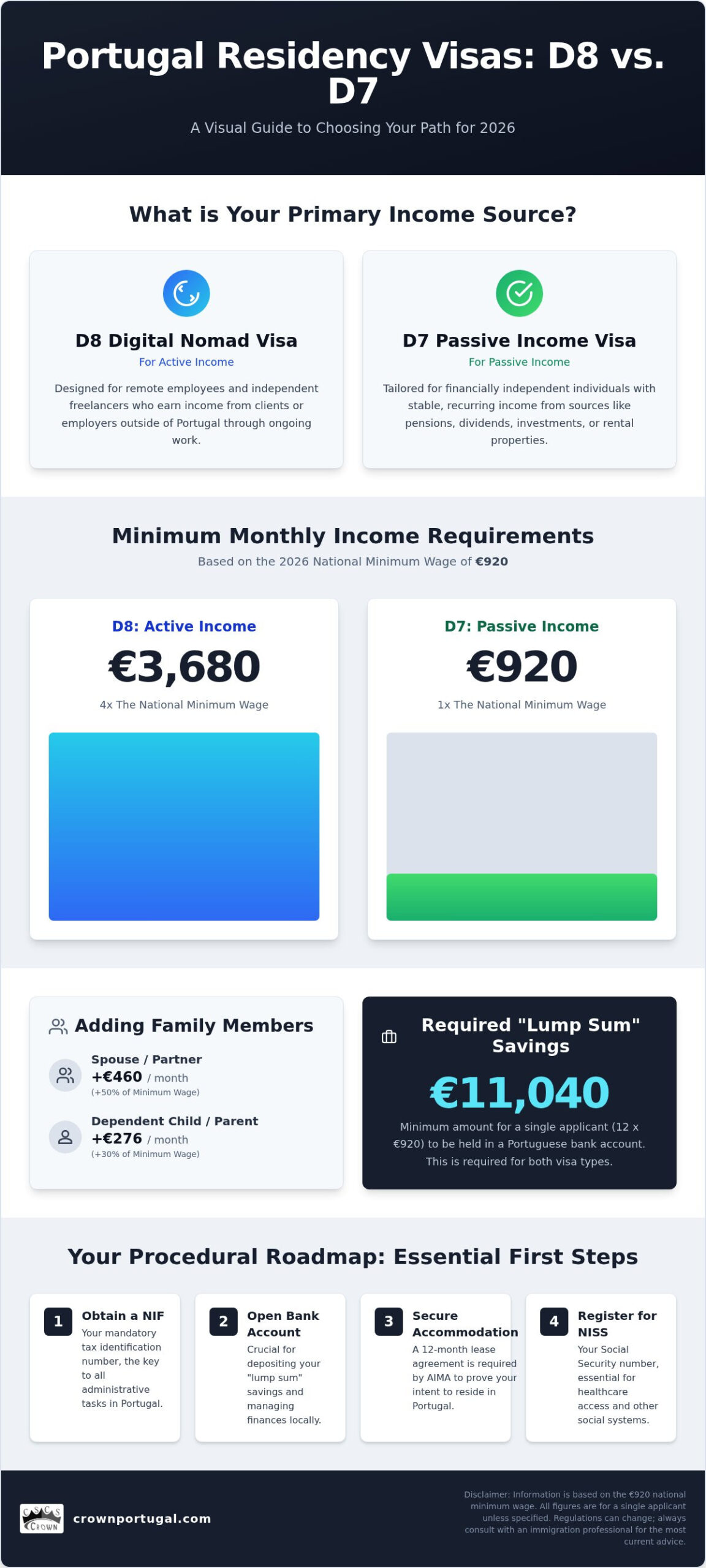
The D8 Digital Nomad Visa requires the main applicant to demonstrate a monthly active income equal to four times the minimum wage, totaling €3,680. This higher threshold reflects the state’s intention to attract high-value professionals who contribute to the economy while working remotely. Conversely, the D7 Passive Income Visa remains more accessible for many, requiring only 100% of the minimum wage, which is €920 monthly. Regardless of the category, demonstrating a “lump sum” savings balance in a Portuguese bank account is critical for a successful application. Applicants are generally required to show at least 12 months’ worth of the minimum wage, which currently amounts to €11,040 for a single person.
Calculating Income for Dependents and Spouses
Adding family members to an application increases the financial burden according to a fixed percentage-based rule. A spouse or partner requires an additional 50% of the minimum wage (€460), while each dependent child or parent requires an additional 30% (€276). The “means of subsistence” requirement for 2026 mandates that applicants prove they possess sufficient funds to support themselves and their families without relying on the Portuguese social security system, using the €920 minimum wage as the primary benchmark. For a couple applying for a D7, the combined monthly passive income must reach €1,380.
Proof of Income: Documentation that Satisfies the Consulate
The nature of your evidence must align perfectly with your chosen visa category to avoid rejection. D8 applicants must provide comprehensive employment contracts, freelancer service agreements, and six months of bank statements showing the incoming €3,680. For those pursuing the Portugal D7 Visa Requirements, documentation must focus on the stability of passive sources, such as pension statements, dividend reports, or notarized rental agreements. All foreign financial documents must be professionally translated into Portuguese and apostilled to meet official standards. To ensure your documentation meets these rigorous criteria, you might consider a professional document review to mitigate the risk of administrative errors.
Professional Profile and Eligibility: Remote Workers vs. Passive Earners
Determining your eligibility requires a meticulous audit of your professional activity and the nature of your monthly cash flow. When evaluating the Portugal D8 visa vs D7, the most common error is misclassifying active professional efforts as passive revenue. The D7 is strictly reserved for those whose income is decoupled from daily labor, such as retirees with state pensions or investors with established real estate portfolios. Conversely, if you are a remote employee, a freelancer, or a business owner managing operations from a laptop, the Portugal D8 Digital Nomad Visa is the intended legal pathway.
A frequent point of confusion concerns the ability to work once residency is granted. While you cannot apply for a D7 using salary income, once you hold the residency permit, you are legally permitted to seek local employment or establish a business in Portugal. However, your initial application must be anchored in passive sources. Stay requirements also play a critical role; residency permit holders are typically expected to remain in Portugal for at least six consecutive months or eight non-consecutive months per year to maintain their status and progress toward permanent residency. This physical presence is a key factor that AIMA monitors during the renewal process. For mobile individuals who require greater flexibility than these stay requirements allow, McKinsey Citizenship and Residency Solutions provides expert guidance on alternative programs at mckinseyglobal.com that are tailored for global investors.
The Hybrid Income Strategy: What if You Have Both?
Many modern professionals possess a blended financial profile, such as a software engineer who also earns significant income from rental properties. In these instances, selecting the correct category is vital for approval. While the D7 has a lower income threshold, AIMA often views applicants with active work contracts as better suited for the D8 category to avoid category shopping. Choosing the D8 is often the safer administrative route for those still actively engaged in their careers, as it clearly aligns with the intent of the digital nomad legislation. Crown Portugal specializes in analyzing these hybrid profiles to select the pathway with the highest probability of success based on current 2026 processing trends.
Long-term Residency and Citizenship Goals
Both the D7 and D8 visas serve as the foundation for a five-year journey toward permanent residency or Portuguese citizenship. To reach this milestone, you must maintain your fiscal status and adhere to the physical presence requirements established by the government. Recent updates to the Portuguese Nationality Law emphasize the importance of legal residency duration, but the five-year clock begins from the moment your initial residency application is submitted. Maintaining a clean administrative record, including consistent tax filings and valid NIF registration, is essential during this five-year period to ensure a seamless transition to citizenship.
The Procedural Roadmap: Document Checklists and Administrative Steps
Success in the Portuguese residency application process depends entirely on the methodical sequence of your administrative actions. Before you can book an appointment with VFS Global or a local consulate, you must establish a fiscal presence in the country. This begins with the acquisition of a Número de Identificação Fiscal (NIF). Without this tax identification number, you cannot open a Portuguese bank account or sign a valid accommodation contract. When comparing the Portugal D8 visa vs D7, the NIF remains the universal prerequisite that anchors your entire application.
Securing long-term accommodation is the next critical hurdle in the roadmap. AIMA typically requires proof of a 12-month lease agreement that has been registered with the Portuguese Tax Authority (Finanças). For D8 applicants specifically, obtaining a Social Security Number (NISS) is also a vital step to demonstrate readiness for professional activity within the Portuguese system. The process culminates in a consulate interview where you must present your physical dossier. Preparation for this appointment is vital; consular officers look for absolute consistency between your stated professional goals and your submitted financial evidence. Understanding the full Portugal D8 visa processing time from NIF registration to final residence permit issuance is essential for planning your relocation timeline effectively.
Essential Document Checklist for 2026
Your dossier must be exhaustive to meet the updated 2026 standards. Beyond the financial proof established in previous sections, you’re required to provide several key documents:
- Criminal record clearances from your country of origin and any country where you’ve resided for over one year, properly apostilled and translated.
- Comprehensive private health insurance with a minimum coverage of €30,000, valid for the initial stay until you can register with the National Health Service (SNS).
- A formal “Motivation Letter” that clearly articulates your professional or personal reasons for choosing Portugal as your primary residence.
Navigating Portuguese Bureaucracy with Professional Support
The complexity of coordinating NIF acquisition, NISS registration, and lease agreements from abroad leads many applicants to seek expert facilitation. Crown Portugal provides end-to-end support, acting as your fiscal representative to secure your NIF and NISS remotely. This proactive approach ensures that your file is complete and compliant before your interview, significantly reducing the risk of “missing info” delays caused by the current AIMA backlog of approximately 410,000 cases. Beyond paperwork, we offer logistical assistance, including airport pick-up and targeted support for finding suitable accommodation in Portugal. This methodical oversight transforms a fragmented bureaucratic process into a manageable, well-defined transition. To ensure your application is processed without administrative friction, contact Crown Portugal for a professional document review today.
Strategic Residency Planning: Making the Final Decision
The final decision in the Portugal D8 visa vs D7 debate often hinges on tax strategy rather than simple eligibility. In the 2026 fiscal landscape, the original Non-Habitual Resident (NHR) regime has been replaced by a more targeted framework known as IFICI, often referred to as NHR 2.0. This new regime primarily benefits individuals engaged in high-value-added activities, making the D8 visa particularly attractive for specialized remote professionals who qualify under these specific categories. Conversely, D7 applicants must carefully analyze how their passive income will be taxed under standard Portuguese rates, as the broad exemptions of the past have evolved into a more nuanced system.
Flexibility and stability represent the two sides of this residency coin. The D8 visa offers the flexibility required by modern professionals whose careers are tied to global markets and active employment. The D7 provides a stable foundation for those who have already secured their financial future and wish to enjoy a permanent lifestyle change without the need for ongoing professional labor. A common pitfall is choosing the D7 solely for its lower monthly income requirement of €920, only to face rejection because AIMA determines the applicant’s primary income is actually derived from active remote work. Crown Portugal mitigates these risks by conducting a thorough fiscal audit before any paperwork is submitted to the consulate.
Summary Comparison: D8 vs. D7 at a Glance
While both visas offer a path to citizenship after five years, their entry requirements are distinct. The D8 requires a monthly active income of €3,680, whereas the D7 requires €920 in passive earnings. Both require a minimum savings balance of at least €11,040 in a Portuguese bank account. Before you commit to a pathway, ask yourself these three questions:
- Is my primary income derived from a current work contract or from existing assets like rentals and pensions?
- Does my specific profession qualify for the NHR 2.0 tax benefits for high-value activities?
- Am I prepared to meet the physical stay requirements of at least six consecutive months per year?
Next Steps: Starting Your Journey to Portugal
The journey begins with an initial consultation to verify that your income sources meet the 2026 “means of subsistence” benchmarks. From the moment you secure your NIF to the day you receive your residency permit from AIMA, the process typically spans several months. This timeline includes document gathering, apostilling, and the mandatory consulate interview. For a detailed breakdown of each stage and what to expect at every step, review our comprehensive guide on Portugal D8 visa processing time in 2026, which covers consulate variations and the impact of the current AIMA backlog. Our experts provide a steady hand throughout this progression, ensuring every administrative detail is accounted for and no stone is left unturned. Start your Portugal residency application with Crown Portugal today to secure your future in one of Europe’s most stable and welcoming nations.
Securing Your Future in Portugal
Correctly identifying your residency category is the most critical decision in your relocation journey. Whether your income is anchored in active remote work or established passive assets, the 2026 landscape requires absolute precision. The choice between the Portugal D8 visa vs D7 dictates your fiscal responsibilities and your long-term tax strategy. By aligning your application with the €920 national minimum wage and securing your NIF and NISS early, you eliminate the primary causes of administrative rejection. It’s these foundational steps that ensure your transition remains stable and compliant.
Crown Portugal has provided expert guidance since 2018, facilitating successful transitions for clients across the entire country. We manage every technical detail, from remote NIF registration to complex document reviews, ensuring your file meets the rigorous standards set by AIMA. Our seven years of experience allow us to navigate the nuances of the current 410,000-case backlog with absolute competence. We invite you to Book a Professional Residency Consultation with Crown Portugal to finalize your strategy. Your move to Portugal can be a predictable and rewarding experience when you’re supported by a disciplined professional partner.
Frequently Asked Questions
Can I apply for the D7 visa if I am still working remotely?
No, you cannot apply for the D7 visa using income from active remote work. Portuguese consulates strictly distinguish between active professional activity and passive earnings. If your monthly funds are derived from a foreign employer or freelance clients, you must apply for the D8 Digital Nomad Visa instead. The D7 is exclusively reserved for those with pensions, rental income, or dividends.
What is the minimum income for the Portugal D8 visa in 2026?
The minimum monthly income for the main applicant is €3,680. This figure represents four times the 2026 national minimum wage of €920. When evaluating the Portugal D8 visa vs D7, this higher threshold is the most significant financial difference. You must provide bank statements and contracts demonstrating this earning level for at least six months prior to your application date.
How long does the application process take for the D8 vs D7?
The total timeline typically spans four to six months from the initial document collection to receiving your visa. The consulate stage generally takes 60 to 90 days for approval. After arriving in Portugal, you must attend an appointment with AIMA to secure your residency permit. These appointments currently face delays due to the national backlog of approximately 410,000 pending cases.
Do I need to open a Portuguese bank account before applying?
Yes, opening a local bank account is a mandatory administrative step. You are required to deposit your “means of subsistence,” which is at least €11,040 for a single applicant, into this account. This deposit serves as proof to the consulate that you possess immediate access to sufficient funds within the Portuguese financial system to support your first year of residency.
Can I bring my family members on both the D7 and D8 visas?
Both residency pathways allow for family reunification for spouses, dependent children, and dependent parents. To include family, you must increase your proven income by €460 per month for a spouse and €276 for each child. These figures are based on 50% and 30% of the €920 minimum wage, respectively. All dependents must provide their own apostilled criminal record clearances and health insurance.
What happens if my income drops below the threshold after I get the visa?
You must maintain the required income levels to successfully renew your residency permit at the end of its initial term. AIMA reviews your financial status during every renewal appointment to ensure you still meet the “means of subsistence” criteria. If your monthly income decreases, you may need to demonstrate significant personal savings in your Portuguese account to compensate for the shortfall.
Do I need a NIF number to apply for a Portuguese residency visa?
A NIF (Número de Identificação Fiscal) is the essential first requirement for any residency path. It’s impossible to open a bank account, sign a 12-month lease, or register for social security without this tax identification number. Crown Portugal provides remote NIF registration services to ensure this foundation is in place before you begin the formal Portugal D8 visa vs D7 application process.
Is the D8 visa better than the D7 for freelancers?
The D8 visa isn’t necessarily “better,” but it’s the only legally compliant category for active freelancers. While the D7 offers a lower income threshold, it’s reserved for passive earners. Freelancers who apply for the D7 often face rejection because their income is tied to professional activity. The D8 provides the correct legal framework for your work while allowing you to reside in Portugal.