

Remote Work Visa Portugal Guide: Navigating the D8 Pathway in 2026

A single missing document in your AIMA application can delay your European residency dreams by over 18 months. Relying on a comprehensive remote work visa Portugal guide is essential in 2026, as the administrative landscape feels increasingly complex for professionals managing a transition from abroad. Many applicants feel a justified sense of stress regarding the NIF registration process and the strict scrutiny applied to financial documentation. It’s common to feel overwhelmed by the requirement to prove a monthly income of at least €3,680 while simultaneously establishing a new fiscal identity.
This professional roadmap is designed to remove that uncertainty and ensure your residency success. You’ll master the intricacies of the D8 pathway, from validating your financial eligibility to completing your fiscal setup with absolute precision. We’ll examine the specific 2026 income thresholds for dependents, the essential role of the Social Security Identification Number (NISS), and the methodical steps required to ensure your application is accepted without delay. This resource serves as your expert consultant for a stable and secure transition to your new professional life in Portugal.
Key Takeaways
- Differentiate between the Temporary Stay and Residency Authorization pathways to align your application with your specific long-term residency objectives.
- Confirm your financial eligibility against the 2026 minimum monthly income threshold of €3,680 as outlined in this remote work visa Portugal guide.
- Execute the essential fiscal prerequisites, including the registration of your NIF and the establishment of a Portuguese bank account, before initiating your application.
- Navigate the mandatory social security registration process (NISS) to ensure your remote professional activities remain fully compliant with Portuguese regulations.
- Prepare for your AIMA biometric appointment by securing a 12-month accommodation contract and organizing your professional dossier for final residency approval.
Understanding the Portugal Digital Nomad Visa (D8) Pathways
The Portugal Digital Nomad Visa, officially designated as the D8 Visa, represents the primary legal framework for non-EU citizens who wish to perform professional activities remotely for entities located outside of Portuguese territory. Established to provide a dedicated pathway for the modern Digital Nomad Lifestyle, the D8 effectively replaced the previous administrative reliance on the D7 Passive Income Visa for remote workers. This legislative shift ensures that applicants are evaluated based on their active professional income rather than passive wealth; this creates a more precise and streamlined selection process for those following a remote work visa Portugal guide to residency.
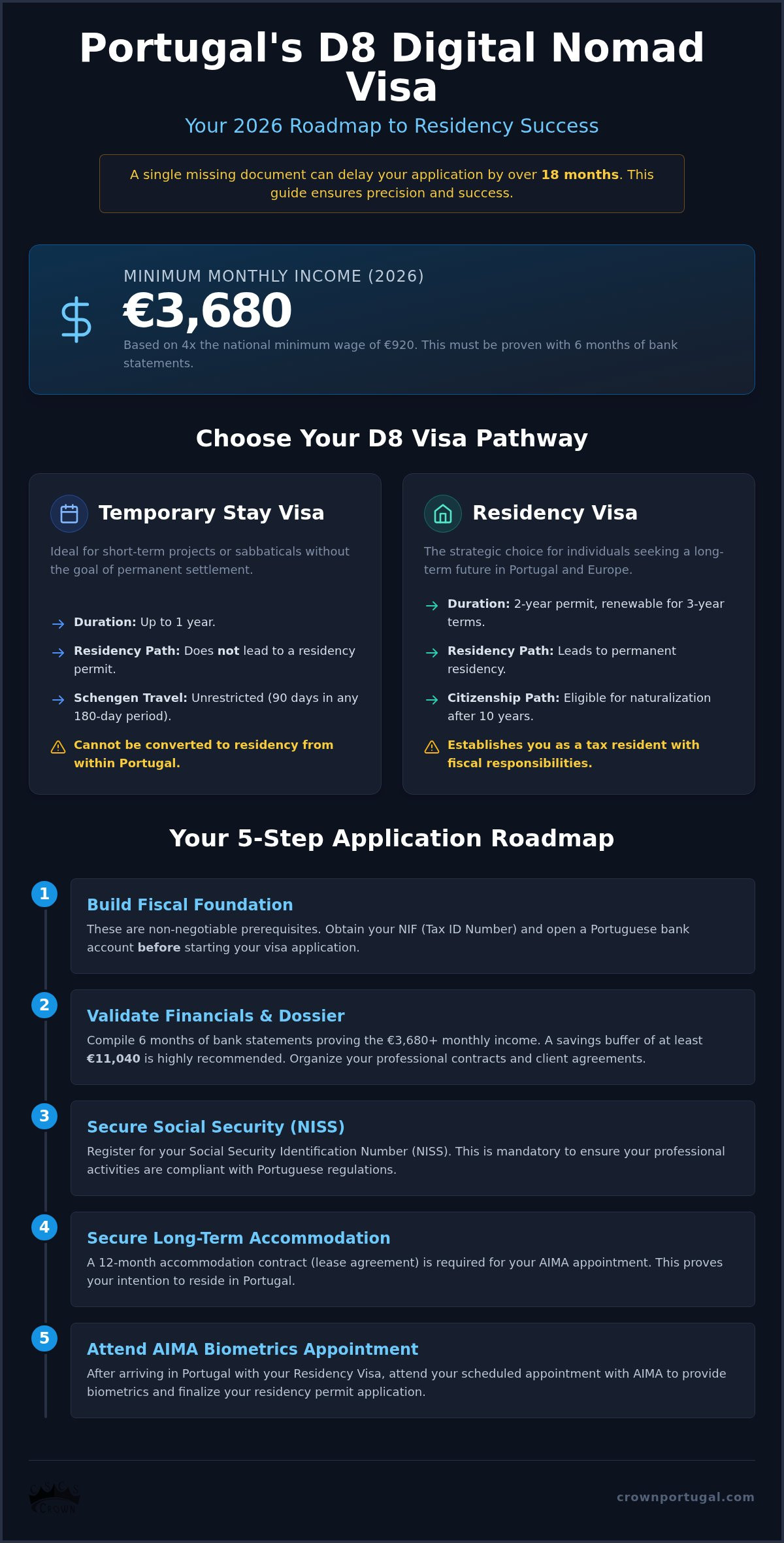
To qualify under the current 2026 regulations, applicants must demonstrate a stable monthly income equivalent to four times the national minimum wage. With the 2026 minimum wage set at €920, the individual income threshold stands at €3,680 per month. This requirement applies to both salaried employees with traditional employment contracts and independent contractors providing services to international clients. This financial baseline serves as the foundation for both the short-term and long-term visa variants.
The Temporary Stay Visa (Short-Term)
This professional mobility often encourages US citizens to diversify their business interests across multiple continents. While securing residency in Portugal, many entrepreneurs also seek expertise on company setup in Brazil for US citizens to establish a dual presence in both the European and South American markets.
The Temporary Stay variant is designed for professionals who intend to reside in Portugal for a limited duration, specifically up to one year. This pathway does not lead to permanent residency or citizenship, making it a suitable choice for those on sabbatical or short-term projects. Key features of this visa include:
- Authorization for multiple entries into Portuguese territory during the validity period.
- Unrestricted travel throughout the Schengen Area for up to 90 days within any 180-day period.
- A simplified documentation dossier compared to the residency pathway, as it excludes the requirement for long-term residency permit applications after arrival.
While this option offers flexibility, it’s vital to recognize that a Temporary Stay Visa cannot be converted into a residency permit once the holder is within the country. It’s a non-renewable authorization that requires the holder to exit or re-apply from their country of origin if they wish to extend their stay beyond the 12-month limit.
The Residency Visa (Long-Term)
The Residency Visa is the strategic choice for individuals seeking a long-term future in Europe. This pathway functions as a two-step administrative process: an initial four-month visa issued by a consulate, followed by a formal application for a residency permit through AIMA. According to this remote work visa Portugal guide, the residency permit is typically granted for an initial two-year period and is renewable for subsequent three-year terms.
Under the 2026 legal updates, this pathway serves as a foundation for permanent residency and potential naturalization. It’s essential to understand that most applicants now face a 10-year eligibility period for citizenship naturalization following a major law change. This long-term route requires the applicant to maintain a significant physical presence in the country and establishes them as a tax resident. This status necessitates a comprehensive understanding of local fiscal responsibilities, including individual income tax and social security contributions.
Financial Eligibility and Professional Documentation Standards
Securing approval for a D8 visa requires a meticulous approach to financial disclosure. The Portuguese authorities demand clear, indisputable evidence that your income exceeds the statutory requirements for the duration of your stay. As established in the Official Portugal Visa Information, the 2026 monthly income threshold is fixed at €3,680 for the main applicant. This figure is non-negotiable and must be proven through bank statements from the last six months, clearly showing the regular deposit of salary or service fees. Any remote work visa Portugal guide must emphasize that while income is the primary metric, demonstrating a savings buffer of at least €11,040 for a single applicant significantly strengthens the dossier by providing proof of subsistence during the initial transition.
Documentation standards remain a frequent point of failure for many applicants. Every non-Portuguese document, including bank statements, contracts, and certificates, must be officially translated by a certified translator. Furthermore, documents issued by foreign authorities require an Apostille or legalization to be recognized as valid within the Portuguese administrative system. This level of precision is essential to avoid immediate rejection by AIMA. If you’re concerned about meeting these rigid standards, securing a professional NIF registration early in the process helps establish your fiscal presence before you even submit your visa application.
Proving Remote Work Status
The distinction between a standard job and a digital nomad role must be explicitly stated in your professional documentation. For salaried employees, the employment contract must contain a specific clause authorizing remote work from abroad. If the contract is older, a formal company declaration on official letterhead is required; this document should confirm your position, salary, and the employer’s consent for your relocation to Portugal. Freelancers must demonstrate a stable professional relationship through active service agreements or a portfolio of contracts that show consistent billing history over the previous quarter. Authorities look for longevity and reliability in these professional ties to ensure you won’t become a burden on the state.
Financial Multipliers for Dependents
Including family members in your application increases the monthly income requirements proportionally. The primary applicant must add an additional 50% of the minimum requirement for a spouse or partner, which amounts to an extra €1,840 per month. For every dependent child or elderly family member, an additional 30% (€1,104) is required. This means a couple applying together must demonstrate a combined monthly income of at least €5,520. When presenting household income, it’s vital to show that these funds are accessible and consistent. Savings requirements also scale; a couple should maintain at least €16,560 in a Portuguese bank account to satisfy the subsistence standards for a residency permit.
The Step-by-Step Application Procedure for Remote Professionals
The path to residency is a structured sequence that begins long before your arrival on Portuguese soil. Following a methodical remote work visa Portugal guide ensures that each administrative phase is completed in the correct order; this prevents the costly delays associated with out-of-sequence filings. The process initiates with the collection of a core document dossier in your country of origin. You’ll need to gather criminal record clearances, proof of professional activity, and comprehensive health insurance coverage with a minimum of €30,000 in coverage. It’s essential that these documents are current and meet the specific apostille requirements for international recognition.
Simultaneously, you must establish your fiscal presence within the country. This second phase involves securing a Portuguese Tax Identification Number (NIF) and opening a local bank account. These steps are prerequisites for the visa application and typically require a professional intermediary to facilitate remote registration. Once these foundations are in place, you move to the consulate interview, where your intent and financial stability are formally evaluated. You don’t want to arrive at this stage without a fully funded Portuguese bank account, as it serves as primary evidence of your means of subsistence.
Navigating the Consulate Interview
The consulate interview is a critical juncture where officials verify the authenticity of your remote work status. You’ll need to prepare for specific inquiries regarding your professional history, the nature of your employer or clients, and your logistical plans for relocation. Your “Statement of Purpose” must explicitly align with current residency laws; it should clearly define your remote work arrangement and your commitment to maintaining the required €3,680 monthly income. In 2026, the official visa application fee is €110. While the statutory processing time is 60 days, you should anticipate a realistic timeline of 4 to 7 months from document gathering to final visa issuance due to current administrative backlogs.
Professional Document Review and Submission
The transition from the former SEF system to the current AIMA administrative framework has introduced significant procedural changes that require expert navigation. Professional consultancy is invaluable during this phase to prevent common rejection pitfalls, such as submitting incomplete employment declarations. If AIMA issues a Request for Information (RFI), you must respond with precise documentation within strict deadlines to avoid an outright application rejection. After you enter Portugal with your initial visa, you’ll attend a biometric appointment to secure your residency permit. Current wait times for these appointments range from 6 to 18 months. Maintaining a complete and correct file is the only way to ensure your residence card is issued within the standard 1 to 3 months following the biometrics session.
Establishing Your Fiscal and Administrative Foundation in Portugal
Success with the D8 pathway relies on more than just meeting income thresholds; it requires a robust fiscal infrastructure within the country. The foundation of this infrastructure is the NIF (Número de Identificação Fiscal), which serves as your primary identification for all financial and administrative interactions. You cannot open a bank account, sign a long-term rental agreement, or even secure a mobile phone contract without this nine-digit number. For non-EU residents, the NIF registration involves a mandatory stamp duty of €10.20. This remote work visa Portugal guide emphasizes that while you can technically obtain a NIF after arrival, doing so remotely is a strategic necessity for a smooth visa application process.
The administrative landscape has shifted significantly following the end of the Non-Habitual Resident (NHR) tax regime in 2024. New applicants in 2026 are subject to standard progressive tax rates once they surpass the 183-day threshold of residency. This change makes the early establishment of your fiscal identity even more critical. You’ll also need to navigate the opening of a Portuguese bank account, which is a prerequisite for demonstrating your means of subsistence. While some digital-first banks allow for remote opening, traditional institutions often require a NIF and a local fiscal representative to facilitate the process before you arrive in person.
Securing Your NIF Remotely
Obtaining your NIF before you submit your D8 visa application is a non-negotiable step for professional applicants. As a non-EU citizen, you’re legally required to appoint a fiscal representative who is a permanent resident or a Portuguese entity. This representative acts as your intermediary with the Tax Authority (Autoridade Tributária) until you establish a local address. Once registered, your NIF becomes the anchor for your entire relocation; it links your Portuguese bank account to your 12-month rental contract, creating the paper trail that AIMA requires for residency approval. If you’re ready to begin this process, you can secure your NIF and fiscal representation through our specialized administrative services.
Social Security (NISS) for the Self-Employed
For freelancers and independent contractors, the Social Security Identification Number (NISS) is as vital as the NIF. You must register with the Portuguese Social Security system to ensure your professional activity is fully compliant with local labor laws. While salaried employees of foreign firms may remain under their home country’s system via an A1 or similar certificate, freelancers typically need a NISS to pay local contributions. Under current 2026 regulations, many newly registered self-employed individuals benefit from a contribution exemption for their first 12 months of activity. Acquiring a NISS involves a specific administrative filing that should be handled concurrently with your initial tax registration to avoid future compliance issues.
Post-Arrival Compliance and Long-Term Residency Management
Arrival in Portugal marks the transition from the preparatory phase to the local administrative phase. Your initial four-month visa serves as a temporary entry permit, but it doesn’t grant full residency rights until you complete the biometric registration process. You must attend a scheduled appointment with AIMA to finalize your status and secure your physical residency card. Given that wait times for these appointments currently span 6 to 18 months depending on the regional delegation, maintaining a meticulous record of your legal presence is vital. A reliable remote work visa Portugal guide suggests carrying your visa issuance confirmation and proof of your scheduled appointment at all times. Once your biometrics are captured, you’ll be required to pay the residence permit application fee of €99.80 and the card issuance fee of €85.80. To appreciate the city’s historic charm and majestic skyline while settling in, many new residents book an excursion with Lisbon Catamaran Tours to celebrate their arrival.
Establishing a permanent base is the next critical step in your residency journey. Authorities require definitive proof that you’ve secured a long-term home, which serves as your official “tax address” in the country. This administrative requirement is strictly enforced during the permit issuance phase and for all subsequent renewals. Failing to maintain a registered address can lead to the revocation of your residency status, making it essential to understand the specific legal standards for Portuguese housing contracts.
Standard tourist rentals or short-term Airbnb stays are insufficient for residency purposes. AIMA requires a 12-month lease agreement that is formally registered with the Portuguese Tax Authority (Finanças). Your landlord must issue official electronic rent receipts (recibos de renda eletrónicos) that are linked directly to your NIF. Finding compliant housing from abroad is often the most stressful aspect of relocation; however, utilizing professional relocation services to secure accommodation in Portugal ensures your contract meets every legal criterion. This prevents the common rejection pitfall where an applicant presents an “informal” agreement that officials cannot verify in the national system.
Residency Renewals and Compliance
Your initial residency permit is granted for a period of two years, followed by three-year renewal cycles. To remain compliant, you must adhere to minimum stay requirements, which generally necessitate spending at least 183 days per year within Portuguese territory. This physical presence confirms your status as a tax resident, requiring you to update your fiscal profile from “non-resident” to “resident” at the tax office. Consistency is key during these renewals; you must continue to demonstrate that your remote work income remains above the 2026 threshold of €3,680 per month.
While the D8 pathway offers a stable route to permanent residency, you should prepare for the long-term timeline. Under the 2026 legislative updates, the eligibility period for citizenship through naturalization is now 10 years for most applicants. This decade-long commitment underscores the importance of maintaining perfect administrative compliance from your first day in the country. By following a methodical approach to your fiscal and professional records, you ensure a secure future within the European Union.
Securing Your Professional Future in Portugal
Transitioning to a new life as a remote professional requires a disciplined approach to administrative compliance. Success in 2026 hinges on your ability to meet the €3,680 monthly income threshold while maintaining a flawless record of your fiscal and social security registrations. This remote work visa Portugal guide has provided the roadmap necessary to transition from a foreign applicant to a legal resident with security and stability. By prioritizing the early acquisition of your NIF and securing a registered 12-month lease, you establish the necessary foundation for a successful AIMA appointment.
Managing these complexities doesn’t have to be a solitary burden. Professional facilitation ensures that your documentation meets the exact standards required by Portuguese authorities. Whether you’re pursuing the D8 or D7 pathway, expert guidance provides the stability needed to navigate these procedural requirements effectively. Simplify your move with Crown Portugal’s expert D8 visa consultancy to receive full support for your NIF and NISS registration, as well as specialized relocation and accommodation assistance. Your journey toward European residency is a manageable process when every detail is accounted for by a seasoned consultant.
Frequently Asked Questions
Can I apply for the Portugal Digital Nomad Visa while already in the country?
You must generally initiate your application for the D8 visa at the Portuguese consulate in your country of legal residence. While you can visit Portugal as a tourist, you cannot convert a tourist entry into a residency permit while in the country. The residency visa is a prerequisite for your AIMA appointment. Entering with the correct visa ensures that your biometric session is processed without the legal complications of an irregular status.
What is the minimum monthly income for the remote work visa in 2026?
The required minimum monthly income for a single applicant in 2026 is €3,680. This figure is calculated based on four times the current Portuguese minimum wage of €920. If you intend to include a spouse or children, these thresholds increase by 50% and 30% respectively. You must demonstrate this income through consistent bank deposits and official professional contracts to satisfy the strict financial scrutiny applied by AIMA and consular officials.
Do I need to pay taxes in Portugal if I work for a company outside the country?
You become a tax resident in Portugal if you spend more than 183 days in the country within a calendar year. Once this threshold is met, your worldwide income is subject to Portuguese progressive tax rates. Since the NHR regime ended in 2024, new residents in 2026 must prepare for standard fiscal obligations. Consult with a professional to understand how double taxation treaties between Portugal and your home country might apply to your specific situation.
How long does the D8 visa application process typically take?
The official processing time for the D8 visa is 60 days, but the realistic timeline in 2026 is between 4 and 7 months. This duration accounts for document gathering, consulate scheduling, and current backlogs at AIMA. Using a professional remote work visa Portugal guide helps you organize your dossier efficiently to avoid requests for additional information. Such requests extend the process significantly, so ensuring your initial submission is complete is vital for a timely result.
Can my family join me on a Portugal Digital Nomad Visa?
Family members can join you through the family reunification process. You can include your spouse or partner and dependent children in your initial application or apply for them later once your residency is established. Each dependent requires additional proof of financial subsistence and a valid NIF. While most family members can be included immediately, you must ensure your accommodation and income levels meet the higher thresholds required for a multi-person household under 2026 regulations.
Is a NIF mandatory before applying for the remote work visa?
Obtaining a NIF is an absolute prerequisite before you submit your remote work visa Portugal guide application. This tax identification number is the cornerstone of your administrative identity and is required to open a local bank account and sign a lease. You cannot demonstrate your means of subsistence or secure compliant housing without it. Many applicants secure their NIF remotely through a fiscal representative to ensure all foundations are in place before their consulate interview.
What happens if my remote work contract ends while I am in Portugal?
If your remote work contract ends, you must secure a new source of income that meets the €3,680 threshold before your residency permit renewal. Your permit is tied to your status as a remote worker. While you won’t be immediately deported, you’ll need to demonstrate continued financial eligibility during your next AIMA appointment. Maintaining a stable professional relationship with international clients is the primary requirement for maintaining your legal status under the D8 pathway.
Is there a difference between the D8 and D7 visas for remote workers?
The D8 visa is designed for professionals with active remote work income, whereas the D7 visa is reserved for individuals with passive income like pensions or rentals. Before the D8 was introduced, many remote workers utilized the D7, but authorities now strictly separate these categories. If your income comes from a salary or freelance services, the D8 is your only legal pathway. Choosing the correct category is essential to avoid a rejection based on the nature of your funds.